

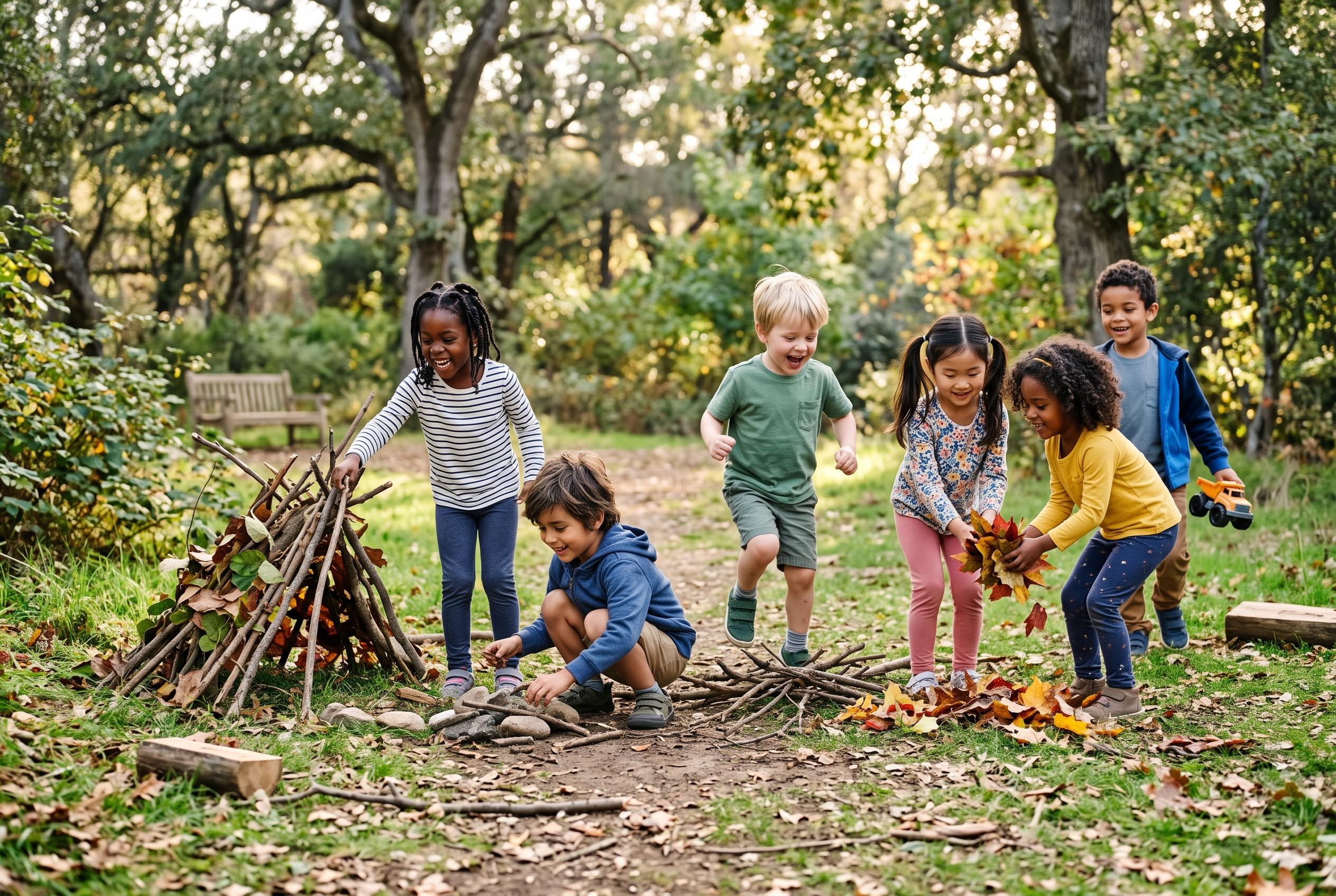

Paediatricians and developmental researchers warn that academic pressure and organised activities are squeezing out the unstructured play that helps children build creativity, resilience and social skills.
Children are born wanting to play. The impulse is so strong that it often survives even when adults try to channel every spare minute into lessons, homework or organised activities. That simple fact sits at the centre of a broader argument now gaining traction among paediatricians, educators and developmental researchers: play is not a decorative extra, but a core part of how children grow.
The essay by Elena Bridgers argues that modern schooling and family life can crowd out the kind of unstructured, social play children need most. She draws on her own experience of school, her observations of her young children and years of research into childhood in hunter-gatherer societies to make the case that many children today are short of outdoor, collaborative play. Her concern is not that formal learning has no place. It is that early academic pressure, homework and a heavy schedule of structured activities may be eroding the time children once had to invent games, negotiate rules and test themselves with peers.
That concern is consistent with guidance from the American Academy of Pediatrics, which has described play as central to healthy brain development, creativity and emotional growth. The academy says unstructured play helps children practise sharing, negotiation, conflict resolution and self-advocacy, while also building confidence and resilience. HealthyChildren.org, the academy’s public information site, has also noted that play supports planning, self-regulation and social bonds, and can help children cope with stress.
Research summaries available through Lumen Learning and peer-reviewed literature point in the same direction. Play is typically self-chosen and self-directed, with the focus on the activity itself rather than an external goal. Developmental studies distinguish between different forms of play, from functional play to symbolic and constructive play, each of which supports different stages of growth. Other research has linked play with creative problem-solving and adaptive functioning, reinforcing the idea that play is not the opposite of learning, but one of its most effective forms.
Bridgers frames that argument in evolutionary terms. She says human children, like the young of other large-brained mammals, are driven to play because it prepares them for uncertainty. Scientific American has similarly argued that play works as a training ground for the unexpected, helping children become more flexible and inventive when situations do not go as planned. That flexibility matters in a fast-changing world, where rote memorisation and early specialisation may offer less protection than curiosity, creativity and the ability to keep learning.
The practical implication, the essay suggests, is not to make play into another performance metric for anxious parents. It is to recognise that play is valuable precisely because children enjoy it and seek it out on their own. In Bridgers’ telling, children are not asking for less serious preparation for life; they are asking for the right kind of preparation, one that leaves room for exploration, social negotiation and the freedom to try things, fail and try again.
Disclaimer: This content is for informational purposes only and is not intended to be a substitute for professional medical judgment, advice, diagnosis, or treatment.



