

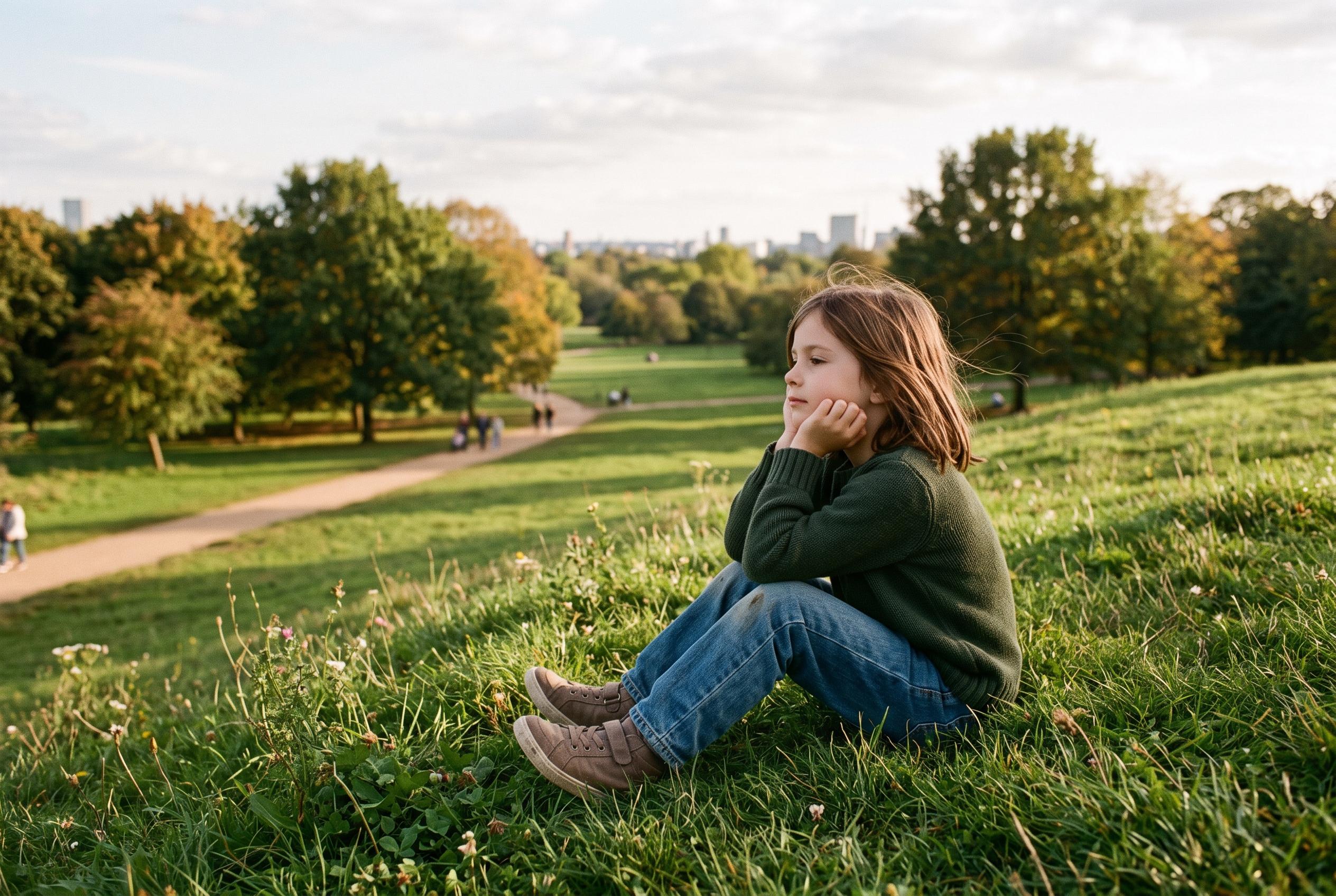

Time without lessons, clubs or adult direction can help children build resilience, creativity and confidence , and learn to trust their own curiosity.
In many homes, the hardest part of a child’s day is not school or sport, but the empty stretch of time in between. A child who has moved from one organised commitment to the next can find an ordinary afternoon at home oddly unsettling, even disappointing. Yet child development experts increasingly point to the value of that unclaimed time. The American Psychological Association says unstructured play helps children build resilience, creativity and social skills, while also giving them room to manage stress and grow in confidence.
That idea sits comfortably with Montessori thinking, which places a premium on child-led activity rather than adult-managed busyness. The point is not to remove structure altogether, but to make sure children are not surrounded by a timetable so full that they never have to decide what comes next. When a child has space to drift, tinker, watch, imagine or simply be still, development often continues in ways that are difficult to measure in the moment.
What can look like idleness from the outside is often the beginning of concentration. Scientific American has reported research suggesting that unstructured play is critical to the growth of social skills, coping strategies and problem-solving ability. The article also notes a broader decline in free play over time, a shift that has prompted concern among child development specialists. Children who are constantly steered by adults may have fewer chances to practise making choices, working through frustration or inventing their own games.
The Children’s Foundation makes a similar case, saying free play supports concentration, social competence and emotional regulation. It is in the loose, self-directed moments that children often learn how to negotiate with others, adapt when plans fall apart and recover from minor setbacks. Open-ended play also gives them a setting in which mistakes are low stakes, which can be especially important for younger children still learning how to manage feelings and relationships.
Play does not need to be elaborate to be useful. The London Children’s Museum describes unstructured play as child-led, open-ended and not directed by adults, whether that means building, pretending, exploring outdoors or making something from whatever happens to be at hand. The Toy Association likewise says spontaneous play helps children test boundaries, develop resilience and absorb life skills through activities they choose for themselves. In other words, a cardboard box, a patch of grass or a pile of blocks can sometimes offer more developmental value than a carefully arranged outing.
This is one reason overscheduling can backfire. Lessons, matches, clubs and other organised activities can be enriching, but when every hour is planned, children can lose practice in self-direction. They may begin to rely on adults to define the day, and become uneasy when no one is providing the next instruction. A balanced routine leaves room for both guided experiences and time that belongs entirely to the child.
Parents, too, may need to rethink the idea that every free moment must be filled. Children are observant; if adults treat constant motion as normal, children may absorb the same expectation. By contrast, a slower family rhythm can create space for reading, drawing, cooking, walking or simply talking without pressure. Those unhurried stretches may not look impressive on a calendar, but they can be the moments in which children process experience, discover interests and learn to trust their own curiosity.
For families wondering whether a child has too much on, the most useful questions are often the simplest: Is there time to play freely? Is there room for ordinary family life? Does the child seem tired, irritable or anxious about keeping up? And is there any part of the week when nobody is telling them what to do next? The answer may point less to the number of activities than to whether a child still has breathing room. In a busy world, that freedom may be one of the most valuable things adults can offer.
Disclaimer: This content is for informational purposes only and is not intended to be a substitute for professional medical judgment, advice, diagnosis, or treatment.



