

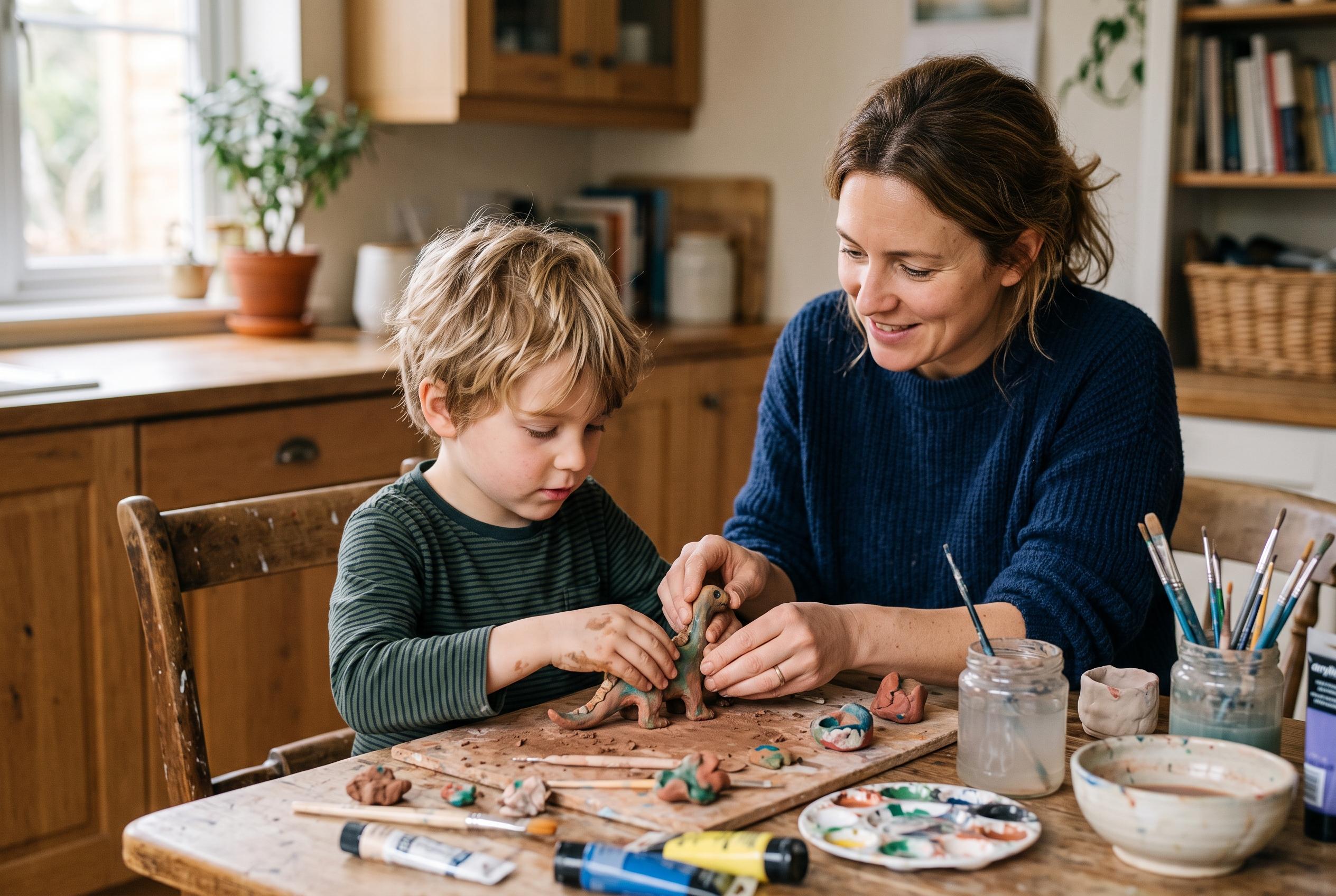

Educators and therapists say clay, painting, cooking and other practical activities can strengthen children’s motor skills, concentration and emotional resilience in an increasingly digital childhood.
In an era when many children spend far more time on screens than with scissors, clay or paint, educators and therapists are warning that something essential can be lost. At Maria Arte & Ofício in Belo Horizonte, occupational therapist Ana Guimarães says hands-on activities help children build identity, confidence and emotional resilience at a stage when the brain is still developing rapidly. That view is echoed by child development specialists cited by Child Mind Institute and other organisations, which say arts and crafts support cognitive, emotional and social growth while strengthening fine motor skills and imagination.
The school, founded 37 years ago by Maria do Carmo Guimarães Pereira and Ana Guimarães, was created to offer arts education linked to broader child development. Its classes are designed not simply to teach technique, but to connect creative work with behaviour, motor coordination, emotions and thinking. Guimarães argues that manual work helps children answer a fundamental question: who they are. In her view, making something by hand allows them to recognise feelings, understand frustration and build a sense of competence that does not depend on outside approval.
That argument fits with a wider body of thinking about creative play. Guidance from Sarah Olbrook Child Care, Child Mind Institute and other child-focused groups points to similar benefits: arts and crafts can encourage problem-solving, patience and the ability to follow instructions, while giving children a way to express themselves when words are not enough. The Esplanade in Singapore has made a comparable case, saying creative workshops nurture confidence and empathy, while other parenting resources note that making things by hand can help children process emotions and develop the habit of seeing a project through.
At Maria Arte & Ofício, those ideas are put into practice through clay, watercolour and even cooking. Two pupils, Valentina Guerra, 10, and Clarice Joviano, 9, say the kitchen sessions are among their favourites. One has become attached to a small pizza recipe she can repeat at home. The other recalls a coloured gelatin exercise that became, in her telling, a lesson about inclusion and difference. Their comments suggest that the classes are doing more than entertaining them: they are helping to build concentration, memory and a sense of pride in finishing something themselves.
Cláudia Felga, who founded Escola da Vila and the adjacent Ateliê da Vila, says she opened her spaces to give children access to materials beyond crayons and felt-tip pens. Cloth, clay and watercolour, she says, offer different textures and sensations that matter in early development. She also believes many children are growing up with too little contact with varied surfaces and natural materials, which may help explain why some become unusually sensitive to touch, grass or sand. Her view is consistent with broader child development guidance, which says creative work can engage several senses at once and help children better understand the physical world.
Felga also sees handcrafts as a kind of investigation. When a child tries to shape a figure in clay or sew a button on to fabric, she says, they must think through balance, structure and sequence. That process can be frustrating, but she believes that is part of the value. In her experience, many children today want results quickly and give up too soon, while manual work teaches them that effort comes before mastery. She adds that children often value what they have made more deeply than what they have bought.
The pressure of screens, meanwhile, is hard to ignore. Felga says children who arrive after time in front of television or other devices tend to be noticeably more restless than those who come straight into the studio. Her observation reflects a broader concern among teachers and therapists that constant digital stimulation can make it harder for children to settle, focus and persist. By contrast, physical play with hands and body movements, she says, supports attention and awareness in ways that may carry into later life, from school to safety in traffic.
That is part of why the work matters so much to parents such as Juliana Anjos, whose daughter Lis, 9, has been taking ceramics classes for a little more than two months. Anjos says she has seen her child’s fine motor coordination improve, along with her ability to stay absorbed in one task for longer periods. Lis, for her part, says she enjoys shaping clay on the wheel and is learning to manage the small details that make a piece work. For the adults involved, the lesson is clear: in a world increasingly shaped by screens, making things by hand still has a place in raising children who are confident, capable and curious.
Disclaimer: This content is for informational purposes only and is not intended to be a substitute for professional medical judgment, advice, diagnosis, or treatment.



