

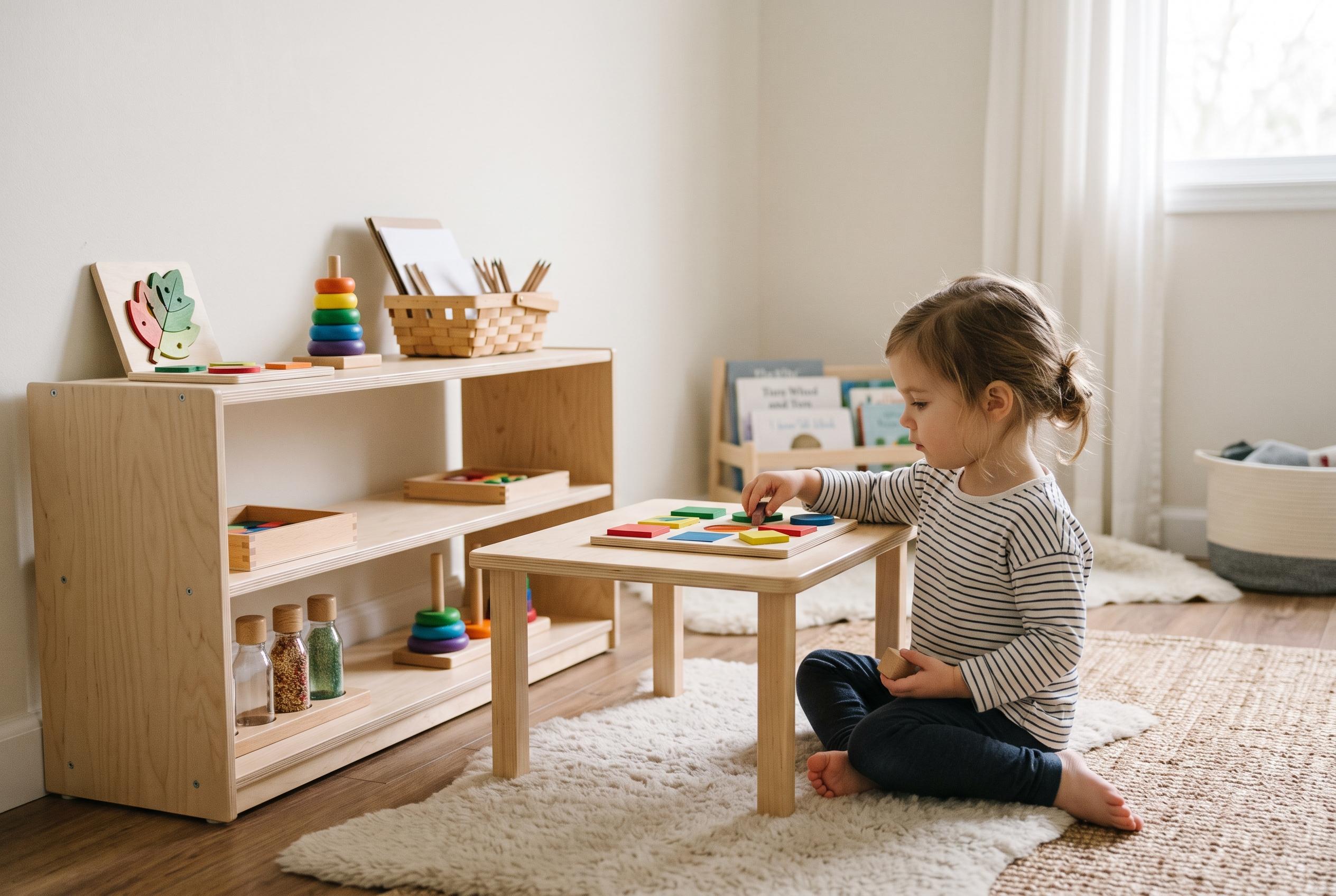

A calm, uncluttered space with a few purposeful activities can help children build concentration, persistence and independence at home.
A child does not need constant entertainment to stay engaged. According to Montessori guidance, a few well-chosen materials, placed within easy reach and matched to a child’s abilities, can be enough to hold attention and encourage real independence. That principle underpins a simple approach parents can use at home: offer fewer but better-prepared activities, allow time for repetition, and create a calm space where children can work without being interrupted.
For toddlers, the most effective activities are usually the simplest. Large objects to transfer, nesting cups, stacking rings, sturdy puzzles, board books and small cleaning tasks can all be deeply satisfying because they give young children a clear purpose and plenty of repetition. Montessori parent resources also point to practical tasks such as wiping a table, watering a plant, carrying napkins or helping with laundry, which bring children into family life in a way that feels real rather than staged. Safety matters, of course, so anything involving water, food or small parts needs close supervision.
As children move into the three-to-four age range, they often want activities with a beginning, middle and end. Washing fruit, arranging flowers, polishing wood, matching socks, folding napkins, drawing, painting and simple lacing or sewing cards all fit that pattern. Montessori-oriented parents and educators also stress the value of tray-based work, because a tray makes the activity visible and complete: the child can carry it, use it and return it independently. At the same time, open-ended play remains important, with blocks, figures, fabric scraps and animals often doing more to spark imagination than flashy toys that do the work for the child.
By the time many children are five or six, they are ready for projects that take longer and ask for more planning. That can mean following a simple picture recipe, building a bridge or city, making a puppet theatre, creating handmade cards or caring for a small indoor garden. Children at this stage may also gravitate towards numbers, maps, writing or collections, so it helps to notice what already holds their interest and then make that interest easier to pursue. A child who loves drawing may need a better sketchbook and coloured pencils; a child who likes building may benefit from more substantial construction materials.
One of the most practical ways to support all of this is a small, orderly shelf. Montessori-inspired shelving guides recommend a low, open unit with only a handful of complete activities displayed at once, each in its own tray, basket or container. The aim is not abundance but clarity. When materials are missing pieces, or when toys are piled into an overfull box, children have a harder time choosing and returning them. Several Montessori playroom guides also suggest dividing the space into distinct zones, such as an activity shelf, a practical life area, a reading nook and a creative corner, so that each kind of work has a home of its own.
Rotating materials can keep that environment fresh without turning it into a constant shopping exercise. Rather than adding more, parents can store some items and bring them back later, watching which activities their child actually uses. That makes it easier to avoid clutter and to match the environment to a child’s changing interests. It also helps parents resist the instinct to step in too quickly when a child is struggling. Sometimes the most useful response is a pause, because the effort itself is where concentration and persistence grow.
The broader lesson is that independence does not appear by accident. It comes from preparation, access and practice, along with enough time for children to become absorbed in what they are doing. That does not replace closeness or attention from adults; it sits alongside them. Children still need conversation, affection and shared family life. But they also need the chance to say, with genuine satisfaction, that they managed it themselves.
Disclaimer: This content is for informational purposes only and is not intended to be a substitute for professional medical judgment, advice, diagnosis, or treatment.



