

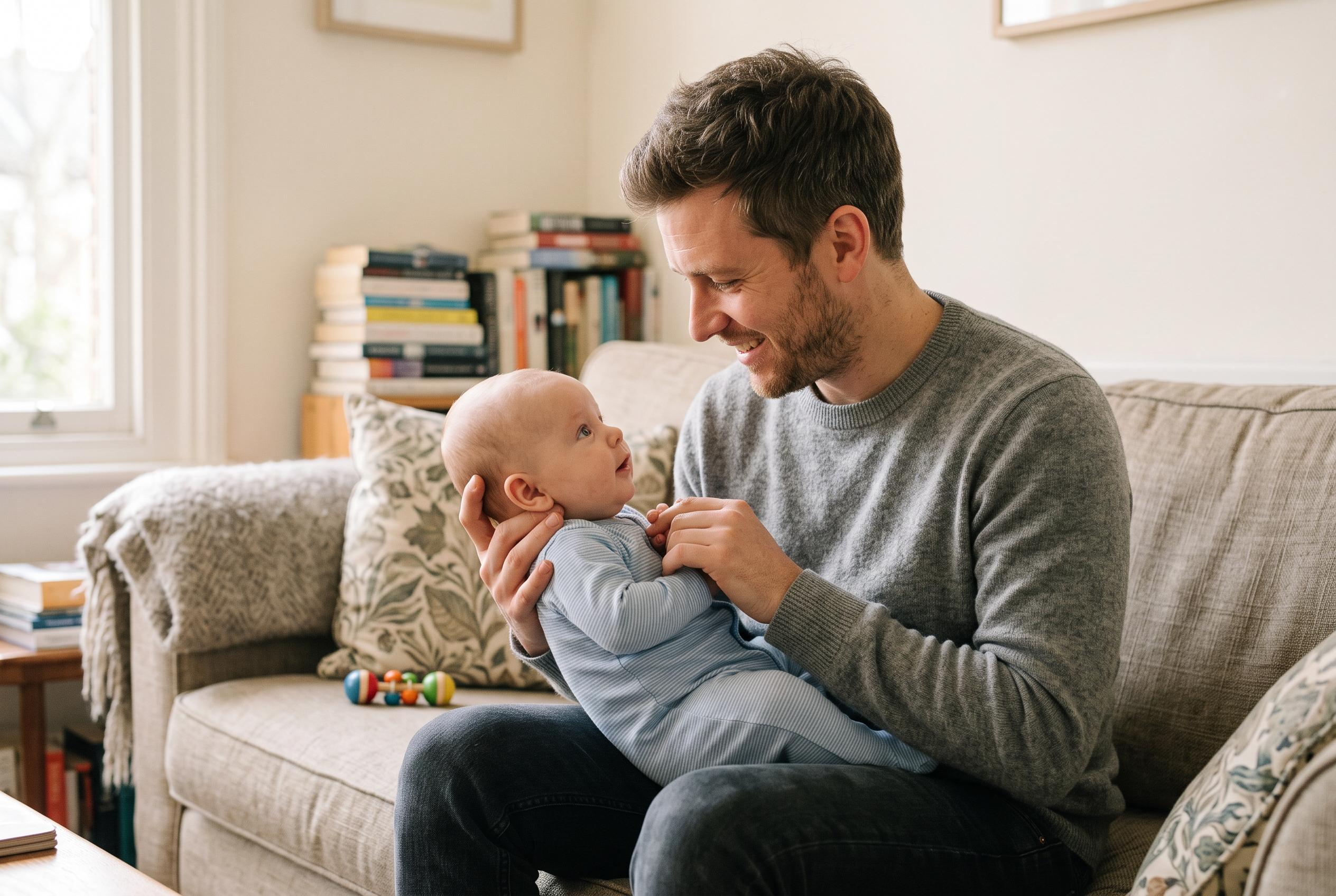

Research suggests that fathers’ everyday involvement from a child’s earliest months can support cognitive, language and social-emotional development while making caregiving a shared responsibility.
Paternal leave should be seen not as a perk for fathers, but as an early investment in a child’s development, according to an article in TIME by Alvin Thomas. The argument challenges a still-common idea in many households: that a mother’s presence is essential from the start, while a father can wait on the sidelines until the child is older. Research summaries from Nature, PubMed and a recent meta-analysis in ScienceDirect all point in the same direction, linking involved fathering with stronger cognitive, language and social-emotional outcomes in early childhood.
That involvement begins in ordinary moments, not in grand gestures. A father who holds a baby, responds to a cry, or repeats a sound back to an infant is helping build the back-and-forth exchanges that support early learning. Harvard’s Centre on the Developing Child has long argued that these interactions help strengthen the neural connections that underpin later development, and the research reviewed by Thomas echoes that point: when children are spoken to, soothed and watched closely by a responsive adult, they gain more than comfort. They begin to learn how relationships work.
The evidence is suggestive rather than absolute, but it is consistent. A systematic review indexed in PubMed found that greater father involvement is associated with better cognitive outcomes in early and middle childhood. Nature’s review of the field adds that paternal engagement can support language acquisition, self-regulation and motor skills, while also easing pressure on mothers and enriching the home environment. A separate review in the Journal of Family Theory & Review argues that fatherhood research is increasingly pointing towards more inclusive and culturally aware approaches, rather than a one-size-fits-all model.
In practical terms, caring for a baby is not a matter of special equipment or carefully staged activities. It can happen while changing a nappy, during bath time, or while soothing a child to sleep. What matters is sensitivity: noticing when the baby looks away, when stimulation has become too much, or when a pause is needed. That attention is part of care too, and it helps fathers learn their child’s cues as the relationship develops day by day.
The article also takes aim at the familiar phrase, “I help with the baby”. That language, it suggests, can quietly turn parenting into a favour rather than a duty. Researchers have repeatedly found that when fathers share daily care consistently, children benefit and mothers are less likely to carry the entire burden alone. The New York State Department of Labor says paid paternity leave is more than time away from work; it can support family stability, deepen father-child bonding and reinforce shared responsibility.
Still, learning to care for a newborn can be unsettling, especially when a baby continues to cry and a parent cannot immediately calm them. Rather than reading that as failure, the more useful view is that parenting is learned through repetition, patience and guidance. Thomas’s argument is that paternity leave creates the space for that learning to happen early, while habits are forming and before caregiving hardens into a routine that leaves fathers on the edge of family life instead of at its centre.
Disclaimer: This content is for informational purposes only and is not intended to be a substitute for professional medical judgment, advice, diagnosis, or treatment.



