

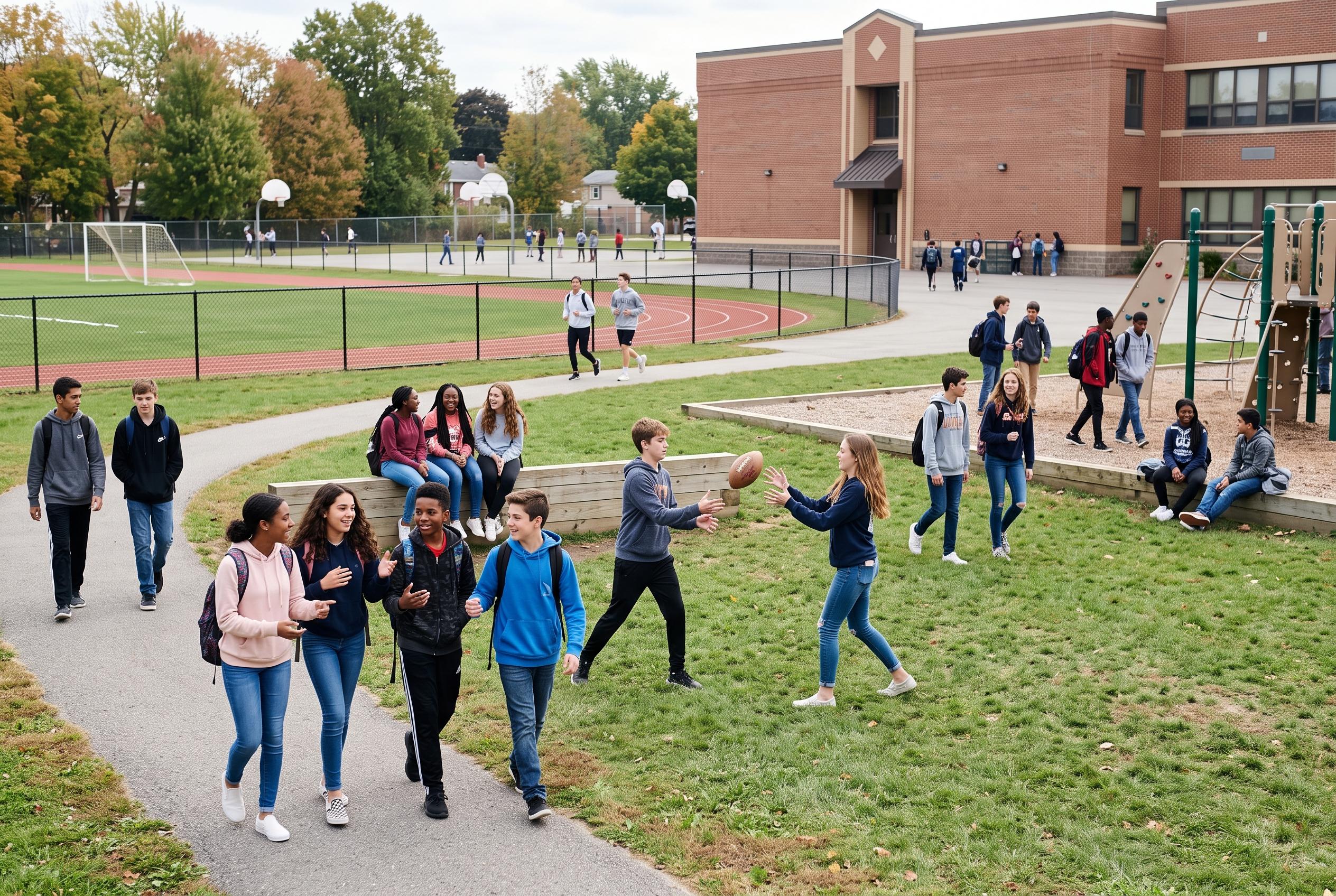

Johns Hopkins researchers are calling for a statewide requirement for at least 20 minutes of daily recess, including for middle and high school pupils.
Recess should be treated as a basic part of the school day, not an optional extra, according to two Johns Hopkins public health researchers who argue that Maryland is overdue for a clear statewide guarantee. Rachel Deitch and Erin Hager write that as students across the state settle into the new school year, many are still moving from lesson to lesson without a protected break for unstructured play, conversation or simple downtime.
Their case is supported by guidance from the Centres for Disease Control and Prevention, which says recess helps children build physical activity into the day while also improving attention, memory and classroom behaviour. The CDC defines recess as a regularly scheduled period for play and movement, ideally supervised by trained adults, and says it can help students reach the recommended 60 minutes of moderate-to-vigorous activity each day. Research summaries cited by the authors also point to social and emotional gains, including better peer interaction, conflict resolution and the chance for children to practise sharing, negotiating and self-regulation.
The broader evidence base is substantial. The American Academy of Pediatrics has recently reaffirmed recess as important for students from kindergarten through Year 12, and a systematic review in the Journal of School Health found that regular recess supports physical health, cognitive function and social development while also improving attention and classroom conduct. American University’s School of Education has likewise noted that unstructured play can support creativity and problem-solving, while the National Center for Biotechnology Information has linked recess, particularly when it comes before lunch, with better readiness to learn and less cafeteria disruption.
Despite that research, Maryland has no state law requiring schools to provide recess. Deitch and Hager note that only 13 states require elementary schools to offer it, and that no state mandates recess in middle or secondary school. In Maryland, they write, only Baltimore City and Howard County require recess for middle school students, leaving many older children without a guaranteed break even as academic pressures increase.
The authors outline four elements they believe should shape any future law: at least 20 minutes of daily recess for all students, a ban on using recess as punishment, a clear separation between recess, physical education and lunch, and practical rules for putting the policy into effect. They also warn that legislation alone will not be enough unless teachers and school leaders are involved in planning and given realistic support. With Maryland’s legislative session due to begin in January, they argue that now is the time to prepare for a policy that could make the state the 14th to require recess , and, potentially, the first to extend that guarantee to middle and high school pupils as well.
Disclaimer: This content is for informational purposes only and is not intended to be a substitute for professional medical judgment, advice, diagnosis, or treatment.



