

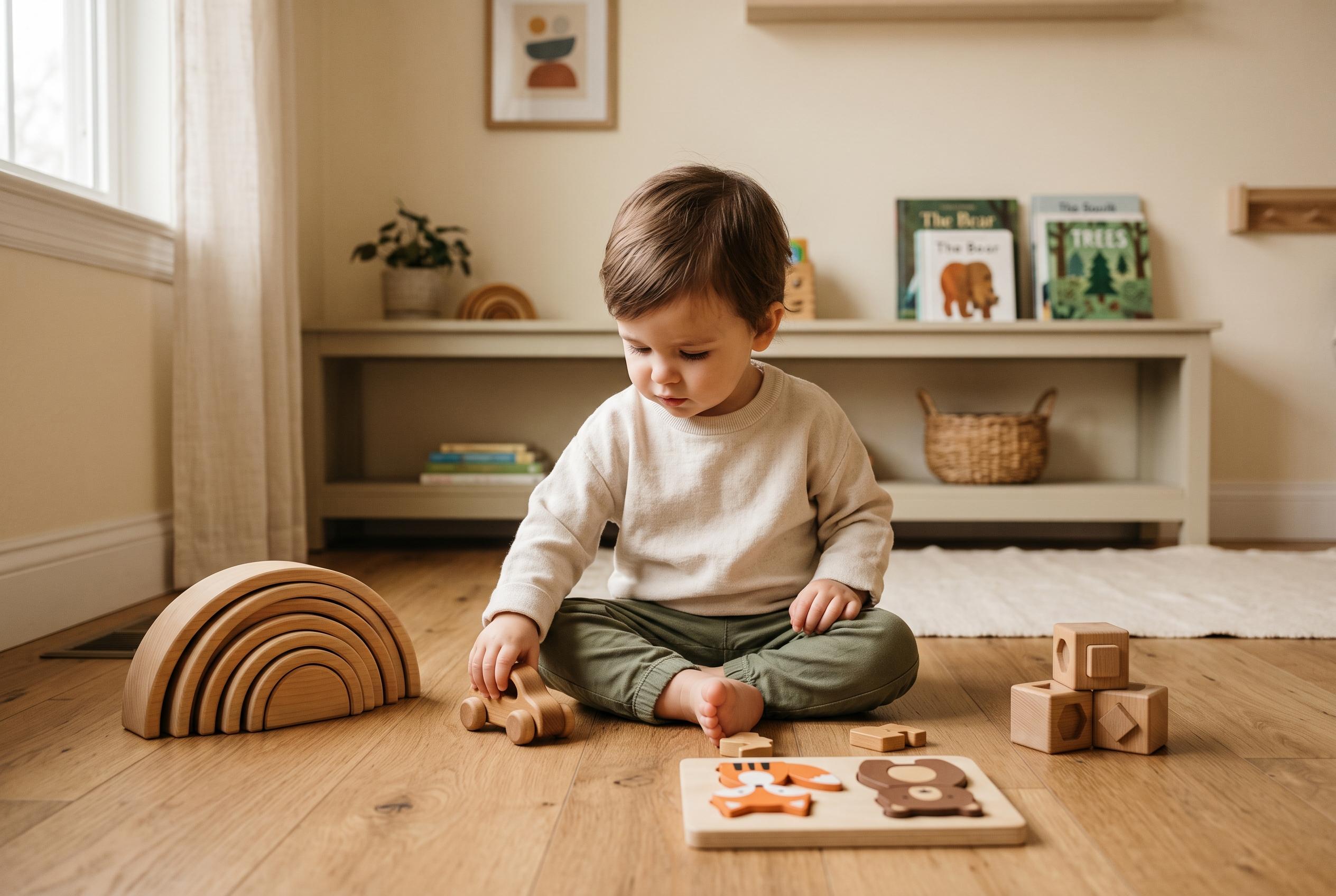

A small University of Toledo study found that toddlers played for longer and explored more creatively when offered four toys instead of 16, suggesting that a less crowded play space may support deeper attention.
Parents who feel overwhelmed by an overflowing toy box may be comforted by a small but intriguing study suggesting that less can be more when it comes to play. In research published in 2018 in Infant Behavior and Development, investigators at the University of Toledo found that toddlers played for longer periods and in more varied ways when they were offered four toys rather than 16. The findings do not mean children need fewer toys in every setting, but they do suggest that a crowded play space may make it harder for very young children to settle into deeper, more imaginative play.
The study followed 36 healthy toddlers aged 18 to 30 months, each of whom visited a plain room twice within a two-week period. In one session, the room contained four toys; in the other, it contained 16. The researchers filmed the children and later analysed the first 15 minutes of play. According to the study, toddlers in the four-toy setting spent more than twice as long on each play bout as those in the 16-toy setting, and they used each toy in more varied ways. Rather than darting from object to object, they were more likely to stay with one item and explore it more fully.
The design gives the findings extra weight because each child served as their own comparison. That makes it less likely that the results were simply due to one group of naturally calmer toddlers. The researchers also reported no meaningful effect from whether the child saw the sparse or crowded room first. Still, the study has clear limits. The toys were new to the children, the setting was highly controlled and the sample was small and relatively homogenous, so the results should be read as a strong hint rather than a universal rule.
Even so, the study fits with broader work on toy quality. Jeffrey Trawick-Smith, professor emeritus at Eastern Connecticut State University’s Center for Early Childhood Education and a leading researcher on children’s play, has spent years studying which toys most consistently draw children into rich, sustained activity. His TIMPANI Toy Study, which examined preschool children in natural classroom settings, found that some simple materials held children’s interest over time and encouraged higher-quality play. In his view, blocks and other open-ended toys tend to have particular staying power because they can be used in many different ways.
Trawick-Smith also argued that toy quantity may matter, even though his own work did not measure it directly. He suggested that very young children, whose working memory is still developing, may be vulnerable to cognitive overload when too many toys are visible at once. He also noted that toys children have not seen for a while can feel new again when they are brought back out, which supports the common parenting strategy of rotating toys instead of leaving everything accessible all the time.
For families wondering how to try this at home, the research points to a simple experiment: put away most of the toys, leave out a small selection and watch what happens. The goal is not deprivation, but attention. If a child returns again and again to a few favourites, those are likely the toys doing the most developmental work. And if an old toy suddenly captures interest after a break, that may be a sign that novelty matters as much as quantity. The broader lesson from the study is modest but useful: children may not need a larger toy collection so much as a less crowded space in which to think, explore and stay with an idea.
Disclaimer: This content is for informational purposes only and is not intended to be a substitute for professional medical judgment, advice, diagnosis, or treatment.



