

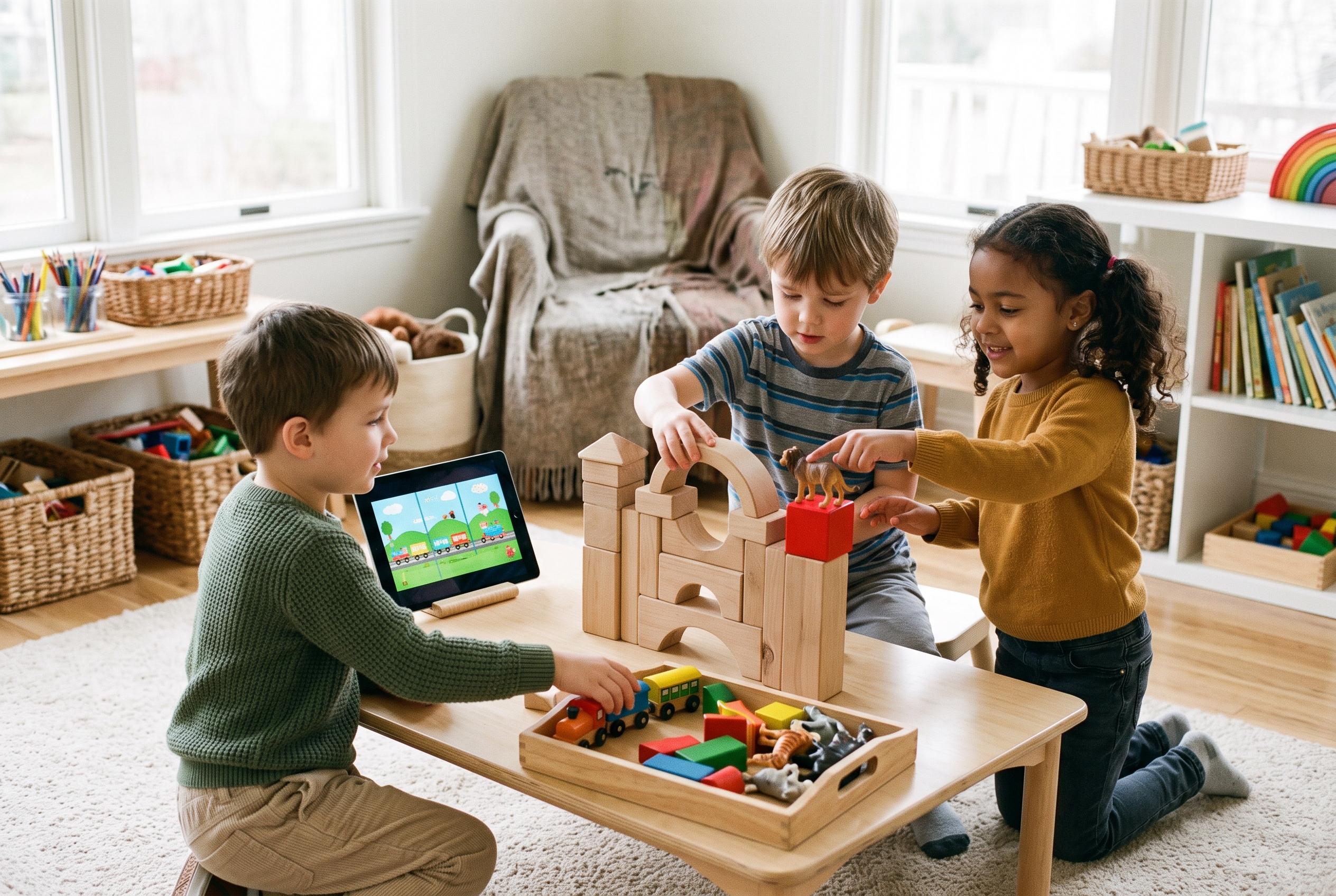

A small study found that peer-directed communication increased when minimally speaking autistic children used video visual scene displays during play, with gains continuing after the intervention ended.
For children who are minimally speaking, the obstacle is often not unwillingness to connect but the lack of a practical way to do it. New research published in the Journal of Autism and Developmental Disorders suggests that a tablet-based communication system built around video visual scene displays, or VSDs, can help autistic children speak to peers more often and keep doing so after the intervention ends. In the study, researchers at Queens College, City University of New York, and Northwestern University found that peer-directed symbolic communication rose sharply when the children used the video-based system during play, offering further evidence that communication tools work best when they are embedded in real social activity rather than taught in isolation.
The approach differs from the grid-style communication boards that are common in augmentative and alternative communication, or AAC. Instead of asking a child to move through abstract symbol categories, VSDs place language inside a familiar scene, such as a shared game or another everyday activity, with tappable hotspots that trigger spoken words or phrases. Earlier studies, including a pilot published in PubMed and a separate preschool trial, had already shown that video VSDs could increase communicative turns between children with autism and their partners. The new study extends that line of work by using dynamic video scenes and a stronger experimental design, which makes the findings more persuasive.
The need for better tools is considerable. Many autistic children remain minimally speaking into their school years, and research in the field has long paid more attention to requests made to adults than to the back-and-forth exchange that happens in peer play. That matters because play with other children is more than a social extra; it helps shape language growth, self-regulation, school readiness and long-term social development. The study therefore focused on whether AAC could support a more natural kind of communication: not a child responding to a prompt, but a child reaching out to another child in the middle of shared play.
To test the idea, the researchers worked with 15 minimally speaking autistic children and 15 age-matched neurotypical peers, arranged into three groups of five dyads. They used a staggered multiple-probe design, a single-case research method that helps show whether changes occur when the intervention begins rather than because of time or practice. Before the video system was introduced, the children used static printed VSDs during baseline sessions. The intervention then replaced those paper supports with a speech-generating tablet app built around dynamic video scenes, allowing the children to activate relevant messages while playing with peers.
The results were encouraging. Across all three cohorts, peer-directed symbolic communication rose as soon as the video VSD intervention started, with little overlap between baseline and intervention performance. The researchers also used Tau-U, a statistical measure designed for single-case studies, and reported large effects. Perhaps more importantly for families and clinicians, the gains held during maintenance checks after the formal intervention ended. That suggests the children were not just performing with support present; they were beginning to use the system as part of their own communication routine.
The findings fit with a broader body of work led by AAC researchers, including efforts at the Rehabilitation Engineering Research Centre on AAC and educational resources from Penn State’s AAC Learning Centre, which have shown that video-based scene displays can support participation and learning for people with complex communication needs. Commercial AAC developers are also beginning to build similar features into dedicated apps. Still, the most important lesson from the new study may be a simple one: the design of the communication system, the context in which it is used and the presence of real peer partners all matter. For children who have too often been left out of classroom and playground conversations, that could make a meaningful difference.
Disclaimer: This content is for informational purposes only and is not intended to be a substitute for professional medical judgment, advice, diagnosis, or treatment.



