

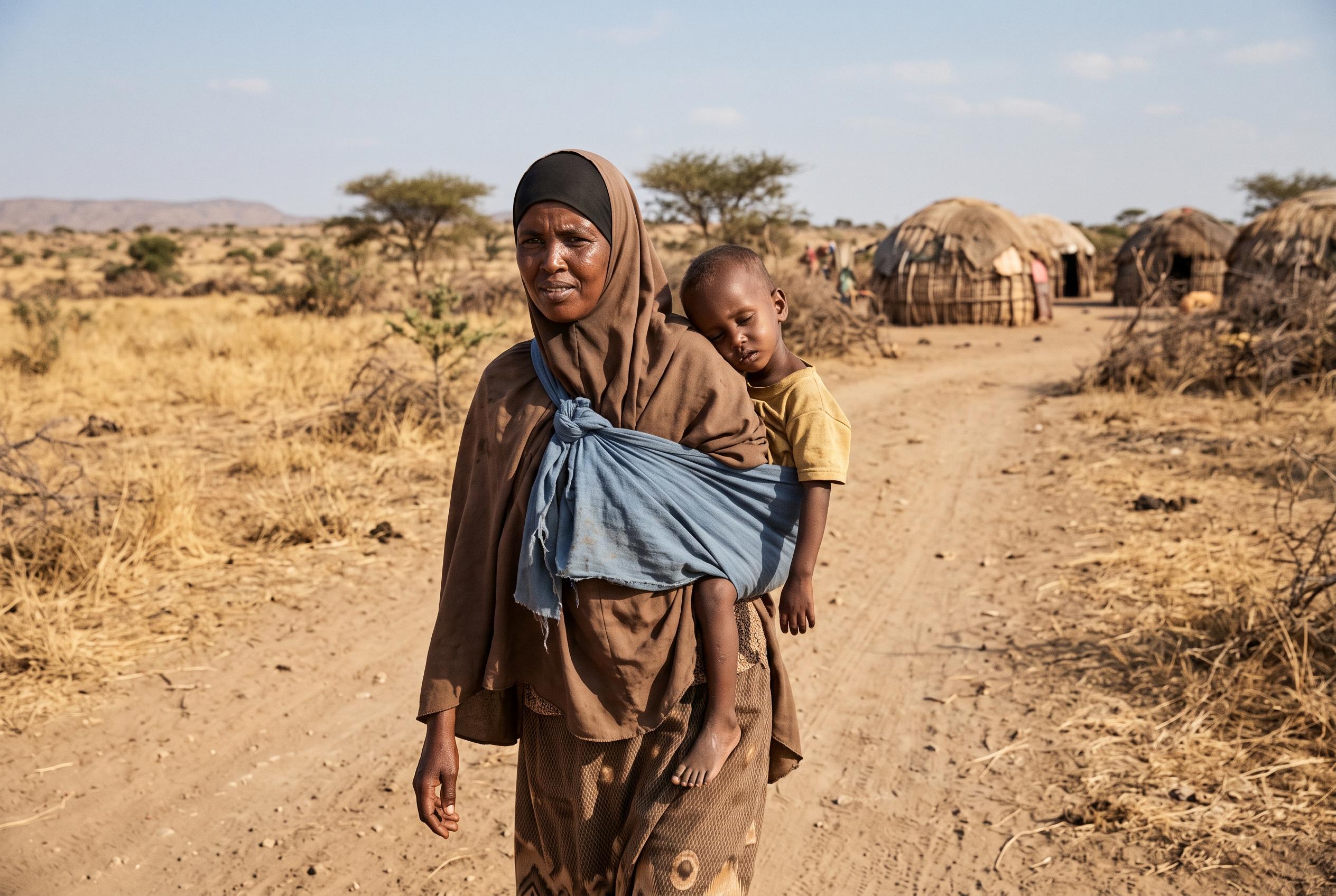

Halima Abdullahi Ibrahim carried her severely malnourished toddler to hospital after a three-day journey, as agencies warn that hunger, disease, displacement and funding cuts are pushing southern Somalia towards catastrophe.
A Somali mother’s three-day trek to reach treatment for her toddler has laid bare the scale of the country’s worsening child malnutrition crisis, with aid agencies warning that hunger, disease and shrinking donor support are colliding in the south.
Halima Abdullahi Ibrahim carried her 3-year-old daughter, Asho Hassan Abdi, for nearly 90 kilometres from their village to Kismayo Referral Hospital after the child’s body began to swell and local medical care was no longer enough. Health workers at the hospital diagnosed Asho with oedema, a dangerous symptom of severe acute malnutrition, according to the account provided by the Associated Press.
That case is far from isolated. An analysis by the Integrated Food Security Phase Classification says 1.92 million Somali children aged between six months and almost five years are suffering from, or are expected to suffer from, acute malnutrition over the year to June 2027. Of those, 433,000 are projected to develop severe acute malnutrition, the most lethal form. In a joint warning, UN agencies and partners said Somalia faces a hunger emergency affecting about 6 million people, with nearly 1.9 million children at risk of severe malnutrition and some districts facing famine if aid does not increase.
The burden is heaviest in the south, where families face disease outbreaks, food shortages and weak access to healthcare, clean water and sanitation. UNICEF’s Somalia representative, Sandra Lattouf, told the Associated Press in Kismayo that children are dying from malnutrition and that illnesses such as measles are making the situation more dangerous. She called for closer coordination between community health workers, local leaders, government authorities and aid groups.
At Kismayo Referral Hospital, the pressure is visible in the wards. Jubbaland Health Minister Ismail Garas said the facility admitted 152 children with severe acute malnutrition in August, and four of them died. That strain is mirrored in the wider humanitarian system, where the World Food Programme says it can no longer reach everyone in need because of funding cuts.
The WFP says nearly one-third of Somalia’s population, or 5.4 million people, are facing acute hunger or worse, and that about 3.5 million people are displaced. The agency has said it needs more funding to sustain life-saving assistance through to March 2027, while warning that current resources allow it to support only a fraction of those who require help. UNICEF has also warned that projected flooding linked to El Niño could push more families from their homes and make food, medicine and clean water even harder to access.
Those risks are already visible in settlements around Kismayo, a port city of more than 250,000 people. In Luglow, on the city’s outskirts, families live in temporary shelters made from branches and plastic sheeting, with stagnant water collecting in the ground between them. At the local nutrition centre, mothers sit with young children as visiting UNICEF staff speak with families about the deterioration in living conditions.
Ali Adan Ali, Jubbaland’s commissioner for refugees and internally displaced people, said many displaced households had received no aid since 2023 because humanitarian organisations lacked money. He warned that flooding along the Juba River could send more people towards Kismayo, increasing pressure on clinics, nutrition centres and already overstretched hospitals.
Sweden’s ambassador to Somalia, Hans Henric Lundquist, who visited the Luglow site with Lattouf, said agencies need to work more closely with communities at a time when funding is tightening worldwide. His message echoed a broader reality in Somalia: families such as Halima’s are being forced to travel long distances for specialist care that should be available far closer to home.
For Asho and many other Somali children, the outcome may depend on whether help arrives in time.
Disclaimer: This content is for informational purposes only and is not intended to be a substitute for professional medical judgment, advice, diagnosis, or treatment.



