

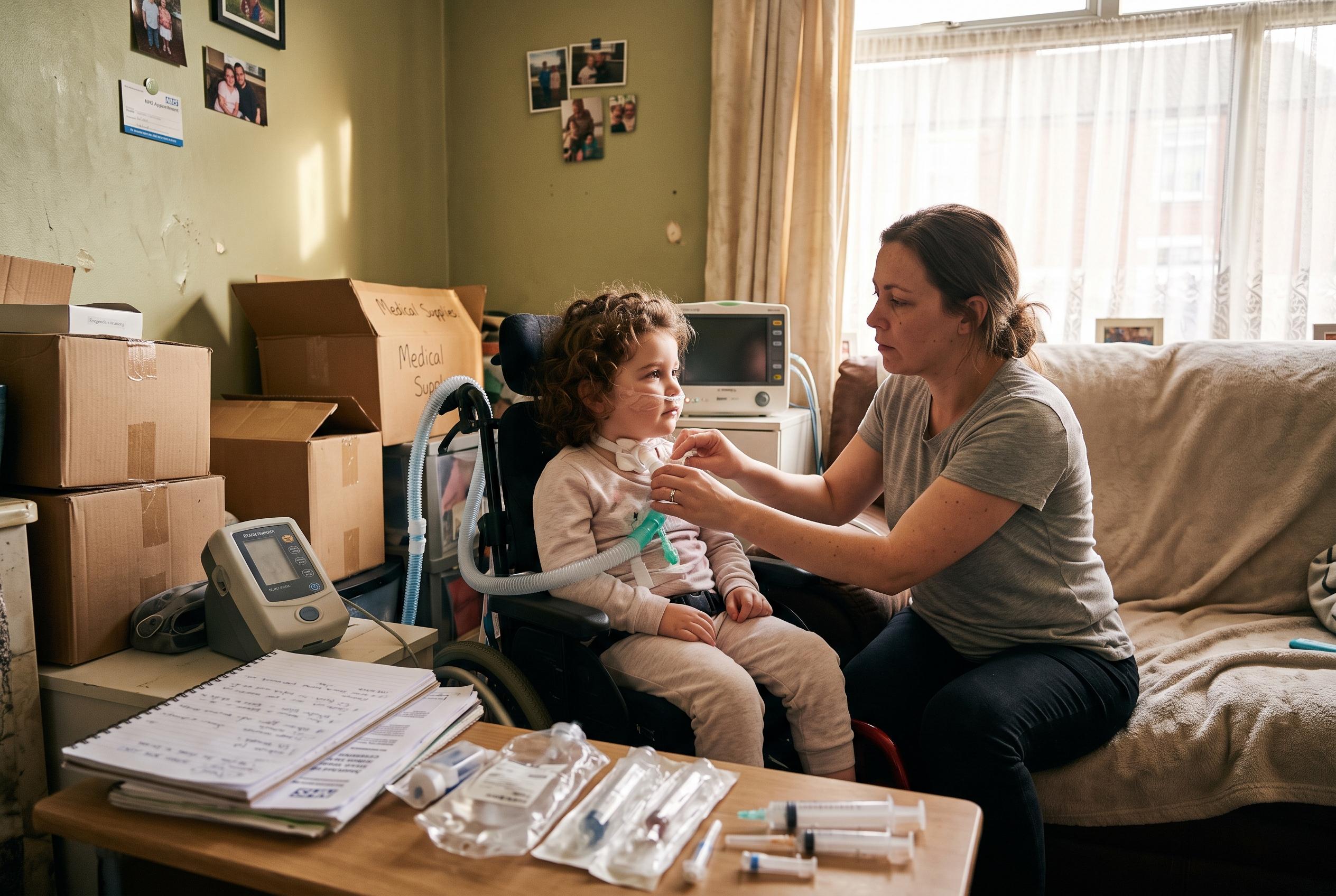

A study of families caring for children with medical complexity finds supply shortages, faulty equipment and normalised hazards are often managed through unofficial workarounds rather than reported to clinicians.
Parents caring for children with medical complexity at home often become de facto clinicians, managing feeding tubes, pumps, syringes, medications and nutrition plans while also trying to keep the household running. A study from Ann & Robert H. Lurie Children’s Hospital of Chicago, published in Pediatrics, suggests that many families are meeting those demands with ingenuity, but also in relative isolation, as they work around supply shortages, malfunctioning equipment and other everyday hazards that can affect safety.
The research focused on a national sample of 21 parents of children with medical complexity who spoke English or Spanish. Over one week, the families took part in twice-daily surveys and were encouraged to send text messages, photos or audio notes about tube-related care. Researchers later interviewed the parents to better understand the situations they described. Their findings point to a pattern familiar to many families: safety problems arise during routine care, but parents often develop practical fixes on their own rather than raising every issue with the care team.
Among the most common difficulties were getting the right supplies, dealing with devices that did not work as intended and managing problems that had simply become part of daily life. The study found that supply issues accounted for 24% of the challenges parents described, while 22% involved devices such as feeding pumps or medication syringes failing unexpectedly. Another 20% involved care problems that families had come to treat as normal, including a child’s feeding tube tangling overnight. Parents also described building their own systems to reduce risk, from workarounds for unreliable equipment to routines designed to prevent adverse events.
Peter Walsh, the study’s lead author and a behavioural research coordinator at Lurie Children’s, said the findings show how resourceful parents can be when safety concerns arise during home care. He also argued that stronger communication between families and clinicians would help surface common problems earlier and allow useful solutions to be shared more widely. Carolyn Foster, the senior author and director of the Health@Home Initiative at the Manne Research Institute, said care plans should be simplified where possible and adapted to each family’s needs, adding that parents should know exactly who to contact when problems come up.
The new study adds to a growing body of evidence that home care for children with medical complexity remains vulnerable to preventable safety failures. Earlier research from Lurie Children’s, including a multi-state study published in JAMA Network Open, found that more than 10% of children with medical complexity experienced safety incidents reported by home care agency staff, with half of those incidents linked to safety concerns and a quarter causing harm. Together, the studies suggest that better training, clearer reporting systems and closer partnership with family caregivers could reduce risks in a setting where most care is delivered outside hospital walls.
Disclaimer: This content is for informational purposes only and is not intended to be a substitute for professional medical judgment, advice, diagnosis, or treatment.



