


A new review says India has made progress on HPV vaccination, screening and domestic vaccine production, but inconsistent follow-up, limited treatment capacity and unequal access threaten its 2030 elimination ambitions.
India has moved closer to a workable plan for eliminating cervical cancer, but the country is still far from turning policy into population-level protection. The disease remains one of the leading causes of cancer death among Indian women, and the World Health Organization says it can be eliminated as a public health problem only if countries reach three goals by 2030: vaccinate 90% of girls by age 15, screen 70% of women with a high-performance test at ages 35 and 45, and treat 90% of women found to have cervical disease. That global benchmark is intended to bring incidence below four cases per 100,000 women.
A recent critical review argues that India now has many of the building blocks needed to make that target realistic. The country has expanded primary care through Ayushman Arogya Mandirs, strengthened its non-communicable disease programme, introduced digital systems for patient tracking, and built a more substantial immunisation platform than it had a decade ago. It has also moved into domestic production of HPV vaccines and molecular tests, while the Union government began nationwide HPV vaccination for 14-year-old girls in February 2026. Even so, the review warns that these gains will matter only if they are matched by reliable delivery, public trust and equitable access.
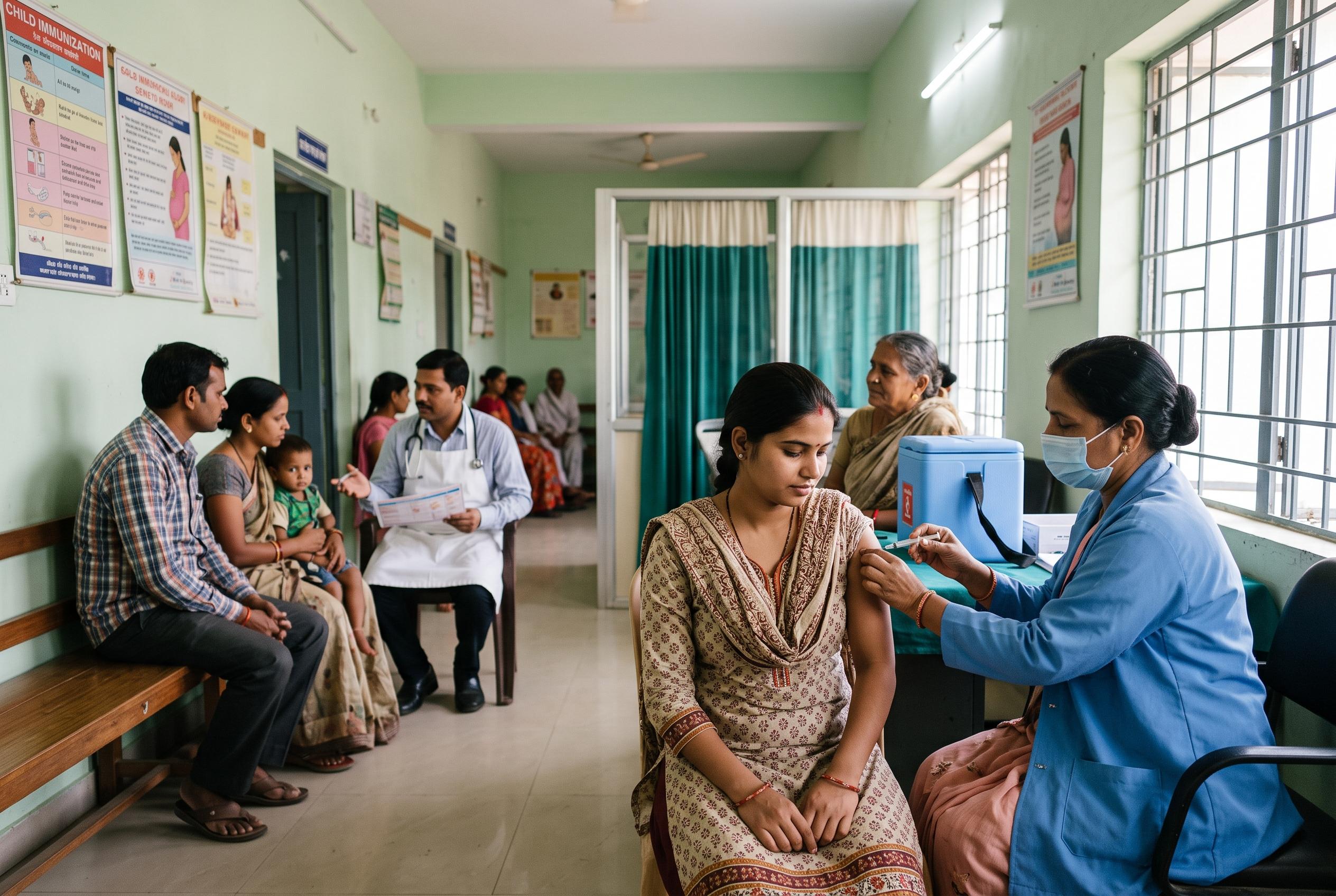
On vaccination, India is beginning from a stronger base than many countries because routine immunisation coverage has improved sharply in recent years, according to government and survey data cited in the review. The new HPV campaign is being run through government facilities with digital registration, stock monitoring and certificate generation, using the U-WIN and eVIN systems. Officials reported that almost 5 million girls had been vaccinated in the first three months, later rising to more than 8 million, although the review notes that these figures come from administrative reporting and should be interpreted cautiously. The authors also point to a key weakness: the campaign currently focuses on one age cohort and depends on parental consent, which may limit uptake unless demand generation is sustained.
The larger gap is screening. India has reported tens of millions of women screened for cervical cancer through its national digital platform, yet the review says that headline totals may conceal weak follow-up, uncertain age targeting and uneven coverage across states. National Family Health Survey data still suggest that self-reported screening remains low overall. The authors argue that visual inspection with acetic acid, the current public-sector workhorse, is too subjective and inconsistent to carry a national elimination strategy on its own. They make the case for a gradual shift to HPV DNA testing, which WHO now prefers because it is more sensitive, more reproducible and better suited to longer screening intervals. They also highlight self-sampling as a practical way to reach women who might otherwise avoid pelvic examination because of embarrassment, stigma or lack of privacy.
Treatment remains the weakest link. Colposcopy, which helps determine whether a woman needs ablation or excision, is still concentrated in a small number of higher-level centres, and the review says referral systems frequently lose women before diagnosis or treatment is completed. For eligible precancerous lesions, the authors favour simpler same-day or screen-and-treat approaches when follow-up is uncertain, backed by Indian trial evidence showing better treatment completion than multi-step pathways. They also argue for greater use of thermal ablation, which is easier to deploy than cryotherapy in many settings and may be more practical for decentralised care. For invasive disease, India still faces a severe shortage of radiotherapy equipment, with the review describing a substantial national deficit and marked regional inequality in survival.
The article’s central message is that India no longer lacks a strategy; it lacks consistent execution at scale. The authors say elimination will depend on sustaining HPV vaccination, moving decisively towards HPV-based screening, expanding treatment capacity beyond a few tertiary centres, and improving national data systems so that screening, referral, diagnosis and treatment can be tracked end to end. WHO and related global agencies have made clear that vaccination alone will not end cervical cancer. India, the review concludes, has the chance to become a major test case for whether a large middle-income country can combine immunisation, organised screening and timely treatment into a functioning elimination programme.
Disclaimer: This content is for informational purposes only and is not intended to be a substitute for professional medical judgment, advice, diagnosis, or treatment.



