

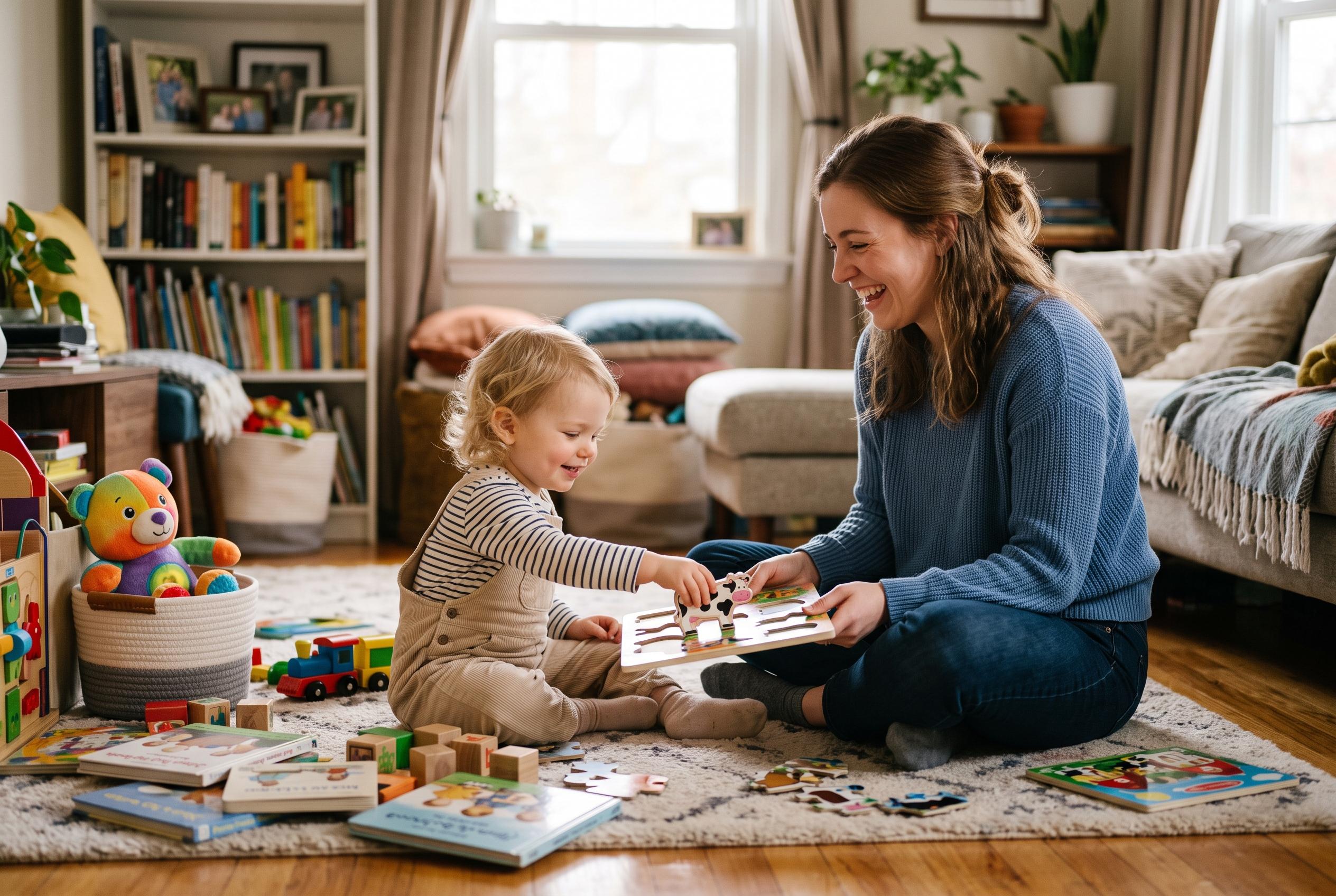

EEG research suggests reading, puzzles and make-believe with caregivers produce brain activity linked to attention, learning and social connection more strongly than passive screen viewing.
Everyday routines like reading a picture book, completing a puzzle or playing make-believe with a toddler may do far more than pass the time. New research from Northwestern University suggests that these shared moments can shift young children’s brains into a state that is more primed for attention, learning and social connection than time spent passively watching a screen.
The study, published in the journal Brain and Language, used a child-friendly form of electroencephalography, or EEG, to observe toddlers during natural parent-child interactions. Researchers fitted 49 children aged between 24 and 44 months with soft EEG caps while they took part in familiar activities with a parent or caregiver, such as reading interactive books and solving puzzles. The team also measured brain activity while the children watched a film alongside an adult, allowing them to compare active engagement with passive viewing.
According to Northwestern, the researchers developed what they call the “Social EEG paradigm” to bring neuroscience out of the laboratory and into everyday family life. Rather than relying on simplified tasks in artificial settings, the method captures how children’s brains respond during the kinds of exchanges that happen at home. The study found that when toddlers were socially engaged with a caregiver, their brains showed lower alpha activity and higher theta activity, patterns associated with alertness, attention and social processing.
Elizabeth Norton, the senior author of the study and an associate professor in the Roxelyn and Richard Pepper Department of Communication Sciences and Disorders, said the findings reinforce the developmental value of direct interaction. Speaking through Northwestern, she said that meaningful play and reading “shifts their brain into a learning mode”. Brittany Manning, a research assistant professor at Feinberg, added that even when a child appears highly absorbed in a movie, the most pronounced engagement showed up during moments of real interaction with an adult.
One notable feature of the study was that the same overall brain patterns appeared in children with a wide range of language abilities, including some diagnosed with autism. Norton said autistic children and those with a language delay displayed many examples of social engagement during the parent-child activities, although such moments were less frequent than among typically developing children. Even so, their brain activity was similarly engaged when those exchanges did occur, suggesting that the neural response to connection may be broadly shared across different developmental profiles.
The research is part of a broader Northwestern project called “When to Worry”, which examines children’s language and mental health development. The team is now analysing EEG recordings from parents as well, with the aim of learning whether parent and child brain activity becomes synchronised during moments of shared attention. If so, that synchrony could help researchers better understand how early relationships support development and may eventually help identify children who could benefit from early intervention.
For parents and caregivers, the message is straightforward: the back-and-forth of ordinary play matters. The study adds to a growing body of evidence that face-to-face interaction is not just emotionally rewarding, but biologically important as well.
Disclaimer: This content is for informational purposes only and is not intended to be a substitute for professional medical judgment, advice, diagnosis, or treatment.



