

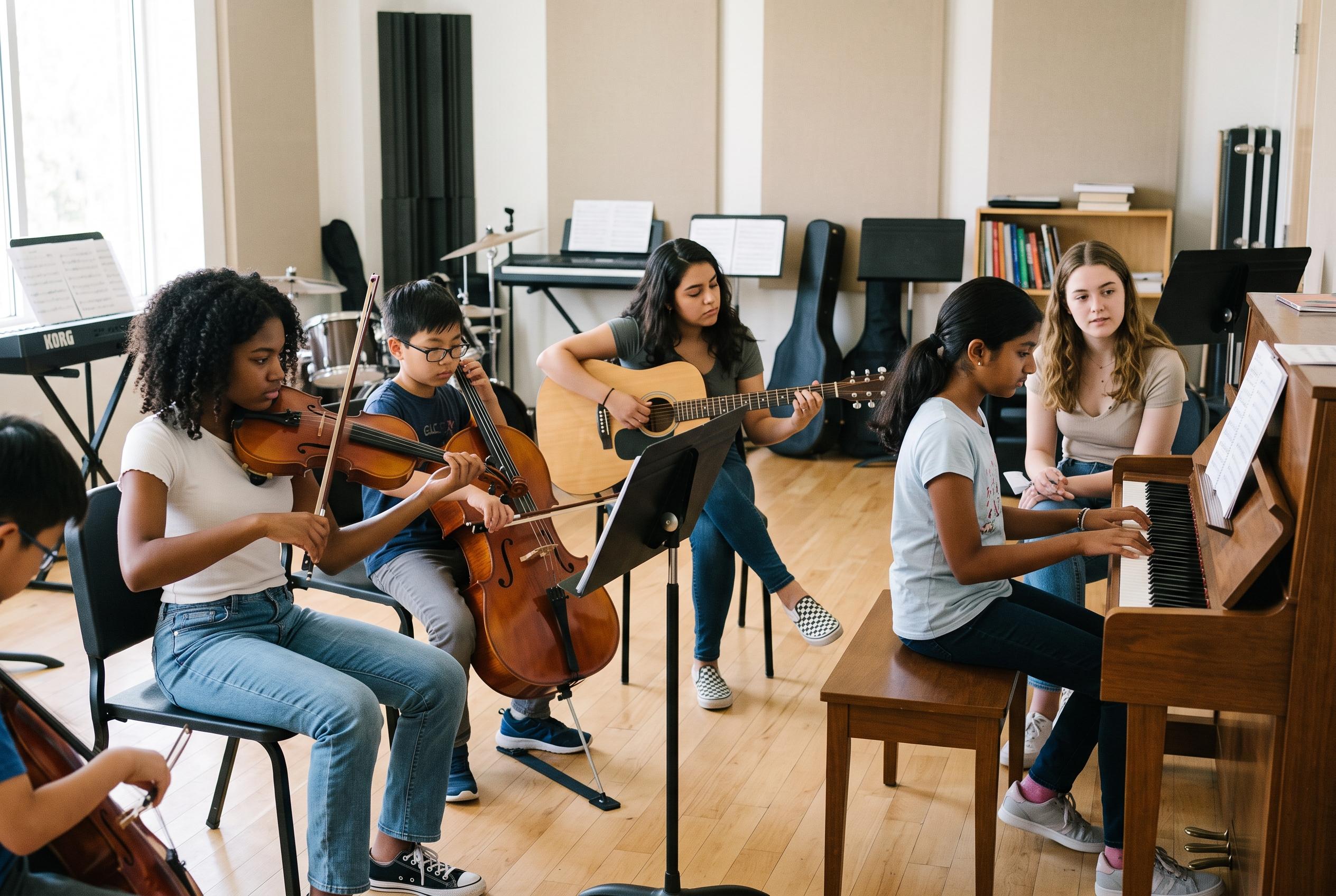

Spanish researchers found that people with long-term musical training responded faster and had fewer lapses in attention, although the cross-sectional study cannot prove that lessons caused the advantage.
Formal musical training is linked to better attention and vigilance from childhood into early adulthood, according to a Spanish study published in the British Journal of Psychology. Researchers compared 268 people aged eight to 34, splitting them between musicians with long-term training and non-musicians, then used propensity-score matching to make the two groups as similar as possible on background factors such as education, physical activity, video gaming, bilingualism, socioeconomic status and personality. The study found that, on a computer-based test designed to measure different forms of attention and vigilance, the musically trained participants were generally quicker, made fewer lapses and showed stronger performance on several measures of sustained focus.
The findings are notable because the researchers did not rely on a simple comparison between self-selected groups. Instead, they matched participants across a broad range of likely confounders and then analysed performance with models designed to capture the uneven way attention develops with age. In that framework, the musicians’ advantage was not uniform across every measure. Some differences were visible at almost every age, while others grew more pronounced over time, suggesting that musical training may be associated with both an early advantage and a later strengthening effect. The authors say this pattern is consistent with the idea that long-term instrument training may support so-called domain-general skills, meaning abilities that help in many settings rather than only in music.
The strongest and most consistent advantages were seen in measures of response speed and vigilance. Musically trained participants were faster overall, showed fewer attentional lapses and performed better on tasks that required quick detection of rare or unexpected events. In one part of the test, the advantage appeared to increase with age, especially for executive control, the ability to manage distracting information. In another, musicians showed lower variability in response times and fewer lapses during vigilance trials. The effects were modest, but the authors argue they remained after extensive statistical control, which makes it less likely that the results were driven only by the background differences between the groups.
At the same time, the study stops short of proving that music lessons cause these benefits. Because it was cross-sectional, it cannot separate the effects of training from pre-existing differences that may have influenced who chose to study music in the first place. The researchers acknowledge that families with higher educational levels, certain personality traits or stronger early cognitive abilities may be more likely to support long-term musical training. They also note that the improvements observed were relatively small, which matters when considering how much practical impact they may have in daily life. Even so, the work adds to a growing body of evidence suggesting that musical practice may be linked to better control of attention, steadier vigilance and improved efficiency on demanding tasks.
Disclaimer: This content is for informational purposes only and is not intended to be a substitute for professional medical judgment, advice, diagnosis, or treatment.



