

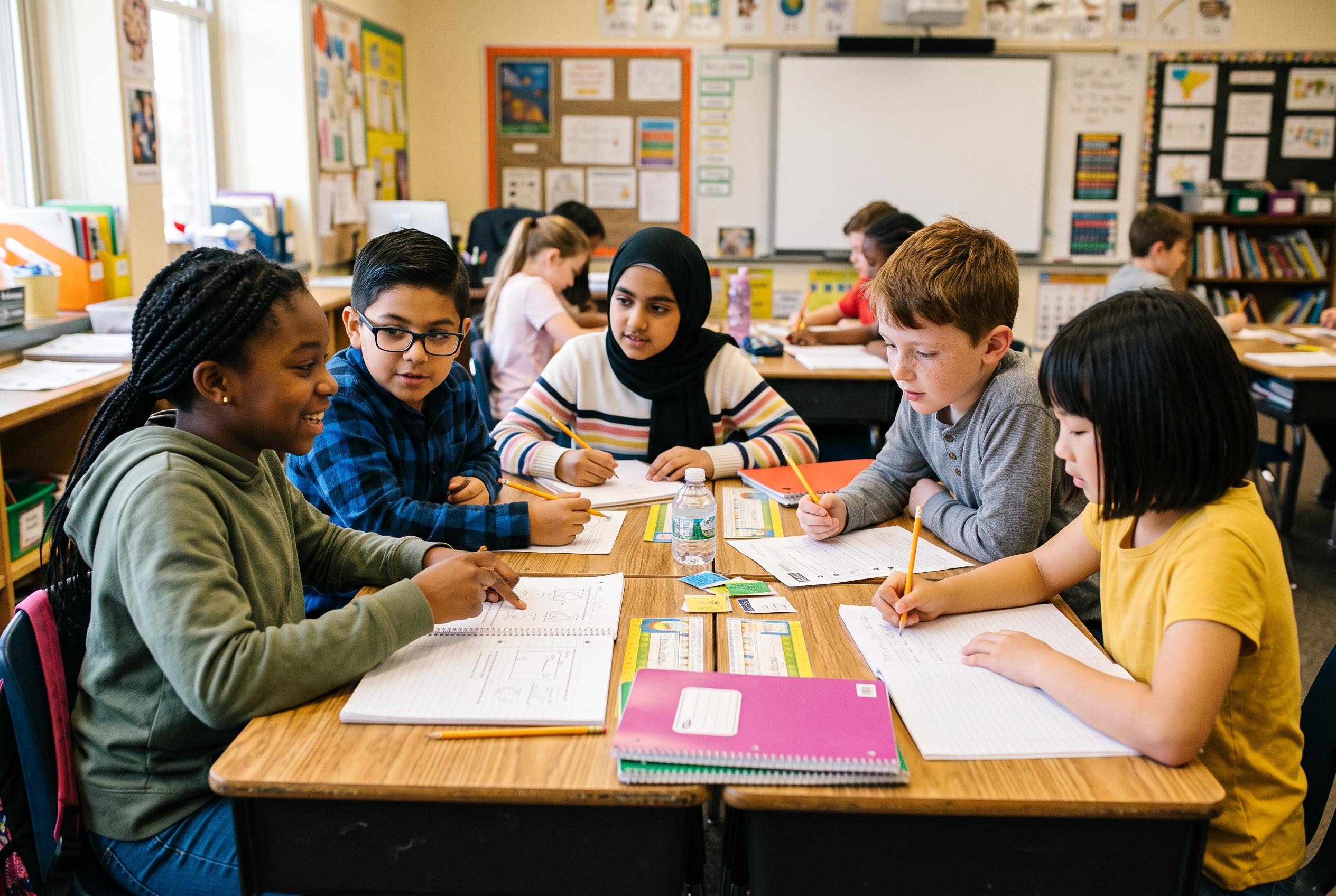

Research suggests pupils can improve achievement, problem-solving and relationships when group work gives every child a meaningful role.
Children often learn more than facts when they work alongside classmates: they learn how to think through a problem, how to explain an idea and how to build trust with others. That is the central message of research into peer learning, which suggests that small-group collaboration can strengthen both academic progress and social development when it is carefully organised. The Education Endowment Foundation says structured collaborative learning can add around five months of progress on average, provided the group is small enough for every child to take part and the task is designed so each pupil contributes.
Evidence from psychology points in the same direction. A study published in Psychological Bulletin examined cooperative, competitive and individualistic goal structures and found that cooperation was linked with stronger achievement and more positive peer relationships. The research, which reviewed 148 studies involving more than 17,000 students aged 12 to 15 in 11 countries, found that pupils in cooperative settings tended to do better on reasoning, problem-solving and critical-thinking tasks, while also getting along better with one another.
That matters because the benefits of peer learning go beyond test scores. When a child explains a solution to a friend, they are forced to organise their own thinking. When they hear another pupil tackle the same challenge in a different way, they learn that there is usually more than one route to the answer. Shared projects also create space for children to practise negotiation, give and receive feedback, and persist when work becomes difficult. In that sense, the classroom becomes not only a place for instruction but a setting where children learn habits that support resilience and belonging.
The structure of the group is crucial. Research on structured and unstructured cooperative work has shown that carefully organised groups produce more cooperative behaviour and more detailed help between pupils than loose, unplanned group activity. The EEF makes a similar point, stressing that effective collaboration depends on clear roles and a shared task, rather than one child doing the work while others watch. In practice, that might mean one pupil designs a character, another writes the code and a third builds the obstacles, before the group comes together to test and improve the project.
Mixed-age learning can add another layer of value. Younger children often gain confidence by watching older peers solve problems, while older children reinforce their own skills by teaching and supporting others. Parents can encourage the same habits at home with simple activities such as a building challenge, a cardboard maze or a family project that gives each child a real responsibility. For shy children, the best starting point is usually a small, hands-on task with just two or three children, where speaking and experimenting feel natural rather than forced.
MakerKids presents its own programmes in that spirit, offering after-school pick-up and weekly classes that place children in small groups working on coding, robotics, Minecraft, Python, Unreal Engine and 3D printing. The organisation says its instructors structure projects so every child has a meaningful role, with the after-school programme combining snack time, homework help and STEM activities, while weekly classes keep the same group together so children can build skills and friendships over time.
Disclaimer: This content is for informational purposes only and is not intended to be a substitute for professional medical judgment, advice, diagnosis, or treatment.



