

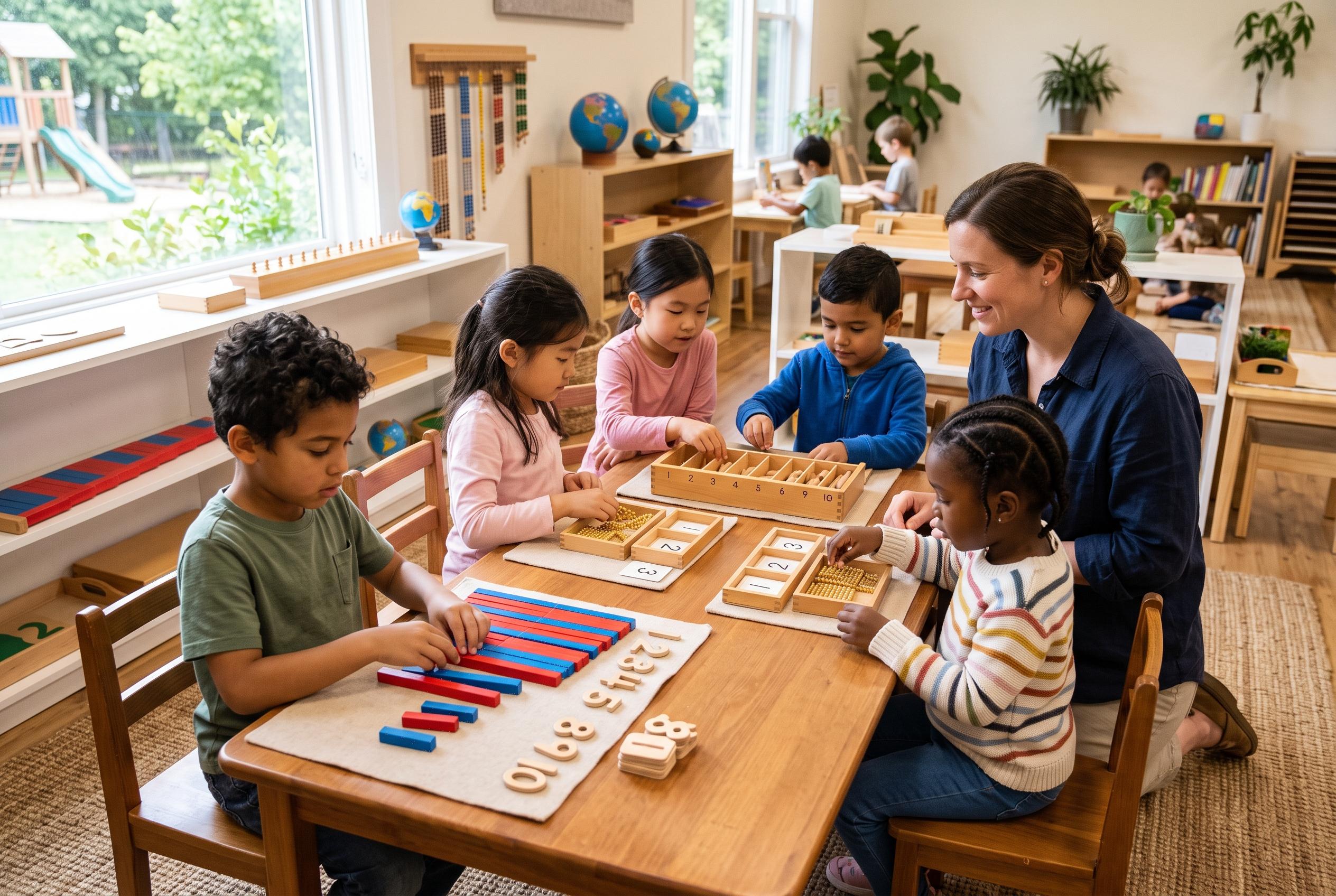

A new analysis suggests Montessori mathematics succeeds not only through hands-on materials, but because its curriculum aligns with four evidence-based principles of learning.
A new paper suggests that Montessori maths may work not simply because it is hands-on, but because it closely matches how children learn. The study, published in npj Science of Learning, argues that the Montessori mathematics curriculum naturally reflects Stanislas Dehaene’s four pillars of learning: attention, active engagement, error feedback and consolidation.
The authors, Chloë Marshall, Louise Livingston and Jo Van Herwegen, examine the curriculum in detail and focus especially on the early materials that introduce children to core concepts. Their analysis says Montessori teaching begins with concrete objects that children can touch and manipulate before moving gradually towards more abstract ideas. In practice, that means pupils are given time to work through ideas at their own pace, often independently or in small groups, rather than being pushed too quickly into formal abstraction.
That approach matters because maths remains a difficult subject for many children. Research cited in the article says attainment in mathematics often falls behind reading in the early school years, while confidence in maths can decline as pupils move through school. Schools also struggle to recruit and keep maths teachers. Against that backdrop, the paper argues, approaches that make mathematical ideas more accessible deserve closer attention.
The new study builds on wider evidence that Montessori education can improve maths outcomes. A systematic review published in 2023 found that, across 12 high-quality studies, Montessori pupils outperformed peers in traditional schools even when both groups posted similar maths scores in the studies being compared. More recent work, including randomised controlled trials, has also reported benefits in mathematics and problem-solving, adding weight to the view that Montessori’s methods can support learning rather than merely offering an alternative classroom style.
What makes the latest paper distinctive is its attempt to identify the active ingredients behind that success. By mapping the curriculum onto Dehaene’s framework, the authors argue that Montessori teaching gives children focused attention through carefully designed materials, encourages effortful participation, provides built-in opportunities to notice and correct mistakes, and supports repeated practice so that knowledge is retained. The paper also suggests the same method of analysis could be applied to other teaching approaches, helping educators distinguish what is essential from what is incidental when methods are adapted for different settings.
The implications may extend beyond maths. The authors note that Montessori already uses concrete symbols to make abstract language concepts visible, hinting that the same principles could help children in other subjects where ideas are hard to see or touch. For parents and teachers, the message is straightforward: a century-old approach may still be relevant because it fits with modern research on how learning happens.
Disclaimer: This content is for informational purposes only and is not intended to be a substitute for professional medical judgment, advice, diagnosis, or treatment.



