

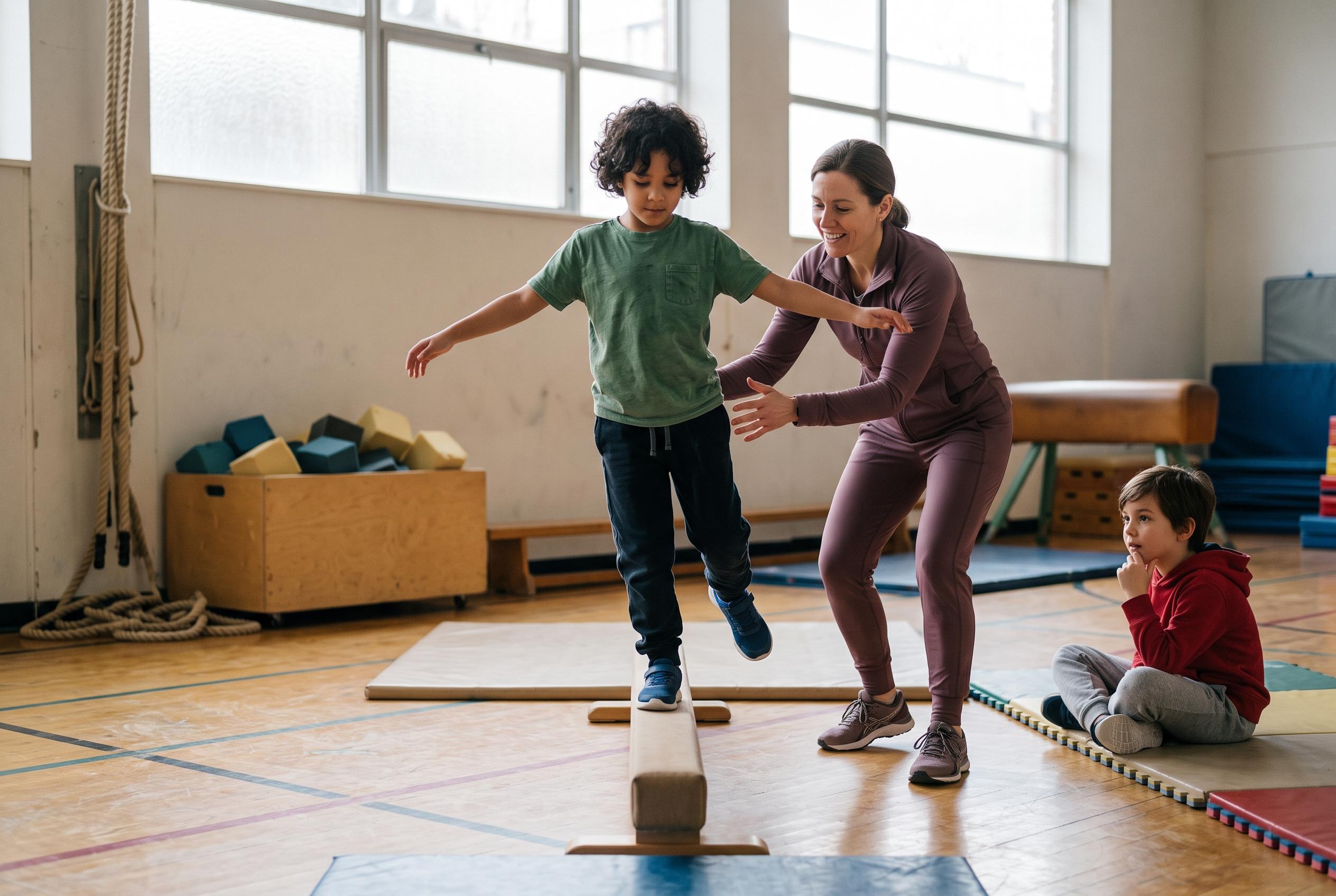

A small Shanghai trial suggests combining movement practice with action observation and mental rehearsal could improve motor skills and processing efficiency in children with developmental coordination disorder.
Children with developmental coordination disorder face more than awkwardness on the sports field. The condition, which affects an estimated five to six per cent of school-age children, can make everyday tasks such as catching a ball, fastening shoelaces or keeping up with classmates in the playground noticeably harder. Researchers have also increasingly linked the disorder, often shortened to DCD, with weaknesses in executive function: the mental skills involved in attention, working memory and self-control. A new pilot randomised controlled trial from Shanghai University of Sport suggests that pairing movement practice with mental rehearsal may help children on both fronts.
The study, published in Pediatric Research, tested a school-based programme that combined fundamental movement skills training with action observation and motor imagery, known as AOMI. Twenty children with DCD were randomly assigned to either the experimental programme or an active control group that received the same movement training alongside video-based physical activity education. Both groups trained three times a week for ten weeks. That design matters, because it means the extra gains seen in the AOMI group are less likely to be explained by more practice time or greater attention alone.
The idea behind AOMI is rooted in neuroscience: the brain does not only learn movement by doing it, but also by watching it and imagining it. Previous research in children with DCD has already suggested that action observation and motor imagery, used separately or together, may support motor planning, coordination and everyday function, although systematic reviews have also warned that much of the evidence carries a moderate to high risk of bias. Smaller studies have reported benefits for eye-hand coordination, automatic imitation, rhythmical actions and even the learning of daily tasks such as shoelace tying and cup stacking. Against that background, the Shanghai trial adds a more structured school-based test of whether the approach can improve both movement and cognition.
To assess progress, the researchers used the Test of Gross Motor Development, third edition, which measures locomotor skills such as running and hopping as well as ball skills including throwing and catching. They also measured executive function with tasks that examined cognitive flexibility, inhibitory control and spatial working memory. The results were encouraging, though still preliminary. Both groups improved their gross motor skills over the ten weeks, showing that organised movement practice itself can help. But the children who also observed and mentally rehearsed movements showed larger gains, suggesting the cognitive layer strengthened the physical training rather than simply repeating it.
The executive function results were more nuanced, but still noteworthy. The AOMI group showed better improvement in reaction time and inverse efficiency scores, a combined measure that takes both speed and accuracy into account. Accuracy alone improved less consistently, which implies that the intervention may have made children quicker and more efficient in how they processed information rather than dramatically changing how often they answered correctly. That pattern is scientifically interesting because it points to faster recruitment of attentional and inhibitory resources, which are closely tied to motor learning and adaptation. Earlier research has suggested that these shared systems may be especially important in DCD, where internal modelling of movement can be less efficient than in typically developing children.
There are, however, important limits. This was a small pilot study, and the authors stress that it was designed to test feasibility and generate hypotheses rather than prove definitive effectiveness. Larger trials will be needed to see whether the benefits hold up in more diverse groups of children, whether they last after the programme ends, and whether they translate into real-world improvements in classroom participation and playground activity. Even so, the school setting is a practical strength. A programme that can be delivered in a regular gym with standard equipment and video support could, if confirmed, offer a more accessible route to help children with DCD than clinic-based therapy alone. For families and teachers, that makes this early work worth watching closely.
Disclaimer: This content is for informational purposes only and is not intended to be a substitute for professional medical judgment, advice, diagnosis, or treatment.



