

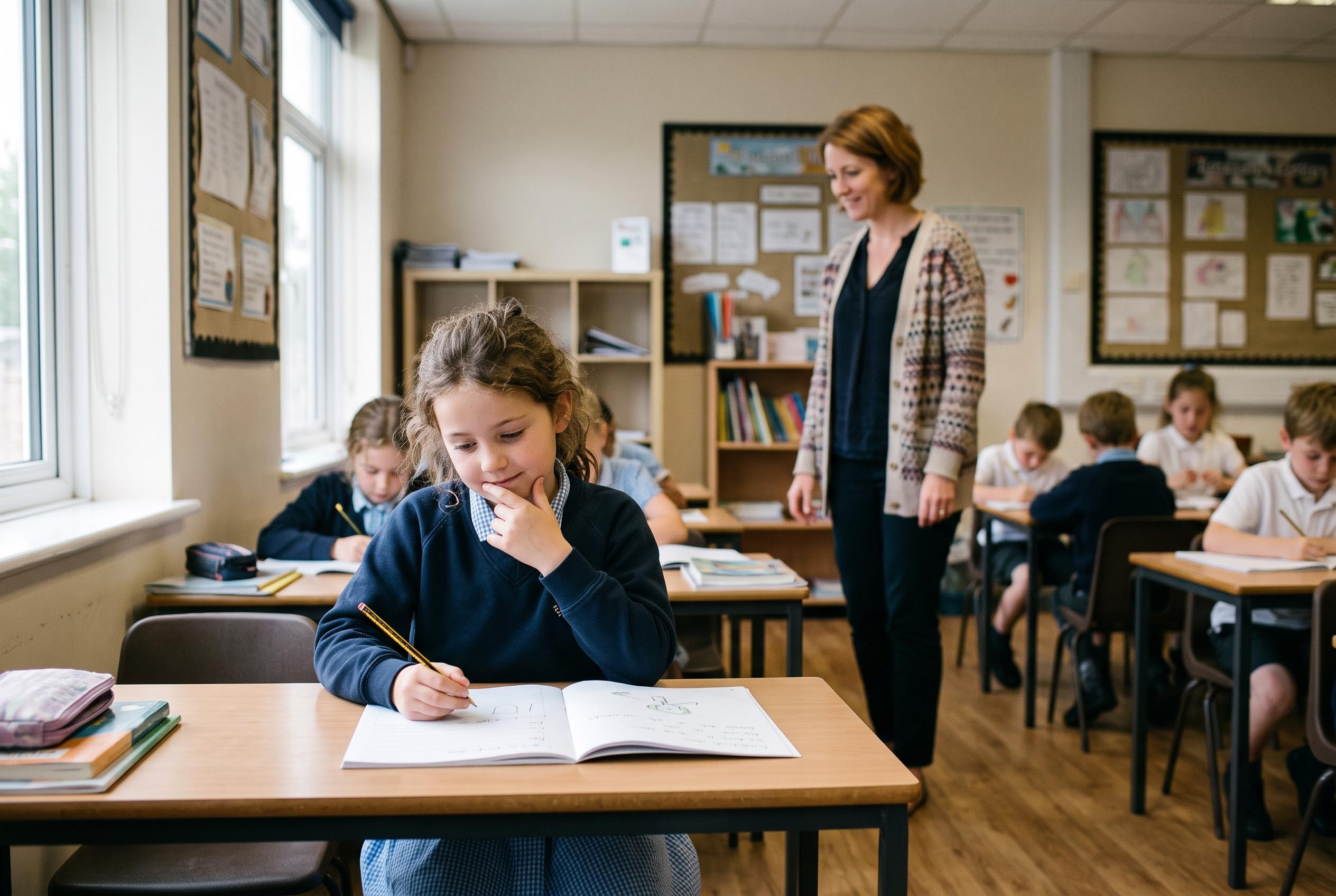

Repeatedly asking adults whether work is correct may reflect anxiety or weak self-monitoring rather than defiance. Clear goals, predictable check-ins and fading prompts can help children judge their own progress with greater confidence.
Some children can complete classwork accurately yet still appear unable to move on without repeated adult confirmation. They ask over and over whether an answer is correct, pause after almost every step, or wait for a teacher, therapist or aide to approve their next move. Educators say that pattern is often less about defiance or a bid for attention than a sign that the child is struggling with anxiety, uncertainty, working memory, planning or self-monitoring. According to Your Therapy Source, the key is to treat the behaviour as a learning need rather than simply a classroom nuisance, and to build the skills that help children judge their own work more confidently.
Clear expectations are the starting point. TeachThought and CollegeNP both stress that independence is easier when pupils can see what success looks like, whether that means a checklist, a model answer, or a clear set of goals. In practice, a child asked to write three sentences, for example, may need a visible reminder about capital letters and punctuation before they can check their own work with any accuracy. The same principle applies in maths, where worked examples can show the method, not just the final answer. Without that structure, many children are left guessing what “finished” should look like.
From there, teachers can teach self-monitoring directly, rather than assuming children will pick it up on their own. Your Therapy Source recommends modelling the process step by step: compare the work with an example, look for missing parts, then decide what to do next. That approach aligns with guidance from K12 Tutoring, which says self-directed learning begins when students understand both the goal and how to assess their progress. Instead of answering “Is this right?” immediately, adults can prompt a child to look back at the directions, explain what they notice, and identify where they are unsure.
Predictable check-ins can also reduce the pressure that drives constant reassurance-seeking. The article from Your Therapy Source argues that some children work better when they know exactly when an adult will return, because it lowers uncertainty without removing support. Teach17 makes a similar point, saying independence is not the same as being left alone; it depends on pupils knowing how to start, what to do when stuck, how to check progress and when to seek help. Gradually extending the time between check-ins gives children a chance to practise those skills while still feeling secure.
Several sources also point to confidence as a major factor. TeachWire links independent learning with self-efficacy, the belief that effort will lead to success, and CollegeNP notes that reflection, problem-solving and a growth mindset all help children become less dependent on adult approval. That matters because some children have learned, often unintentionally, that they must wait for permission before continuing. In those cases, teachers may need to reinforce that mistakes are part of learning and that a child can often make a sensible decision without immediate correction.
For pupils who need a concrete routine, Your Therapy Source suggests a simple three-step process: look, check and decide. That kind of structure can be reinforced with visual reminders on a desk or in a notebook, and it can be paired with adult prompts that gradually fade as the child grows more confident. Perkins School for the Blind also advises adults to step back in ways that still preserve choice and dignity, rather than taking over the task. For parents and caregivers, the broader lesson is similar: independence grows best when children are taught how to judge their own work, given clear support, and allowed enough space to try.
Disclaimer: This content is for informational purposes only and is not intended to be a substitute for professional medical judgment, advice, diagnosis, or treatment.



