

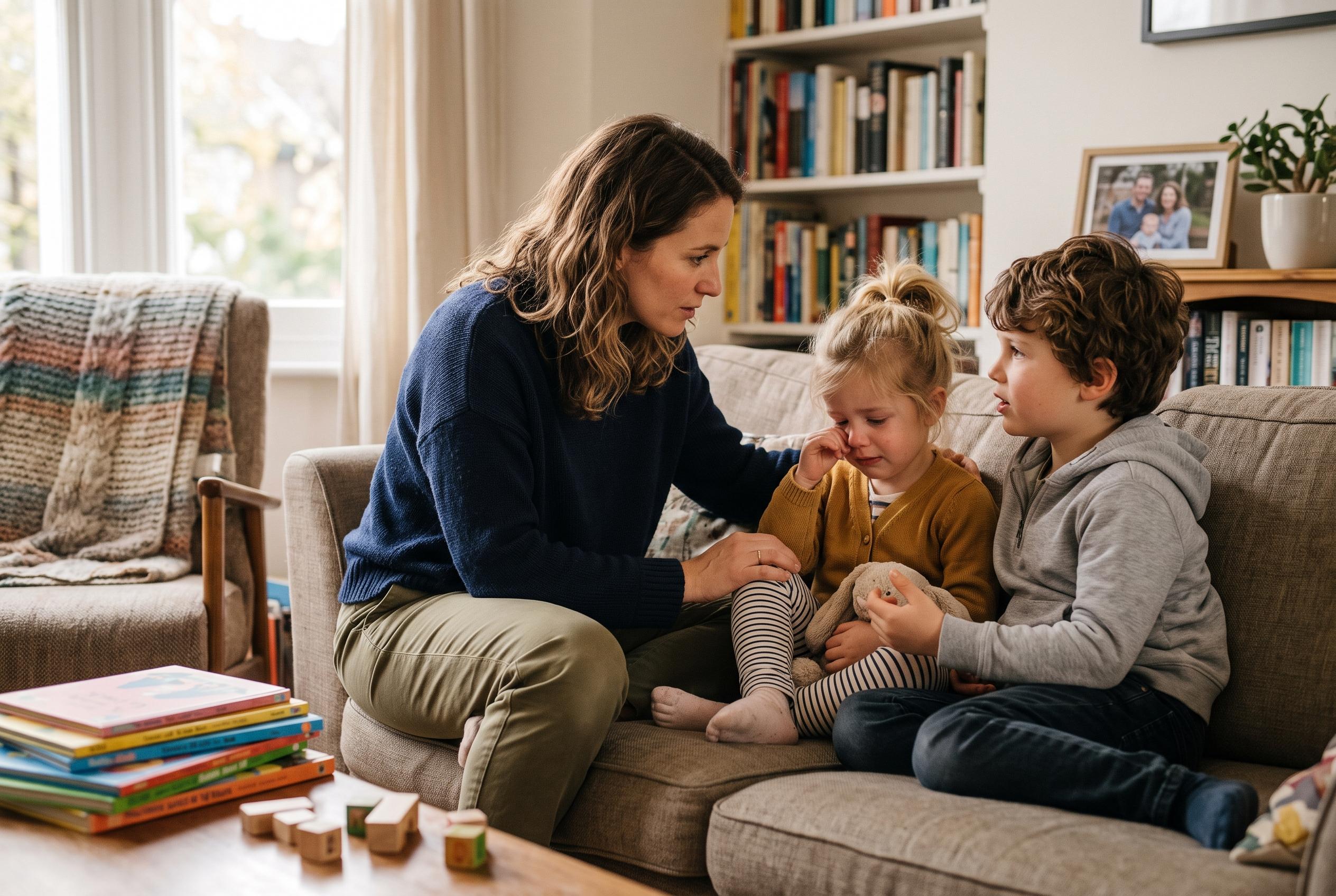

Children aged four to eight may need help repairing arguments, rather than being left to resolve them alone, according to research by psychologist Laurie Kramer.
Parents are often told to step back when brothers and sisters quarrel, on the theory that children should learn to sort things out for themselves and may be using the dispute to get an adult’s attention. But Laurie Kramer, a psychology professor at Northeastern University in Boston, says there is no evidence to support that assumption, and that young children usually need help learning how to repair a clash before it escalates.
Kramer’s research centres on the skills children need to manage disagreement: seeing another person’s point of view, explaining their own needs and working towards a solution that feels fair to both sides. She argues that many children do not fully develop those abilities until about the age of eight, which means they are often not ready to negotiate alone. Even when children do have some of those skills, she says, they may still need a timely reminder to use them.
That view is backed by Northeastern University reporting on Kramer’s work, which suggests that children aged four to eight can have as many as eight fights in an hour. Rather than treating sibling conflict as something parents must simply endure, Kramer has developed a programme called “Fun With Sisters and Brothers” to help families manage it more constructively. The initiative offers both in-person and online training designed to give parents practical strategies for stepping in effectively.
A study published in the journal Family Relations examined an online preventive version of the programme, called “More Fun With Sisters and Brothers”. The research looked at asynchronous modules that teach parents how to intervene in sibling disputes, with the aim of improving relationships between children aged four to eight. Northeastern has said Kramer’s wider research also shows that sibling rivalry is not fixed, but can be shaped by how parents respond.
The broader point, according to sibling-relationship research, is that conflict between children is not only unavoidable but can also be formative. When guided well, arguments at home can help children practise emotional understanding, self-control and compromise. The challenge for parents is not to eliminate every disagreement, but to know when and how to step in so that a routine squabble does not become something harder to undo.
Disclaimer: This content is for informational purposes only and is not intended to be a substitute for professional medical judgment, advice, diagnosis, or treatment.



