

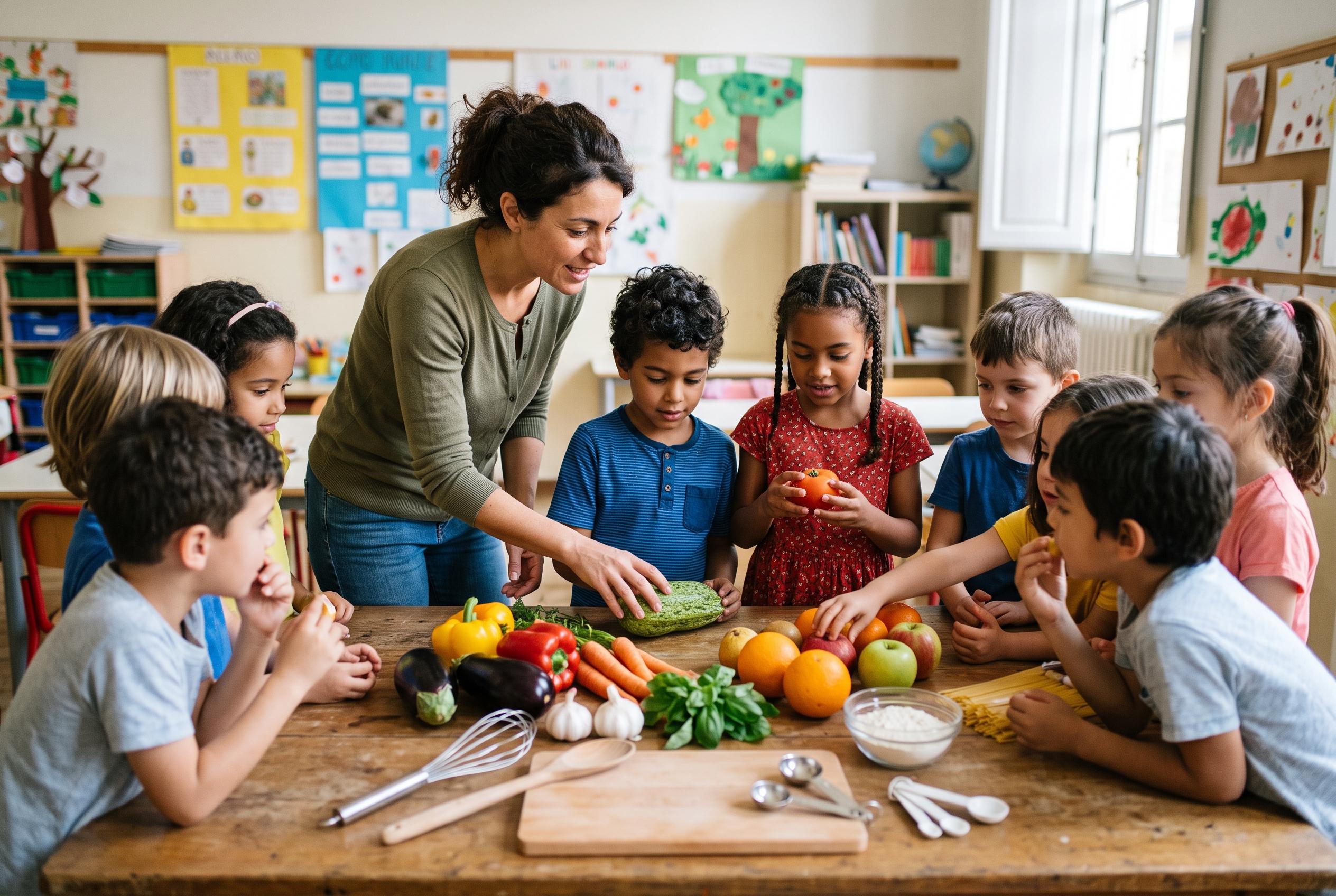

A permanent food education programme could help Italian children cut waste, make healthier choices and preserve the country’s culinary culture, supporters say.
Italy should make food education a permanent part of the school curriculum, starting in primary school, if it wants to tackle waste, poor diets and widening gaps in nutritional knowledge, according to Italia a Tavola. The publication argues that occasional projects and one-off initiatives, however well intentioned, do not give every child the same grounding in how to choose, store and value food.
The case for change is strengthened by evidence on both waste and health. Waste Watcher data cited by Andrea Segrè, scientific director of the observatory, show that younger Italians throw away about 800 grams of food a week per person, compared with 350 grams among baby boomers. That puts youth waste at more than twice the level seen in older generations and well above the United Nations’ 2030 target for Italy of roughly 369.7 grams a week per person.
Segrè has long argued that food education cannot be left to chance. Speaking in an interview with Italia a Tavola, he said that teaching children how to judge quality, safety and value at the table is about sustainability, public health and the future of Italy’s agri-food system. He also warned that if younger consumers lose touch with culinary knowledge, the country risks weakening part of the food culture that helped earn Italian cuisine Unesco recognition.
The health data point in the same direction. In 2024-25, 32.3% of Italian children aged three to 10 were either overweight or obese, meaning almost one in three was carrying excess weight. Broader figures released in June 2026 indicated that about two million children and adolescents aged three to 17 were in excess weight categories, roughly a quarter of the group examined.
The problem is not confined to childhood. Statista data cited by Italia a Tavola show that 28% of Italians aged 18 to 34 eat fast food or junk food at least once a week, compared with 9% of those over 54. The contrast suggests that habits formed early can shape later behaviour, long before young adults fully take charge of their diets and shopping.
That is why supporters of a formal subject say lessons should build gradually with age. In primary school, pupils could learn what makes a balanced meal, how to recognise foods and how to avoid waste. Later years could introduce label reading, nutritional needs and proper storage. In practice, such skills would help students connect everyday choices with health, spending and environmental impact.
The idea is not new. Italia a Tavola notes that the World Health Organisation has recently underlined the role of schools in shaping eating habits and promoting health, while Italy’s Parliament has already seen several proposals without any becoming law. Bills in 2023 and 2025 would have introduced structured teaching on food, healthy lifestyles and related subjects, but none led to a dedicated subject in schools.
Some practical work is already under way. Italy’s school meals and programmes such as “Frutta e verdura nelle scuole”, backed by the agriculture ministry and funded with more than €14 million for the 2026-27 school year, aim to encourage primary pupils to know and eat more fruit and vegetables. But Italia a Tavola says these efforts should complement, not replace, a proper curriculum. It is now calling on the education ministry and the agriculture ministry to work together on a stable teaching path that would reach all pupils, not just those lucky enough to take part in isolated projects.
Disclaimer: This content is for informational purposes only and is not intended to be a substitute for professional medical judgment, advice, diagnosis, or treatment.



