

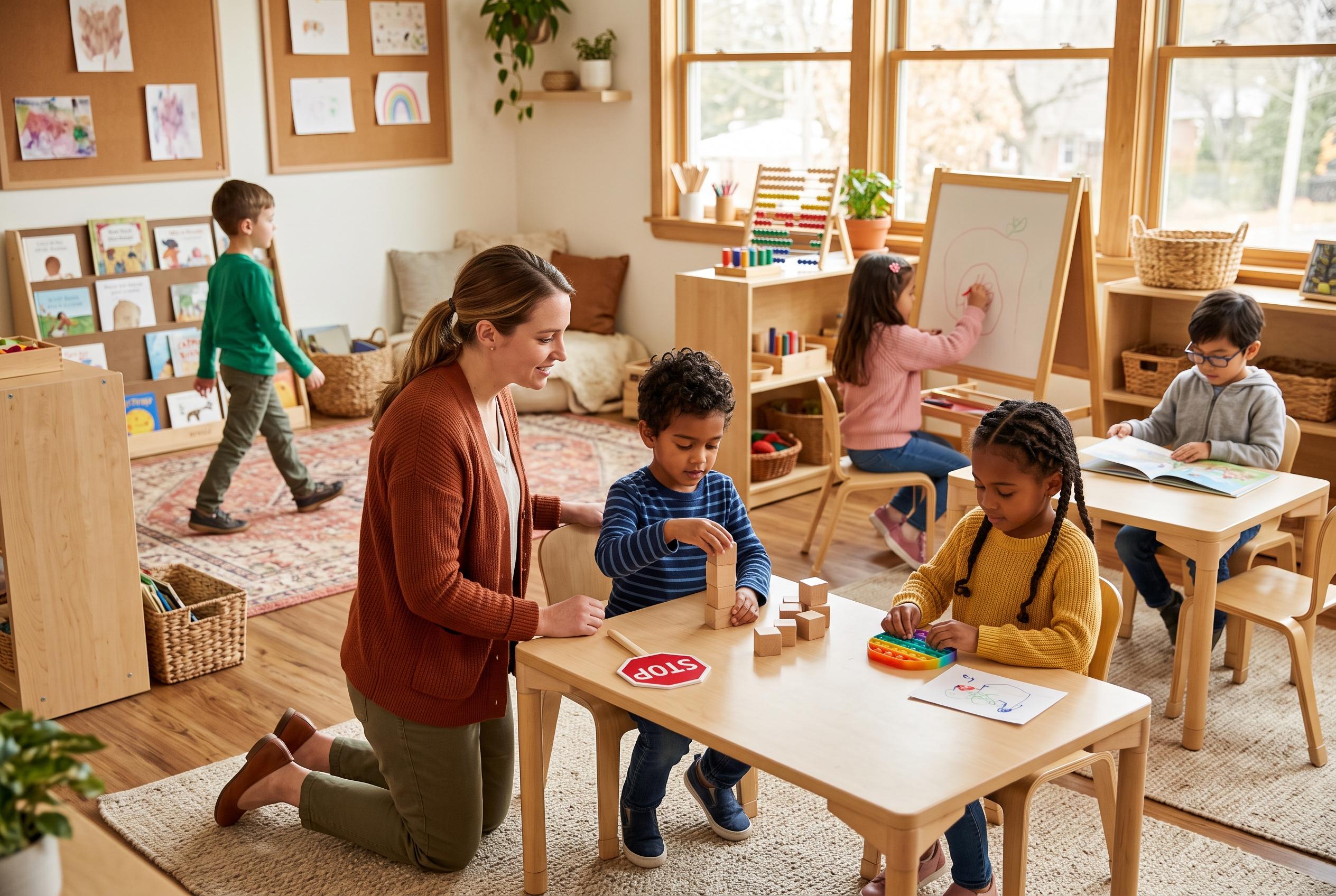

Teachers are using whispers, stop signs, fidgets and snail-paced walks to make self-regulation practical for five-year-olds.
Kindergarten teachers are finding that one of the hardest lessons for young children is not reading or counting, but waiting. In classrooms shaped by faster routines, more screen time and higher academic expectations, impulse control has become a daily challenge for many pupils, and educators say the problem was sharpened during the pandemic. Emily Bartz, a learning specialist at Friends School of Baltimore and an independent education consultant, told Education Week that children today often struggle more with boredom and delayed gratification than earlier generations did. That fits with wider child-development guidance, which treats impulsive behaviour less as defiance than as a sign that the brain systems behind self-regulation are still maturing. According to psychologists who study executive function, the ability to pause, think and choose develops gradually and is closely tied to the prefrontal cortex.
That is why Bartz has built a set of simple, memorable classroom routines designed for five-year-olds. Her approach rests on executive function skills, the mental processes that help children focus, shift between tasks and control their reactions. She argues that teachers should avoid a constant stream of negatives such as “don’t” and “stop”, and instead give children concrete actions they can practise together. Her methods are built on the idea that children learn best when the strategy is playful, named clearly and rehearsed as a group before it is used in the moment.
One of her techniques asks children to whisper “whoa” to themselves, like a rider stopping a horse, when they feel the urge to blurt out or grab. Another uses a small stop sign as a visual cue for “stop, then choose”. Bartz also teaches pupils to hold an idea in a fist until it is their turn, squeeze their hands together and count to five when they feel like pushing or snatching, and give their hands a job with a fidget while listening. The aim, she says, is to replace impulsive motion with a short, repeatable routine that children can remember under pressure.
Other strategies focus on slowing the body down. Bartz encourages children to move in “slow motion” like a snail during transitions, especially after recess, when energy is high and focus is low. She also uses a talking object, such as a stuffed animal or pretend microphone, so that only the child holding it speaks. The techniques are rooted in a broader educational understanding that impulse control is not a fixed trait but a skill that can be strengthened with practice, repetition and clear adult modelling. Child-development specialists say that makes early childhood a particularly important time to teach children how to wait, listen and respond intentionally.
For teachers, the appeal is practical as much as developmental. These strategies do not ask children to suppress their natural urge to move, talk or react; they give them something else to do instead. That distinction matters in classrooms where sitting still for long periods is increasingly expected, even though many children at this age are still driven by play and movement. Bartz, drawing on the work of psychologists Peg Dawson and Richard Guare, is essentially offering a way to make self-control visible, concrete and teachable , one whisper, stop sign and snail-paced walk at a time.
Disclaimer: This content is for informational purposes only and is not intended to be a substitute for professional medical judgment, advice, diagnosis, or treatment.



