

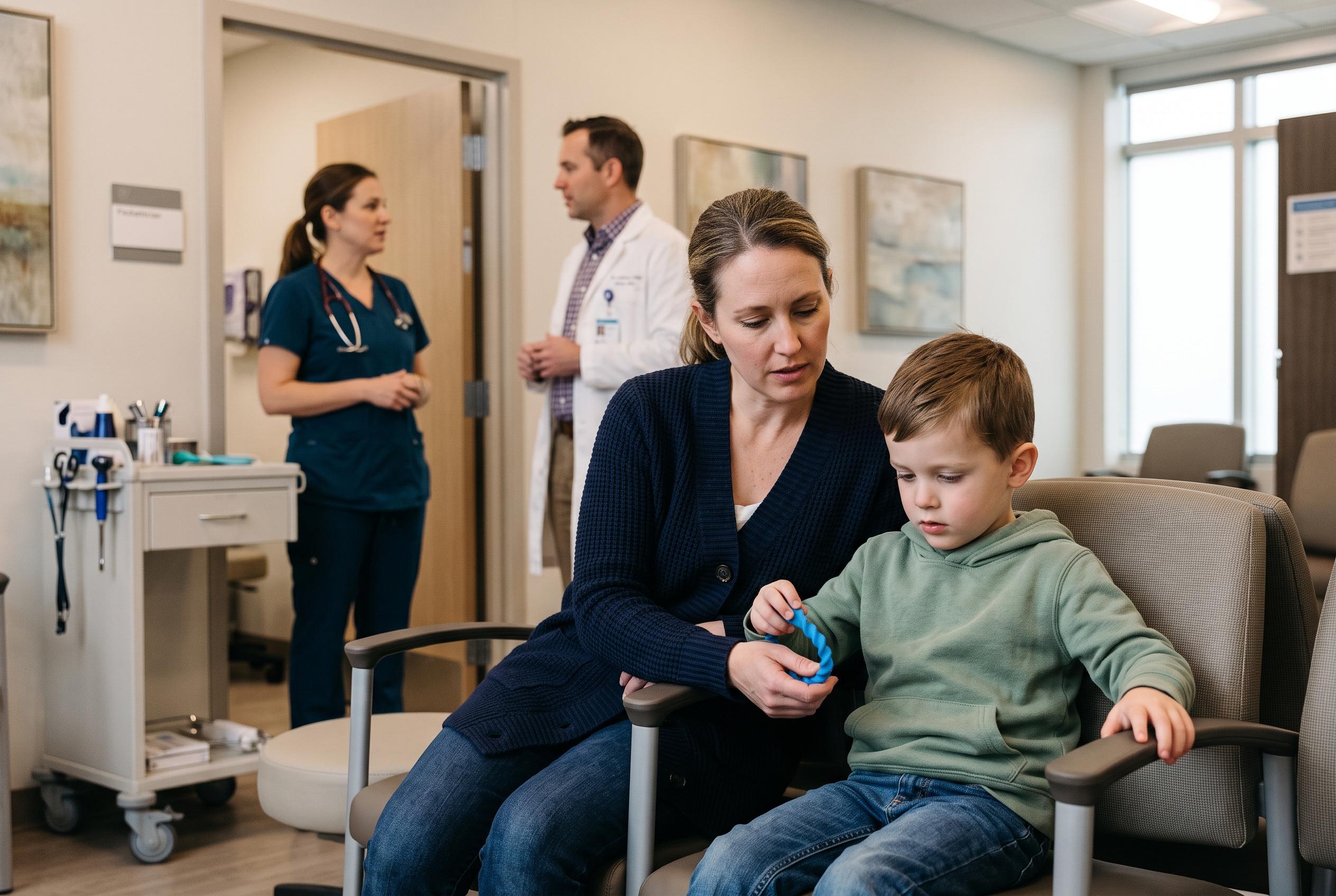

Candice Burton shares her story of how her son’s pain was overlooked due to misattribution to autism, prompting calls for systemic changes in medical care for autistic patients, as revealed in a new documentary.
Candice Burton says her seven-year-old son’s pain was repeatedly missed because professionals focused on his autism rather than his symptoms, in a story now being highlighted in a new documentary about autistic people’s experiences in healthcare.
Burton, from Newton Aycliffe in County Durham, appears with Cameron in “Hidden Barriers: Autism and GP Surgeries”, a film made with the North East Autism Society. The documentary argues that autistic patients are often misunderstood in medical settings and says more than half have had their symptoms dismissed by GPs as “just autism” or anxiety.
Burton told the filmmakers she had “lost count” of the times doctors had written off Cameron’s distress as behaviour linked to his autism. In one case, she became worried because Cameron’s self-harming seemed to signal something more serious was wrong. His grommets, the small tubes used to help prevent ear infections, had become dislodged and were eventually found stuck sideways in his ear after months in which the problem was blamed on ear infections. Burton said the delay made an already difficult situation more frightening and could quickly become dangerous.
The film places that experience in a wider context. Research cited by the North East Autism Society says autistic people are more likely than the general population to have poorer health, mental health difficulties and shorter life expectancy, and are twice as likely to need emergency care. A separate survey carried out for the documentary found that 80% of autistic adults and children struggle in GP waiting rooms because of noise, crowds and bright lights. The same proportion said they have difficulty identifying or explaining pain to doctors, while 75% said physical examinations are hard because they are sensitive to touch.
Despite legal duties on GP surgeries to make reasonable adjustments under the Equality Act, the survey found only 8% of respondents had been offered changes such as longer appointments or quieter waiting areas. Paul McGinnety, chief executive of the North East Autism Society, said no one should have pain or illness dismissed because they are autistic, adding that simple adjustments could transform care and save lives.
Dr Kathy Petersen, medical director for mental health, neurodivergence and learning disability for the North East and North Cumbria Integrated Care Board, said the health system is “not as autism accepting as we would like” and that more work is needed. She said one planned step is a digital flag intended to identify when a person may need adjustments, with the system due to roll out across the North East, North Cumbria and England from 2026 onwards.
Disclaimer: This content is for informational purposes only and is not intended to be a substitute for professional medical judgment, advice, diagnosis, or treatment.



