

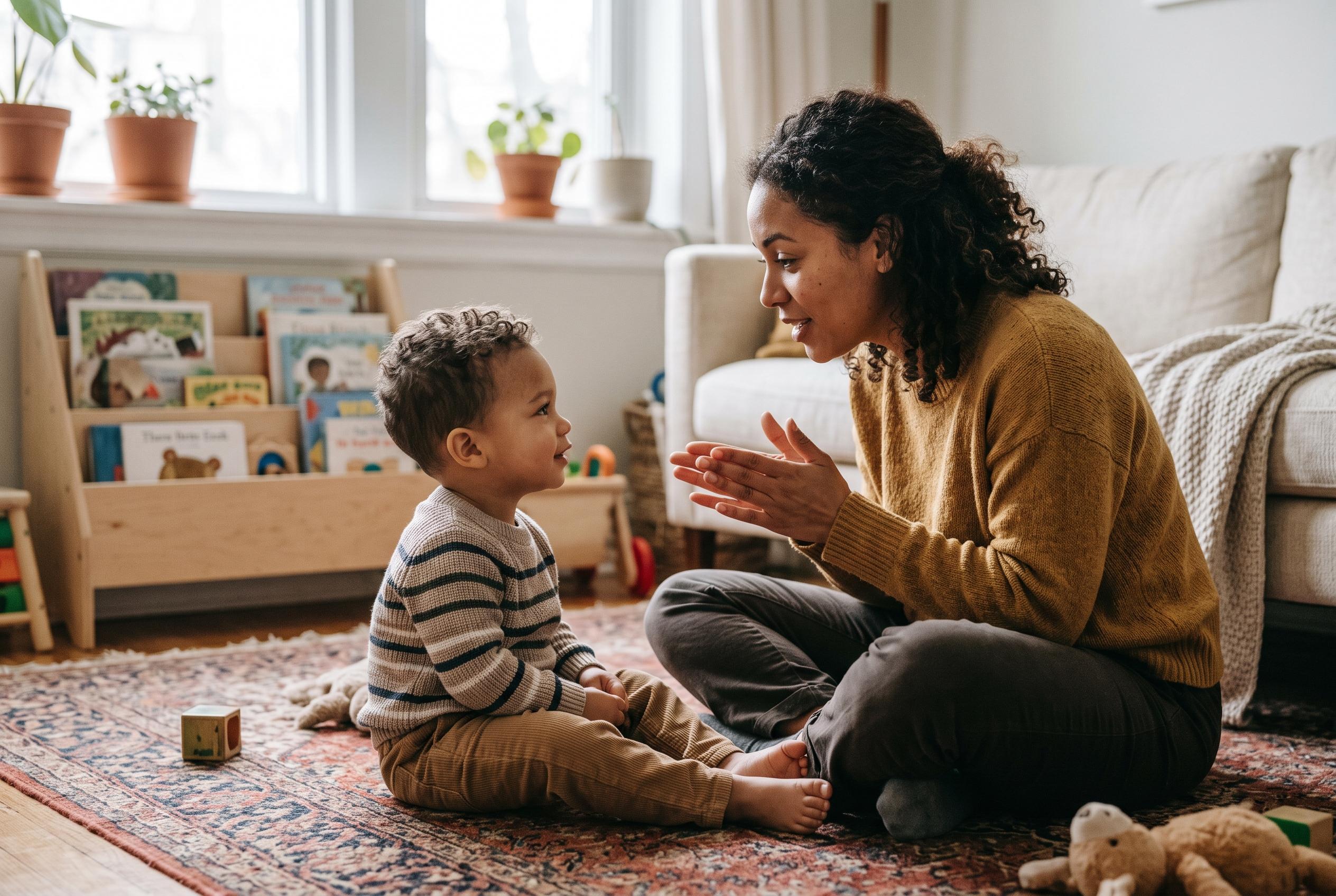

Research from the University of Iowa shows that combining speech with hand gestures enhances neural synchrony between parents and young children, potentially improving early learning outcomes.
A University of Iowa study suggests that the way adults talk to young children may matter as much as what they say. Researchers in the university’s Department of Psychological and Brain Sciences found that speech paired with hand gestures appeared to strengthen learning in children aged five to seven, pointing to a simple but underused tool for parents who want to support early development.
The project examined 45 parent-child pairs and used hyperscanning, a neuroimaging approach that measures brain activity in two people at the same time during interaction. According to the study published in August 2026 and the Daily Iowan’s account of the work, the researchers found that combining speech with gestures increased neural synchrony, the moment when two brains show aligned activity during a shared task. In practical terms, that means a child and parent were more likely to be mentally “in step” when words were reinforced with movement.
Ece Demir-Lira, an associate professor in the department, said her lab is interested in why some children struggle while others keep pace at school, and in how that relates to development inside the brain. The study’s design deliberately moved away from the kind of computer-based tests often used in child research and instead focused on the back-and-forth of real conversation, because children typically learn by interacting with adults at home and in classrooms. The findings suggest that gestures do more than decorate speech: they can supply spatial and visual information that words alone may not fully capture.
The implications extend beyond parenting. Susan Cook, another associate professor in the department who studies mathematics learning, has found that gestures can help children make sense of abstract concepts, including the equal sign. Her earlier work showed that hand movements can make instruction more concrete and improve children’s understanding of equations. Together, the Iowa studies add to a broader body of research from the university showing that multimodal communication, especially when speech and gesture are combined, can play an important role in learning, attention and parent-child synchrony.
Disclaimer: This content is for informational purposes only and is not intended to be a substitute for professional medical judgment, advice, diagnosis, or treatment.



