

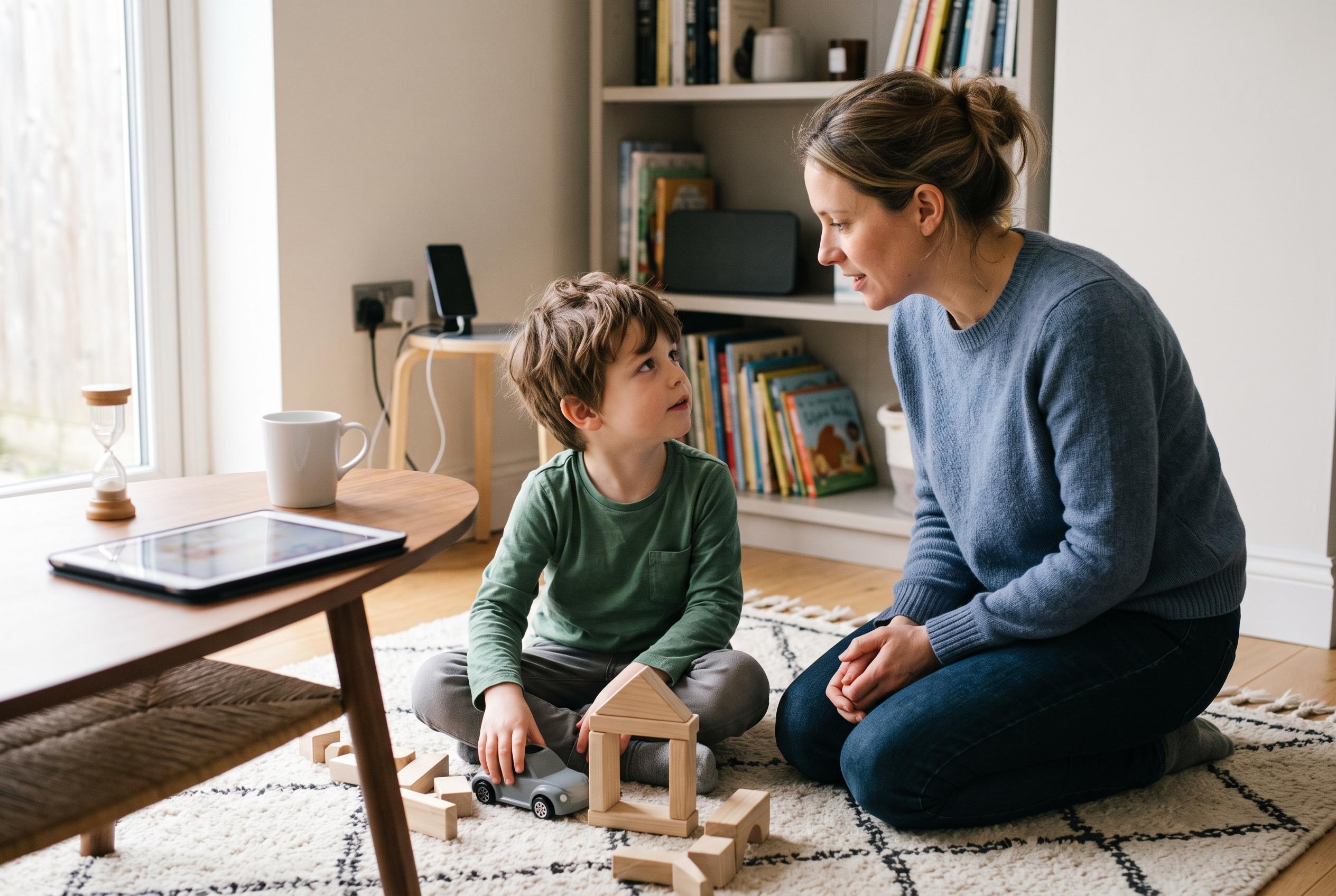

As children are exposed to AI technologies early, specialists urge parents to prioritise basic media literacy, safety, and human connection over novelty, highlighting risks of AI toys and low-quality content.
Parents navigating young children’s growing exposure to artificial intelligence are being urged to focus less on novelty and more on basic media literacy, safety and human connection. PBS News reported that specialists in child development and paediatrics say children begin absorbing information from technology long before school age, which makes the early years an important time to explain that a smart speaker, chatbot or AI-generated video is a machine response rather than a human one. UNICEF likewise advises parents to start these conversations early and use familiar examples from daily life to make the idea of AI easier to grasp.
For many families, the simplest lessons come from ordinary devices already in the home. Jennifer Katzenstein of Johns Hopkins All Children’s Hospital told PBS that parents can use interactions with Alexa or Siri to show children the difference between a person and a computer. Lauren Girouard, a researcher at Harvard Graduate School of Education and the University of Michigan, said young children are already encountering AI in households, childcare settings and classrooms, and that by preschool age they can learn information from technology. Her point, echoed in guidance from the Irvine Unified School District and HealthyChildren.org, is that parents should keep the conversation practical: explain privacy, encourage questions and make clear that a machine can sound friendly without being alive.
Several experts also say families should be wary of AI toys. Common Sense Media has warned that products marketed to young children can bypass safety limits, produce age-inappropriate answers and create privacy concerns by collecting data. In PBS’s reporting, the organisation said its testing found that more than a quarter of responses from three AI companion toys were unsuitable for children. Jenny Radesky, a developmental behavioural paediatrician at the University of Michigan, said such products can crowd out imaginative play and reduce the back-and-forth with adults that helps children develop language, social understanding and self-control.
That caution extends to AI-generated video and other online content. Girouard told PBS that children often learn less effectively from a screen than from a person, and that much AI-made material is low quality or simply wrong. She compared some of it to brightly packaged junk food: eye-catching, but with little educational value. Radesky recommended steering children towards content parents know is not AI-made, such as familiar children’s programming, while UNICEF and ParentMap both advise families to treat AI as something to discuss, question and fact-check rather than accept at face value.
The broader message from the experts is not to panic, but to build habits that will help children use technology without becoming dependent on it. PBS reported that Radesky and Molly O’Shea, a paediatrician who works with the American Academy of Paediatrics, both stressed the value of screen-free time, unstructured play and real-world relationships. Those experiences help children practise critical thinking, emotional regulation and cooperation, skills that no AI system can replace. O’Shea said parents can also model problem-solving by thinking aloud when they do not know an answer, rather than handing the task immediately to a device.
Disclaimer: This content is for informational purposes only and is not intended to be a substitute for professional medical judgment, advice, diagnosis, or treatment.



