

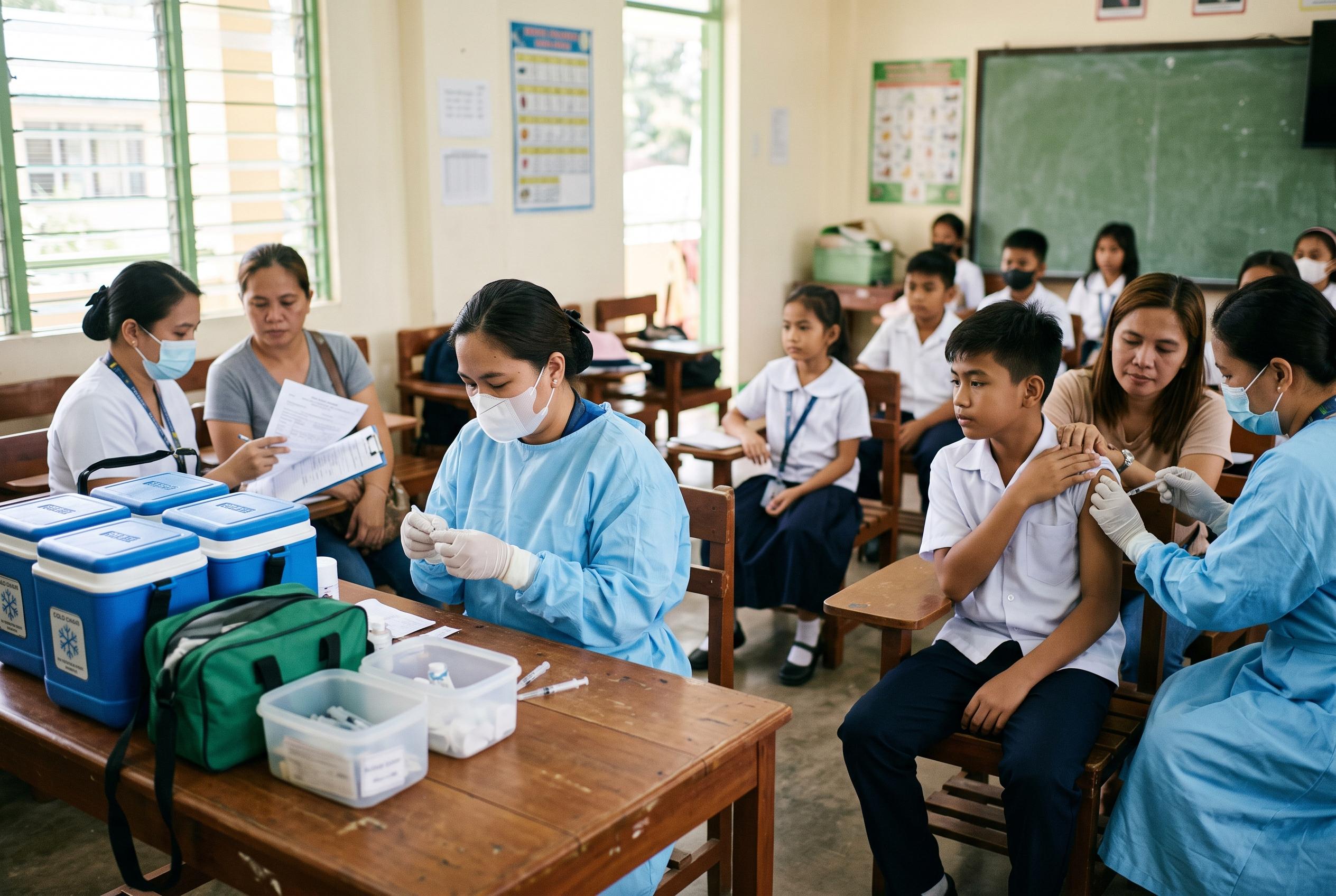

Over 4.6 million students in the Philippines are set to receive vaccines for measles-rubella, tetanus-diphtheria, and HPV in a nationwide school-driven effort, aiming to boost coverage and address persistent immunisation gaps.
More than 4 million students across the Philippines are expected to take part in the Department of Education’s school-based immunization programme for school year 2026-2027, as health officials and education workers prepare for a wider rollout aimed at preventing vaccine-preventable disease in classrooms.
Jhpiego, a global health nonprofit involved in the effort, said the programme is designed to reach 4.6 million students in total. That includes 3.6 million pupils in Grade 1 and Grade 7 who are slated to receive measles-rubella and tetanus-diphtheria vaccines, along with 1 million Grade 4 girls who will be offered human papillomavirus, or HPV, vaccination.
In a statement, Ingrid Magnata, country programme manager of Jhpiego Philippines, said vaccination campaigns need more than supply chains and clinic visits to work well. She said success depends on stronger systems, better-informed communities and coordinated action across sectors. DepEd’s acting chief and supervising health programme officer for the School Health Division, Lilibeth Gonzales, said in a separate statement that the programme will succeed only if data and plans are translated into practical steps at regional, division and school levels.
Preparatory workshops for school health personnel have focused on reviewing vaccination coverage for measles-rubella, tetanus-diphtheria and HPV, while also examining attendance and participation patterns in elementary and secondary schools. Organisers have also been looking at behavioural factors that shape vaccine uptake, including misinformation, access barriers and parental confidence. Those issues have become increasingly important as health authorities seek to improve routine childhood immunisation and extend protection through schools.
Local health authorities have also been urging parents to back the campaign. The Quezon City Health Department said earlier this month that the school-based immunization activity will run from October to December 2026 and will be carried out in public schools nationwide, with some private schools included under local government arrangements. The Department of Health’s broader immunisation programme continues to provide free vaccines through public health facilities, and officials have singled out measles prevention and HPV coverage as key priorities. That urgency is reflected in recent regional gains: the Department of Health in Ilocos Region said Ilocos Norte became the country’s first province to exceed the World Health Organization benchmark for HPV vaccination, after reaching 95.7% coverage among girls aged nine to 14.
Public health officials have linked the drive to persistent gaps in protection. The Philippine Cancer Society has said the country has the lowest HPV screening rate globally, with only 1% of women screened regularly, while government statistics also show that measles vaccination uptake remains uneven despite comparatively strong coverage for the first dose of the measles, mumps and rubella vaccine. Against that backdrop, officials hope the school-based programme will turn classrooms into a more reliable entry point for prevention, especially for children who might otherwise miss routine immunisation.
Disclaimer: This content is for informational purposes only and is not intended to be a substitute for professional medical judgment, advice, diagnosis, or treatment.



