

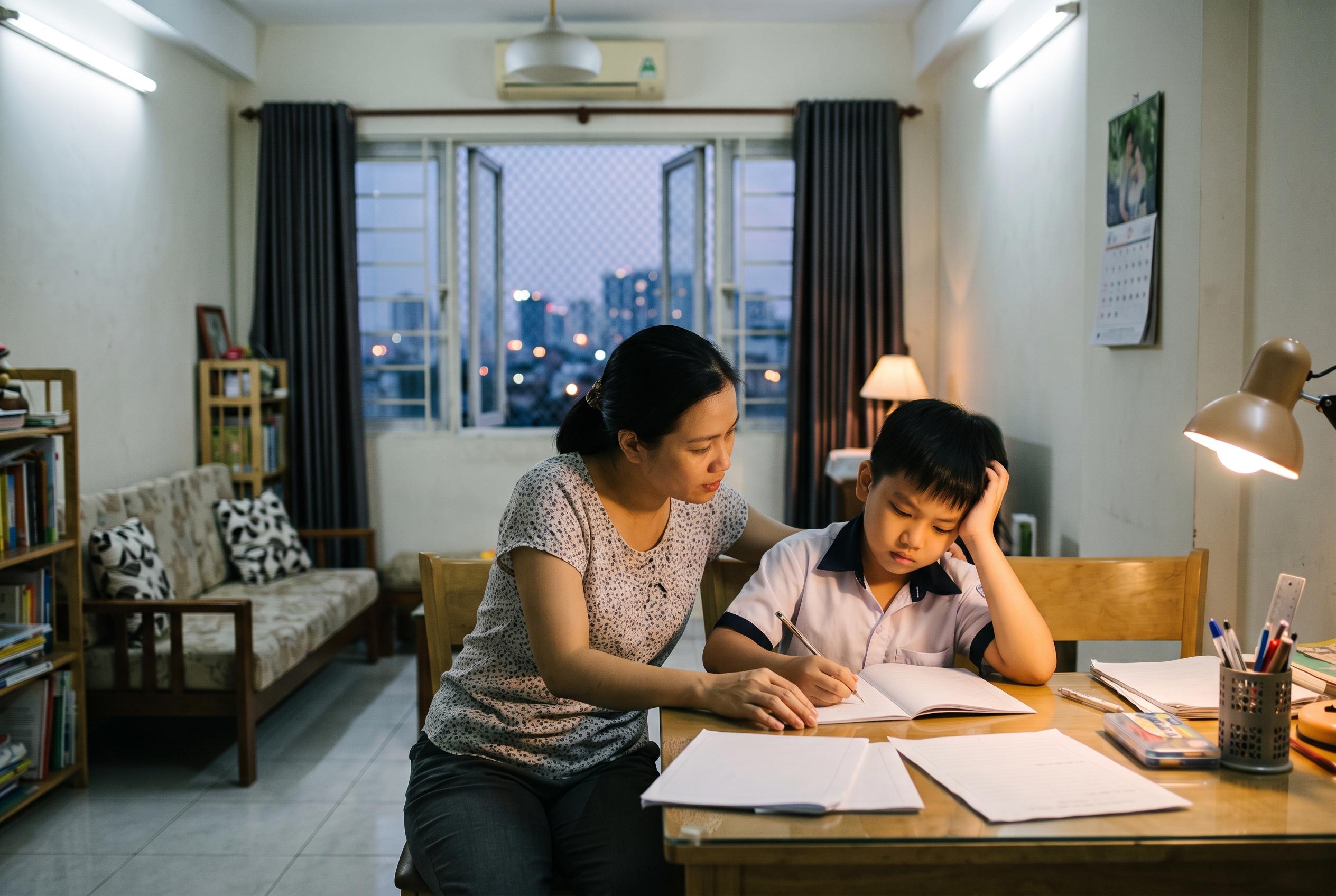

In Ho Chi Minh City, parents struggle with balancing help and independence during homework, revealing insights into how parental guidance impacts children’s learning and emotional well-being.
For many families, the evening homework routine has become a daily flashpoint. In Ho Chi Minh City, one father described how the period after dinner, when he and his wife sit down with their child to study, often turns into a cycle of frustration as assignments take too long, mistakes pile up and concentration slips. A mother with a primary school pupil said she once believed firmness was the same as care, until her child began asking her not to stay beside him while he worked. Their experience reflects a familiar pattern in which a parent’s wish to help can quickly turn into pressure at the kitchen table.
That tension is not just about a single wrong answer. It is often tied to broader fears: that a child will fall behind classmates, lose confidence or struggle later in school. Psychologists say that is exactly why homework can become emotionally loaded. According to Thạch Thị Thùy Trang of The Healing Room in Ho Chi Minh City, parents may react strongly because they are seeing one mistake as a sign of bigger risks ahead. She said adults also tend to judge children through an adult lens, expecting them to respond with a level of patience and self-control they have not yet developed.
Research suggests that the way parents step in can shape a child’s learning behaviour. A longitudinal study indexed by PubMed found that children’s early self-regulation predicted how mothers taught them later, with greater self-control linked to more cognitive assistance and questioning, and less directive instruction. Another study, also published in PubMed, found that mothers’ teaching style and attitudes affected preschool children’s ability to delay gratification, underlining how parental guidance helps build self-control over time.
Other evidence points to the downside of taking over too quickly. A University of Pennsylvania study reported by Phys.org found that when adults intervene too much, children are less likely to persist with a task, because they can begin to feel less capable and less motivated. That finding fits the experience of many parents and children who say homework becomes harder when the adult at the table answers too quickly or pushes too hard. The result can be a child who stops trying, not because the work is beyond them, but because the atmosphere has made effort feel risky.
Huỳnh Hải Huy, a psychologist at Inner Light in Ho Chi Minh City, said parents should agree the study plan before the session begins: how long it will last, what the child will do alone and where adult help is appropriate. He stressed that there is a meaningful difference between asking, “What part is confusing you?” and snapping, “Why can’t you do something this simple?” The first invites problem-solving; the second can make a child defensive. Lê Thanh Trúc, a working mother in Ho Chi Minh City, said she eventually stopped sitting beside her child for the whole session. By letting him try first and stepping in only when needed, she found she shouted less and the evenings became calmer. That, experts say, is the real aim of homework time: not only finished exercises, but a child who is willing to ask questions, make mistakes and try again.
Disclaimer: This content is for informational purposes only and is not intended to be a substitute for professional medical judgment, advice, diagnosis, or treatment.



