

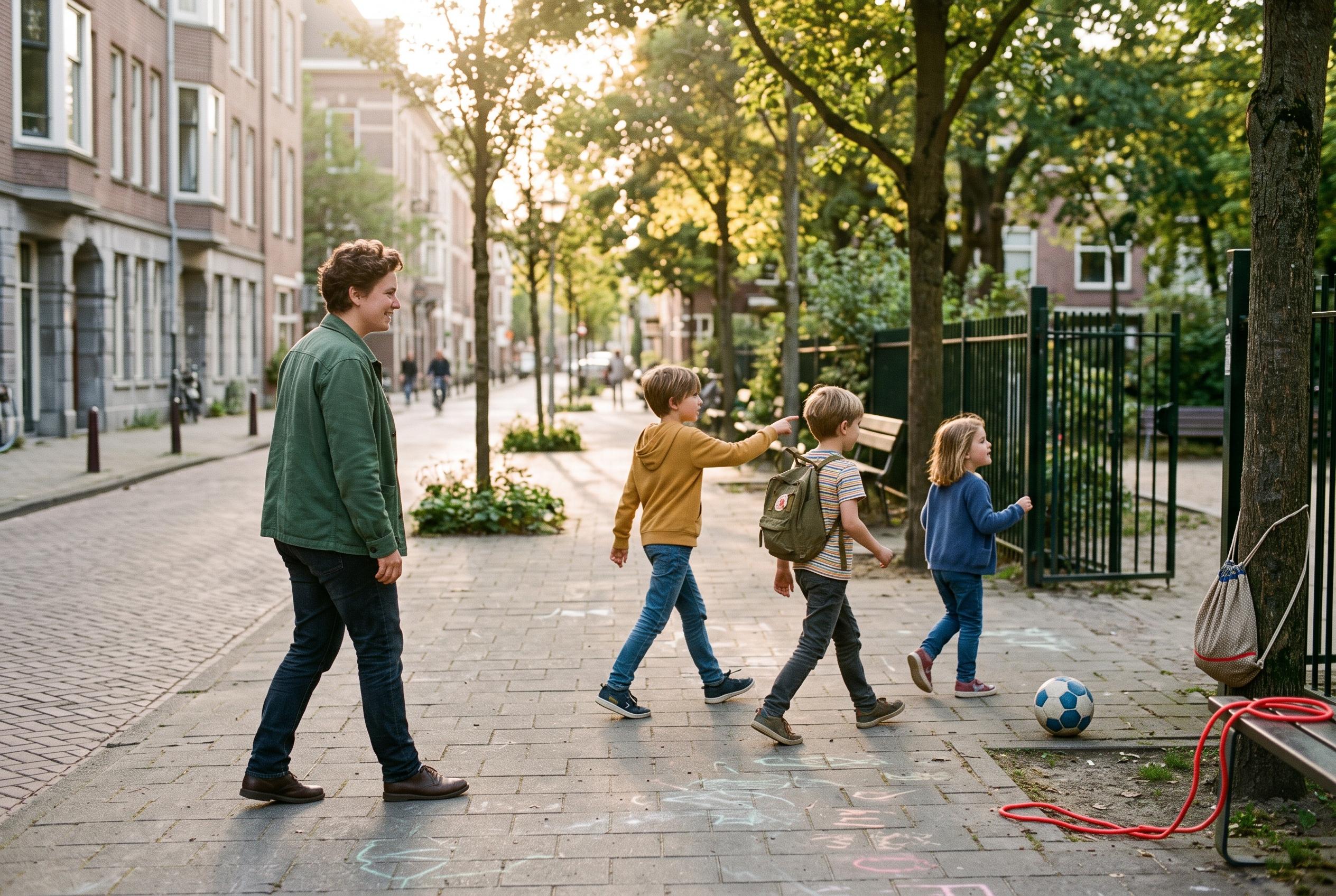

Italian pedagogue Francesco Tonucci champions children’s right to free outdoor play, criticising modern restrictions and advocating for city design and family policies that prioritise childhood independence and imaginative freedom.
Francesco Tonucci has spent decades arguing that childhood is being squeezed by adults’ fears, schedules and habits. In a new push, the Italian pedagogue is using his long-running campaign for children’s autonomy to make the case for something once taken for granted: that boys and girls should be able to leave home, meet friends and play outdoors without being shadowed by adults.
Tonucci’s thinking is rooted in memory. He recalls growing up in Fano, on Italy’s Adriatic coast, during the Second World War and the difficult years that followed. For him, the city was not first a place of institutions or traffic rules, but of streets, rubble, improvised games and constant invention. He has said that the experience of war in his own childhood helped shape the later idea behind “The City of Children”, his international project that asks municipalities to plan with children’s needs in mind.
That project, now more than 30 years old, began in Fano and has since spread to hundreds of cities in Europe and Latin America, including Rosario and Buenos Aires. According to Tonucci’s official website, the initiative is built on a simple premise: if a city works for children, it works better for everyone. The project encourages local authorities to listen to children directly, not as a symbolic gesture but as part of real urban planning.
Tonucci’s new campaign, “I Go Out to Play”, extends that argument into family life and schooling. The campaign, described on his website, frames free play as central to development and warns about the effects of early and heavy use of screens. Its message is not merely anti-technology; rather, it argues that children need something better than a phone in order to resist the pull of devices.
That is why Tonucci proposes a pact between children, parents and schools. In his view, children should give up the phone if adults give them back time outdoors, unsupervised play and less homework. He has also argued that tasks requiring repeated drill belong inside the school day, where teachers can guide them, rather than being pushed into the home and consuming the time that might otherwise be used for play.
The broader educational philosophy has remained consistent across his interviews and writings. In a conversation with El País earlier this year, Tonucci criticised schooling that rewards standardisation over curiosity and treats the teacher as the sole authority in the room. He has long advocated more dialogue, mixed-age learning and classrooms in which children are active participants rather than passive recipients. That same belief runs through his public work as a researcher, author and cartoonist known as Frato.
What gives his arguments force is the fact that they are not abstract. Tonucci speaks as someone who remembers play as a daily occupation, not a luxury, and who believes modern adults have mistaken control for care. For parents and teachers, his message is straightforward: children do not only need protection. They need room to roam, room to imagine and, above all, room to be children.
Disclaimer: This content is for informational purposes only and is not intended to be a substitute for professional medical judgment, advice, diagnosis, or treatment.



