

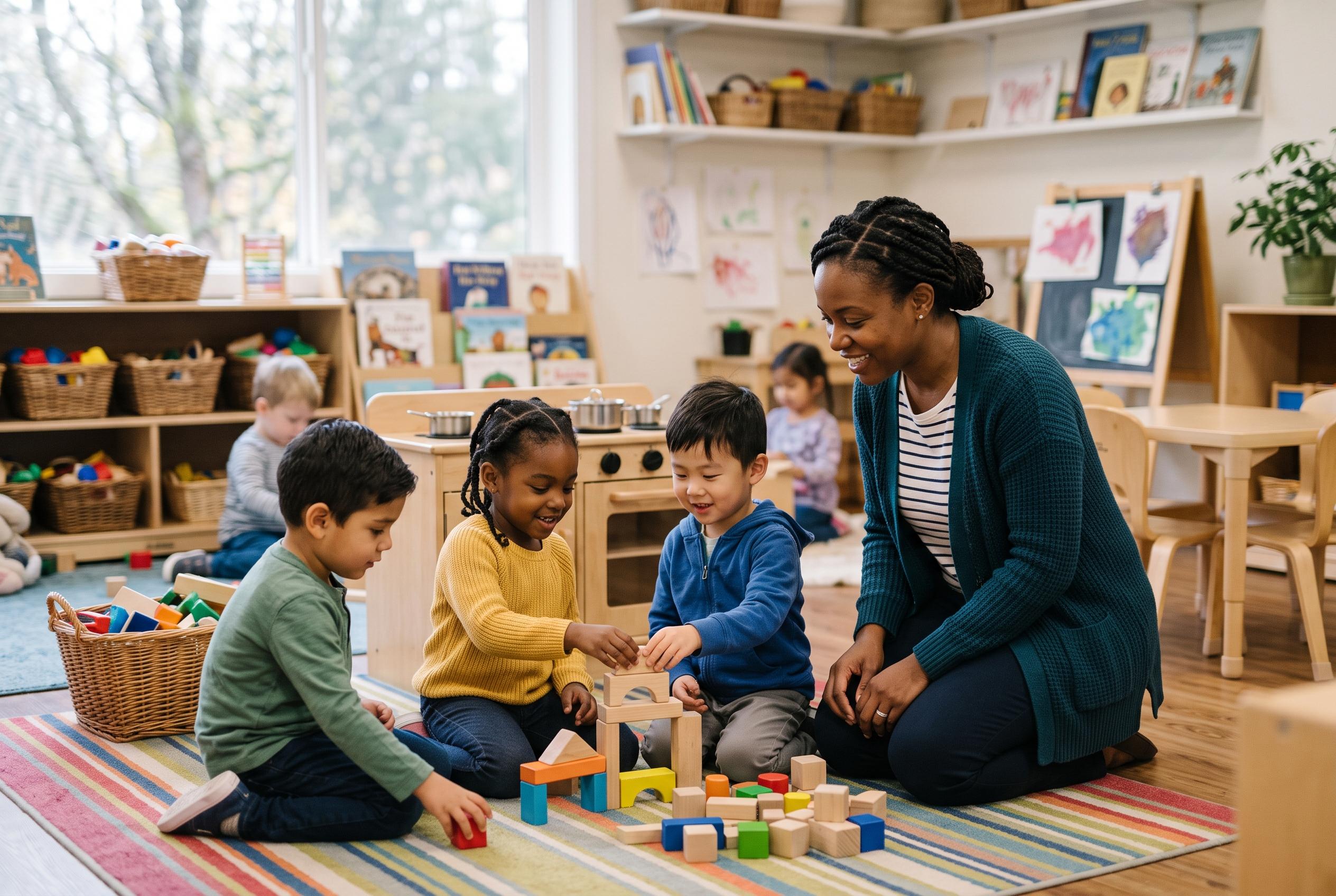

While parents and educators often debate between play and formal lessons in early years, latest research underscores the importance of a balanced, child-led approach that nurtures social skills, emotional development, and curiosity, avoiding premature academic pressure.
Many parents worry that nursery should either focus on play or on school-style lessons, but experts say that is a false choice. The real task of early years education is not to turn preschoolers into first-form pupils, but to help them build the habits that make learning possible: listening, waiting, talking with others, following simple rules and staying with a task long enough to finish it. That approach is increasingly backed by international research, which shows that free play and guided play both matter in early development, while child development specialists stress that emotionally supportive early experiences lay the groundwork for later school readiness. According to the OECD, playful learning helps children understand the world, strengthens curiosity and supports both academic and social development. The American Academy of Pediatrics has likewise argued that all early experiences, whether at home or in childcare, contribute to learning and resilience.
That is why educators warn against treating kindergarten as a miniature school. In practice, children do not need to arrive knowing how to write in copybooks, but they do benefit from having a basic grasp of letters, numbers, space on the page and pencil control. More important still is the ability to work with other children, cope with frustration and ask for help without falling apart. The danger, teachers say, is not only that some children start formal schooling without those foundations, but that others are pushed so hard in advance that they arrive already exhausted by study.
Svetlana Ustinova, a primary school teacher and expert with the presidential platform “Russia – the Land of Opportunity”, said the issue should not be framed as a battle between play and preparation. Speaking in the article, she argued that a good nursery prepares children for school through play, not through drilling. In her view, the best early education helps children learn to hear an adult’s instructions, work in a group, complete a task and follow rules. She also warned that if preschool is stripped of that role entirely, parents end up carrying the burden alone.
Her point is echoed by research on play-based learning. The OECD report says guided play and child-led play are both central to development, while the American Psychological Association has highlighted evidence that imaginative play with an involved adult can improve readiness skills. The Institute of Education Sciences has also noted that guided play can be especially effective for teaching younger children academic content, because adults can shape the activity without turning it into rigid instruction. That matters, because play is not simply downtime; when it is purposeful and supported, it becomes a way to build self-control, language and problem-solving.
Psychologist Yana Chichkanova takes a similar view from the angle of child development. She said in the article that role play is the leading activity in the preschool years, and that it is through play that children develop speech, thinking, fine motor skills and the ability to regulate attention and emotion. She cautioned that parental anxiety can do more harm than a missed worksheet because children absorb the stress of adults around them. In her words, that pressure can push a child into survival mode rather than a learning mode, where curiosity and thinking give way to fear of making mistakes.
The practical warning for families is to watch the child, not the calendar. A child may be tired after a developing activity and still feel satisfied, but tears, refusal, sleep problems, stomach aches or a return to earlier behaviours can be signs that the load is too heavy. The article also points to a South Korean study of 380 children aged three to five, which found higher everyday stress among those who spent nine hours or more in nursery than among those there for seven hours or less. Taken together, the message is clear: school readiness is not about pushing earlier and harder, but about building steadily, with enough play, enough support and enough room for the child to remain interested in learning.
Disclaimer: This content is for informational purposes only and is not intended to be a substitute for professional medical judgment, advice, diagnosis, or treatment.



