

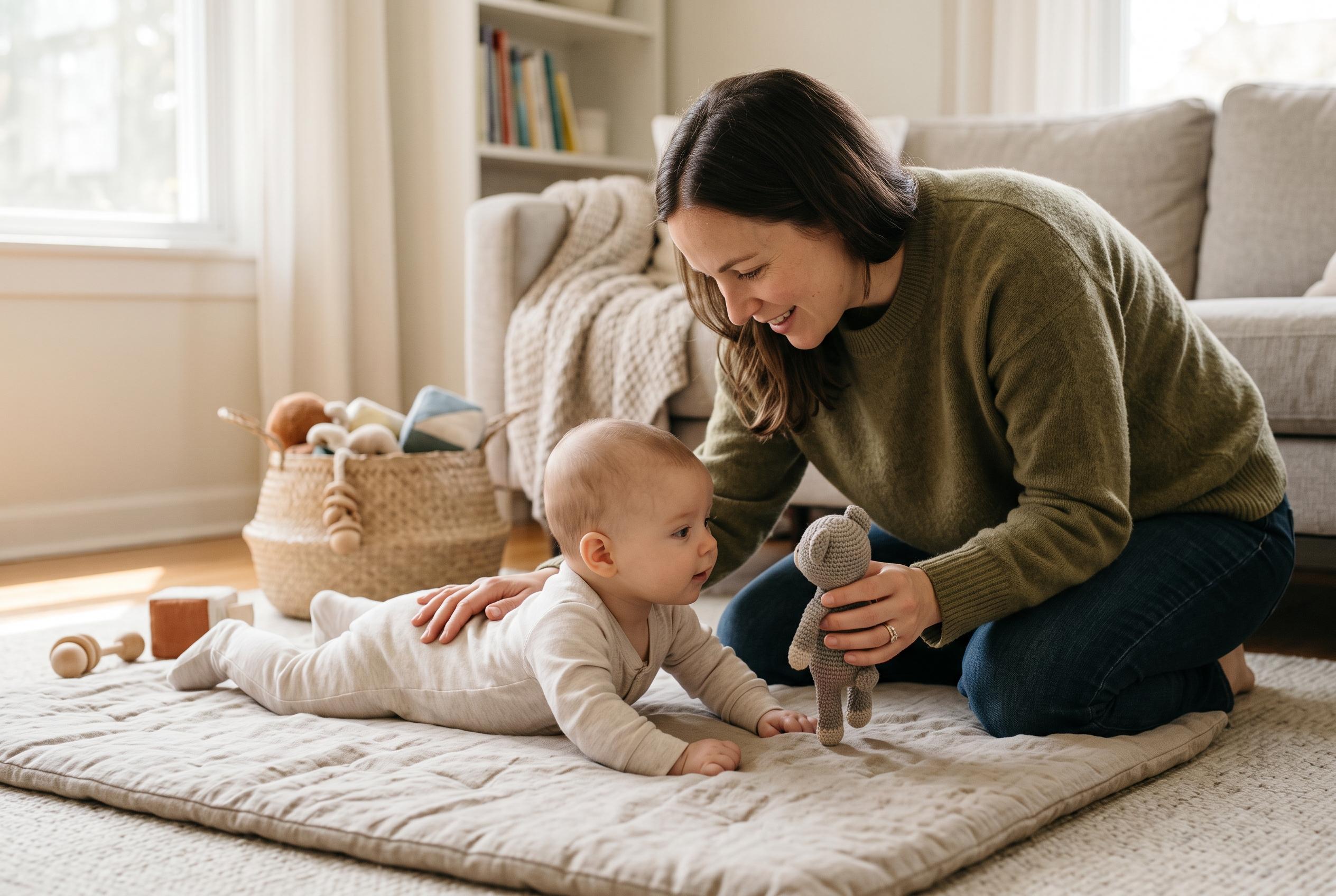

New insights highlight how everyday routines like tummy time, talking, and sensory play can significantly boost a baby’s physical and cognitive development without the need for special toys or packed schedules.
Many new parents worry they are not doing enough to support their baby’s development, but the most valuable learning often happens in the ordinary moments of the day. Feeding, bathing, changing and cuddling are not just care tasks; they are also rich opportunities for connection, language and movement. A baby does not need a packed calendar or specialist toys to thrive. What matters most in the first year is a familiar voice, a responsive face and repeated, loving contact.
One of the simplest ways to support physical development is tummy time. According to the Cleveland Clinic and the National Institute of Child Health and Human Development, supervised time on the stomach helps babies strengthen the neck, shoulders, arms and core muscles they need for later milestones such as rolling, sitting and crawling. It can also help reduce the risk of flat spots on the back of the head. The key is to keep sessions short at first, on a firm surface, and to make them pleasant rather than pressured. Even a few minutes at a time, repeated through the day, can make a difference.
Talking to a baby is just as important as moving with one. Research highlighted by the World Economic Forum suggests that the amount of language a baby hears shapes early brain development, and that back-and-forth exchanges, in which a caregiver responds to a baby’s coos and gestures, are especially useful. In practical terms, that means narrating the day as it unfolds, naming objects, and answering babbles as if they were a real conversation. It may feel one-sided, but babies are learning the rhythm of speech, attention and turn-taking long before they can form words of their own.
Games such as peek-a-boo and simple nursery rhymes do more than entertain. Peek-a-boo helps babies begin to grasp that people still exist even when they cannot be seen, an early step in understanding the wider world. Singing and rhymes add repetition, melody and pattern, all of which support language and memory. Action songs also bring in touch and movement, which can make the experience even more engaging. For many families, a familiar song at nappy changes, bath time or bedtime also gives the day a reassuring structure.
Everyday routines can become sensory play with very little effort. Bath time offers warmth, splashing and sound, all of which stimulate a baby’s senses, while board books introduce images, colours and the sound of a caregiver’s voice. A short read before bed, even if the baby is too young to follow the story, can still support bonding and early language exposure. The same applies to mealtimes, nappy changes and winding down at the end of the day: small, repeated moments create a sense of safety and predictability.
The best play is often responsive rather than staged. If a baby is fascinated by sunlight on the wall, a spoon in the high chair or the noise of keys in a hand, following that interest helps build curiosity and trust. Experts quoted in the World Economic Forum piece on language development say that contingent interaction, where the adult responds to what the child is doing, helps lay the groundwork for early learning. That same principle applies across daily life: notice, respond and join in when your baby is ready. For tired parents, that is also a useful reminder that there is no need to perform perfectly. A calm voice, a returned smile and a few attentive minutes are already doing a great deal.
Disclaimer: This content is for informational purposes only and is not intended to be a substitute for professional medical judgment, advice, diagnosis, or treatment.



