

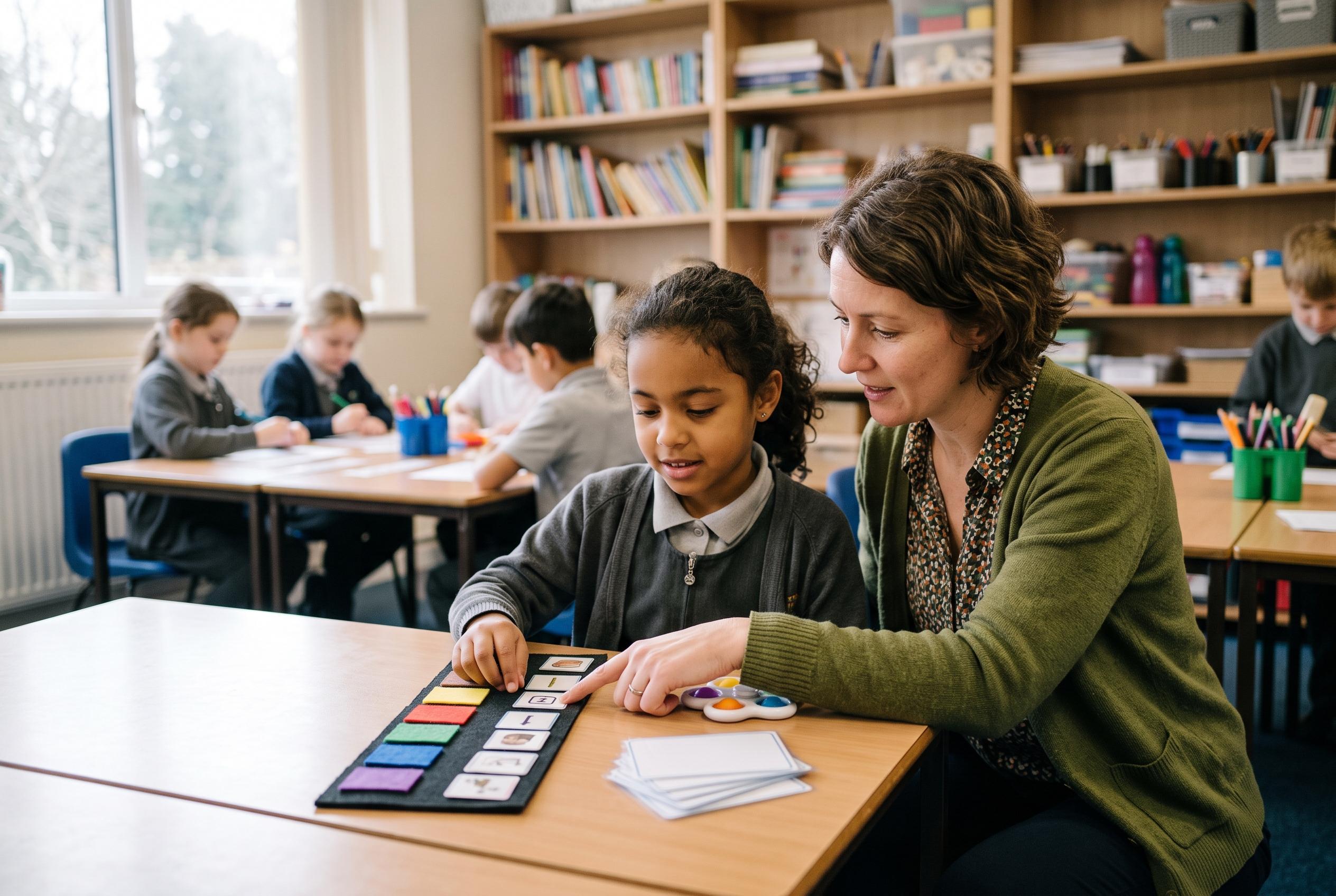

Tailored, small-scale interventions such as visual schedules, task chunking, and movement breaks can significantly improve how children with processing or attention difficulties manage their school day, without added pressure.
Helping a child keep up with the pace of a classroom often begins with a simple question: where, exactly, does the process break down? Some children lose the thread when instructions come too fast. Others understand the lesson but cannot start, cannot finish, or run out of energy long before the school day ends. Educators and parenting guides alike suggest that the answer is rarely to push harder; it is more often to identify the bottleneck and adjust one support at a time.
That distinction matters because a child who appears “slow” may be dealing with slow processing speed, task overload, distractibility, fatigue or a gap in the underlying skill. Psychology Today says children with slower processing speed may seem confused or unable to follow directions, even when they are trying to do exactly that. The practical response is usually to reduce the hidden load: shorter instructions, clearer steps, more time and visual prompts.
At home, the most useful first step is to make the school day visible. A simple written routine, a checklist or a visual schedule can help a child know what comes next without having to hold every transition in mind. Articles from eTutorWorld and other teaching resources stress that parents should work with the teacher rather than guessing at the problem from the kitchen table. If a child is losing time during group work, copying from the board or shifting between activities, that pattern is more informative than a vague sense that school feels hard.
Breaking tasks into smaller pieces is another practical way to restore momentum. Teacher guidance from Pinnacle Blooms recommends chunking work into manageable steps, praising effort and using visual timers or checklists to support persistence. The idea is not to make school easier in a way that lowers expectations, but to lower the amount of organisation a child must manage all at once. For many children, especially those who struggle with attention, this kind of scaffolding turns an overwhelming task into something they can actually complete.
Movement and breaks also matter. Growtale, in guidance on helping children with ADHD follow classroom rules, notes that strategic seating and planned movement breaks can reduce fidgeting and impulsive restlessness. The same principle applies more broadly: a child who is expected to sit, listen and produce work for too long without a reset is likely to slow down, not because they are unmotivated but because their attention and energy are being stretched past a workable limit.
Parents can help most when communication with the teacher is frequent, specific and calm. Rather than asking only whether homework was finished, it is more useful to ask what happened when the child had to start, how long they needed, and whether the difficulty appeared during transitions, independent work or timed tasks. eTutorWorld suggests that families keep the focus on collaboration and on support at school, not just extra practice at home. That may mean a different seat, fewer copied items, a reduced workload or more time for unfinished work later in the day.
It is also important not to overcorrect. Adding a visual schedule, a timer, reward charts and longer homework all at once can create a new burden. Teaching resources for classroom persistence recommend one change at a time so parents can see what actually helps. The same advice appears across guidance for children who work at a slower pace: judge progress by completion, calm and confidence, not by speed alone. A child who is steadily finishing work and feeling less anxious is making real progress even if they are not the first to pack up.
For families, the most effective approach is usually the least dramatic one. Identify the moment the pace breaks, ask the teacher what that moment looks like in class and test one support for a couple of weeks. For some children, that will be extra processing time. For others, it will be a shorter task, a visual cue, a movement break or simply a better way of starting. What helps is usually not a single perfect fix but a sequence of small adjustments that make the day easier to manage.
Disclaimer: This content is for informational purposes only and is not intended to be a substitute for professional medical judgment, advice, diagnosis, or treatment.



