

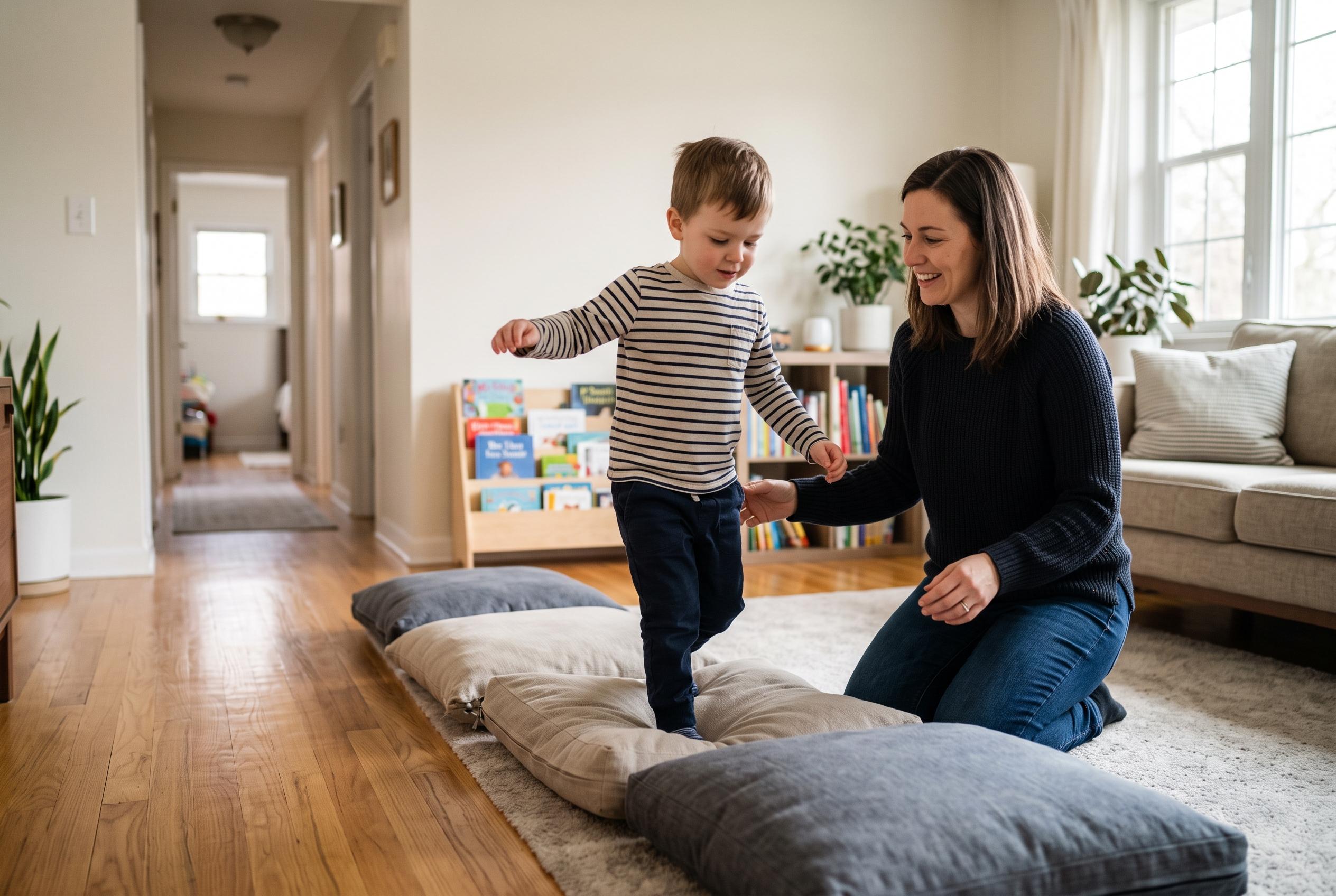

You don’t need a dedicated playroom or expensive equipment to help children develop essential gross motor skills at home. Using everyday household materials and simple routines, parents can create effective indoor activities that promote balance, coordination, and motor planning, supporting children with diverse needs and fostering independence.
Helping children build gross motor skills indoors does not require a dedicated playroom or expensive equipment. The simple, repeatable movements that matter most are crawling, climbing, balancing, jumping and throwing, and they tend to work best in short daily bursts rather than in one long session. The guiding principle is to match the task to what a child can already do, keep the setup predictable and let repetition do the teaching.
Gross motor skills are the large movements that carry us through everyday life: walking, running, hopping, climbing, catching and holding a steady position. The Down Syndrome Resource Foundation notes that these skills underpin independence, strength, endurance and even later fine motor tasks, while children with Down syndrome may face added challenges because of low muscle tone, weaker strength and joint looseness. More broadly, many children with autism, ADHD or sensory processing differences need extra time and support with balance, coordination, motor planning and postural control, which is why indoor movement practice can be especially useful at home.
The good news is that the household materials needed are already within reach. Painter’s tape can turn a hallway into a balance line or hopscotch path, pillows and cushions can become soft steps or a climbing slope, and cardboard boxes can be cut into tunnels. Blogs from Montessori Parent Guide and Creative Children’s Center also recommend simple tools such as rolled socks, balloons, laundry baskets and low furniture, with one important caveat: clear away breakables, check the space for hazards and keep the play area defined so the child knows exactly where the activity begins and ends.
A floor obstacle course is one of the most effective starting points because it combines motor planning, balance, bilateral coordination and spatial awareness in a single route. Tape lines, a low crawl-under section, a cushion step and a cardboard tunnel can all be arranged in a straight line and demonstrated once before the child tries them. From there, the course can be made easier by shortening the route or widening the tape, or harder by narrowing the path, adding a turn or asking the child to carry a soft ball. Lowcountry Therapy and Understood both emphasise that repetition matters: these skills improve through practice, not novelty.
Balance work can be as basic as walking along a tape line, stepping carefully between two strips or pausing on one foot near a wall for support. Pillow stacks and cushion climbs add core and leg strength, while balloon batting, sock-ball tossing and other gentle throwing games help with timing and hand-eye coordination because the object moves slowly enough for success. Animal walks, such as bear walks, crab positions and frog jumps, work multiple muscle groups at once, and a short movement dance with the same sequence every time can help children who benefit from predictability. A fort or cardboard tunnel adds crawl practice and spatial awareness, while a calm routine with reaches, squats, turns and side steps can turn movement into something children begin to request on their own.
The biggest mistakes are also the easiest to avoid. Starting too hard, changing activities every few minutes or praising only completion can all get in the way of learning. Creative Children’s Center and other therapy resources advise keeping the task simple, making it repeatable and adjusting the challenge rather than pushing through frustration. If a child refuses, the most useful response is usually to lower the difficulty and offer a choice, not to insist. For children who struggle with strength, coordination or sensory regulation, a small, successful practice session done most days is far more valuable than a perfect-looking workout.
Disclaimer: This content is for informational purposes only and is not intended to be a substitute for professional medical judgment, advice, diagnosis, or treatment.



