

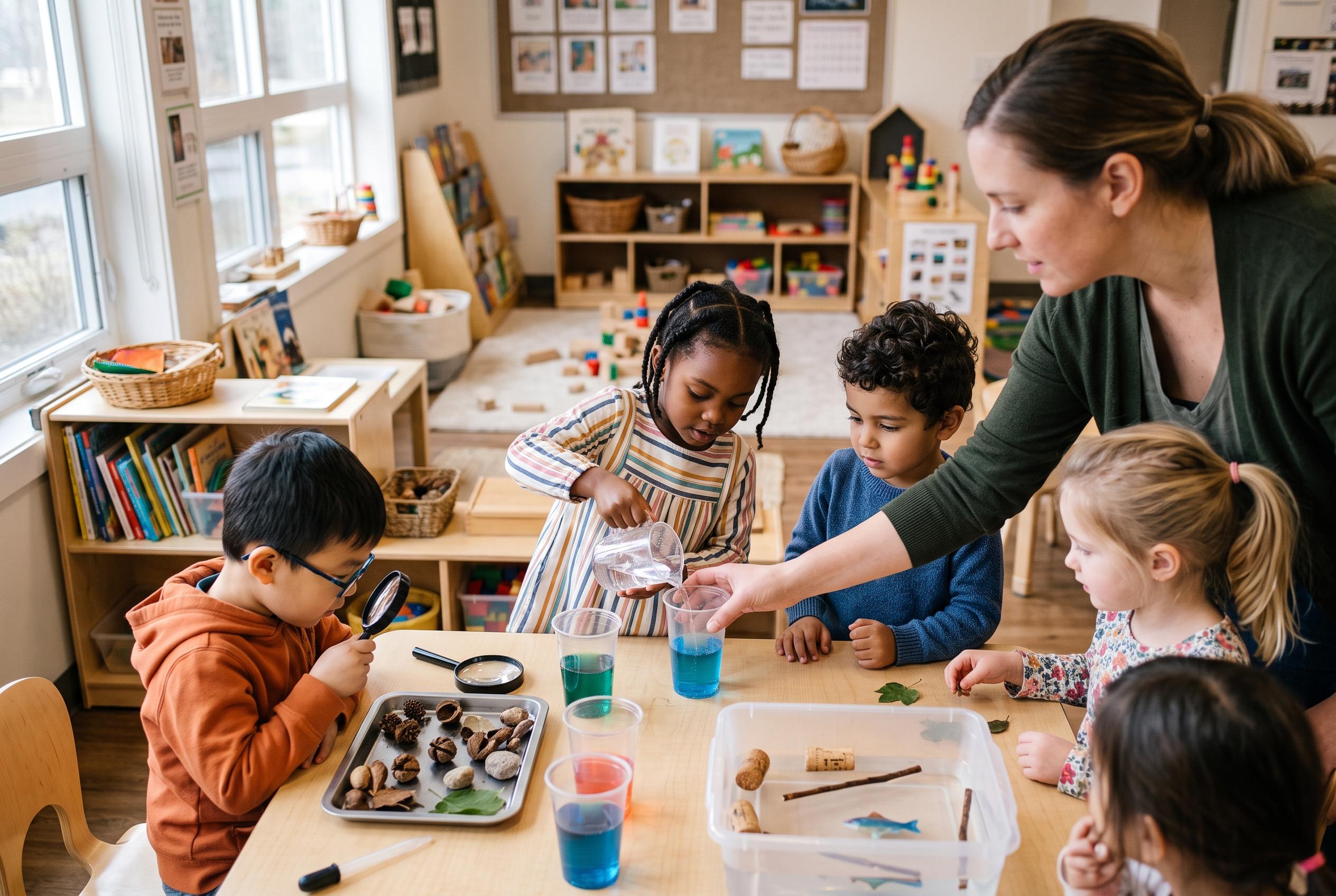

Introducing consistent, practical science activities in kindergarten classrooms enhances engagement, vocabulary, and comprehension by allowing children to explore concepts through concrete experiences and inquiry-based methods.
Many elementary classrooms still squeeze science into the edges of the day, tucked into reading or maths blocks because there is no dedicated time for it. In a kindergarten setting with a separate 45-minute science and social studies block, that opens the door to something more ambitious: regular, hands-on lessons that turn abstract ideas into concrete experiences children can see, touch and discuss. Science Is Elementary and other education groups have long argued that this kind of active learning helps young pupils understand concepts more deeply because they are not simply listening or memorising; they are exploring.
That is the thinking behind a weekly “Mad Science” session, held on either Thursday or Friday depending on the timetable. The routine is deliberately simple. Most of the experiments can be finished in half an hour, using common classroom materials that can be bought in bulk and reused. The value lies not in complexity but in repetition: pupils begin to recognise patterns, make predictions and notice what changes when materials are combined or moved. According to Earthwatch, hands-on science can improve engagement, critical thinking and problem-solving because children see a direct link between what they are doing and what they are learning.
The process also introduces the scientific method in age-appropriate form. Even in kindergarten, children can make a hypothesis, test it and talk about what happened. They can write or draw observations, compare expectations with outcomes and explain their thinking to classmates. Lesson planners who specialise in inquiry-based science say this kind of structure works best when children are given a real question to investigate and enough freedom to gather evidence for themselves. That approach gives the lesson a sense of discovery, rather than reducing science to a worksheet.
Just as important, the classroom atmosphere changes when the lesson becomes physical. Children react aloud, ask more questions and use more language as they describe what they see. That verbal activity matters, because the discussion itself helps build vocabulary and reinforces content knowledge. The Smithsonian’s science education work has also pointed to hands-on STEM activities as a way to make science feel relevant and exciting, while broader education research from LEGO Education and others suggests that build-and-do learning supports retention as well as curiosity. In practice, the teacher still prepares the materials and directs the flow of the lesson, but the pupils do most of the work, including as much of the clean-up as the experiment allows.
Disclaimer: This content is for informational purposes only and is not intended to be a substitute for professional medical judgment, advice, diagnosis, or treatment.



