

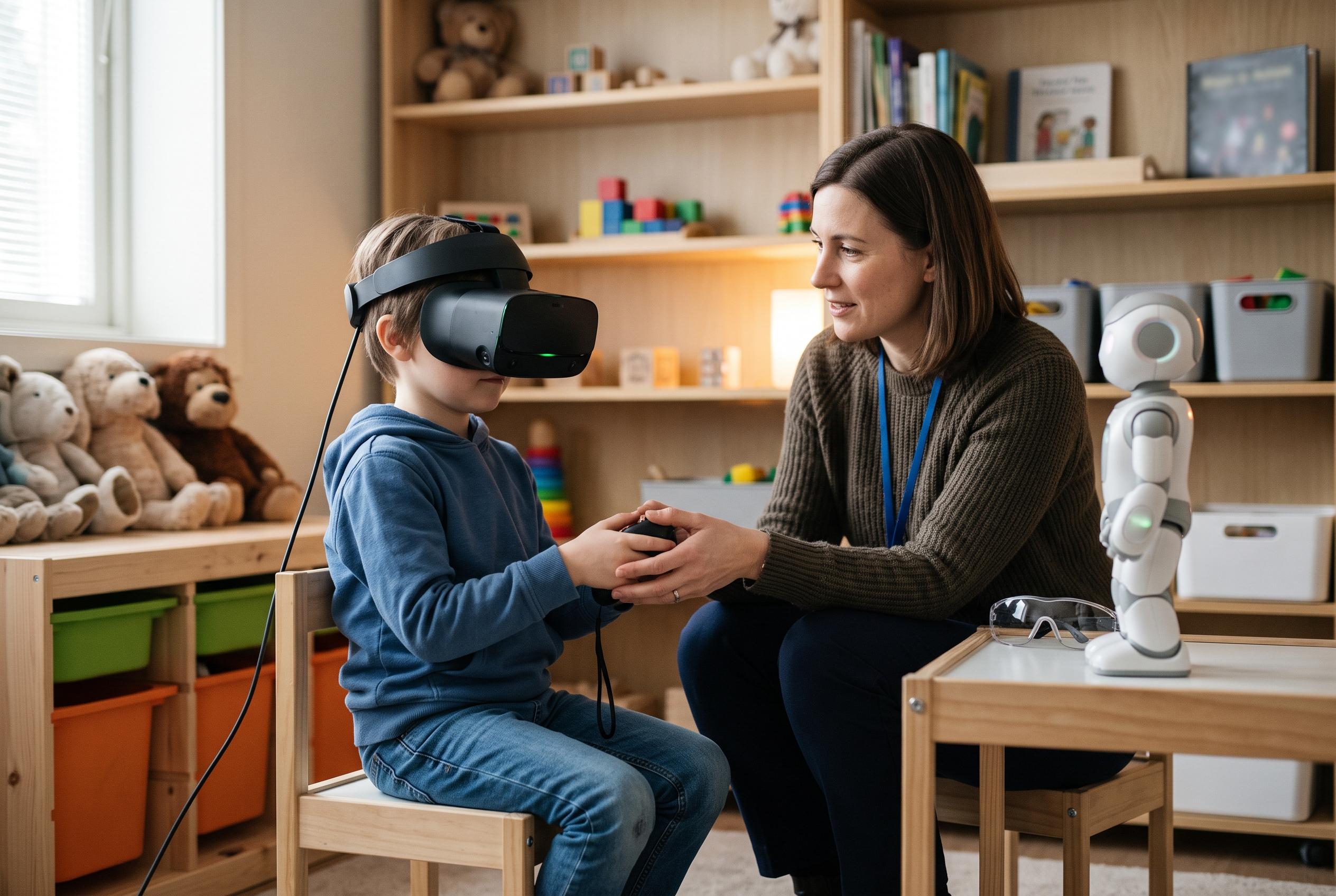

A comprehensive review highlights rapid advances in tech-driven autism interventions, emphasising the need for improved scientific rigour and long-term evidence to confirm their real-world effectiveness.
Technology is moving deeper into autism therapy, but the pace of innovation is outrunning the evidence needed to judge what truly helps. A new scoping review in the Journal of Autism and Developmental Disorders examined 72 empirical studies published between 2019 and 2025 and found a field that is expanding quickly, yet remains fragmented across devices, settings and intervention styles. Rather than grouping studies by gadget alone, the authors organised them by the way the technology interacts with the user, a shift that helps explain why some tools are being studied more often than others and where the biggest gaps remain.
The review divides the literature into four main pathways: extended reality, socially assistive robotics, exergames and embodied-interaction systems, and hybrid or adaptive approaches. Extended reality, which includes virtual and augmented reality, was the largest category, with 25 studies. Socially assistive robots followed closely, with 23. Exergames accounted for 13, while hybrid systems made up 11. That balance suggests that virtual environments and humanoid robots are developing in parallel, rather than one replacing the other. Related research published in 2026 points in a similar direction. A separate study of a tangible social game called “Yum-Yum!” showed how virtual agents and physical objects can be combined to encourage attention, emotional regulation and social behaviour in children with low-functioning autism.
What the technologies are being used to target is just as telling. According to the review, social communication was the most common outcome, appearing in 49 of the 72 studies. Cognitive and executive function measures were also frequent. By contrast, far fewer studies examined daily-living skills or sensory processing, even though both are central to many autistic children’s day-to-day challenges. The imbalance suggests that the field has concentrated on easier-to-measure social and cognitive goals, while leaving more practical domains underexplored. That pattern matters for families, because gains in a controlled study are not necessarily the same as improvements in independence at home or in school.
Across the extended-reality studies, researchers used everything from head-mounted virtual reality to augmented reality tools that superimpose cues onto the real world. Some systems were designed to help children rehearse social situations that would be difficult or overwhelming in daily life. Others embedded cognitive behavioural therapy in virtual settings, or used multi-sensory feedback to monitor performance while training was under way. The appeal is clear: virtual environments let therapists repeat scenarios, control difficulty and reduce unpredictability. Recent commercial partnerships are also pushing the category forward. Virtuix Holdings said in July that it had teamed up with Sirica Therapeutics to use its Omni One platform in immersive autism therapy, and in September it said it was expanding the programme with The LP Foundation for a multi-site pilot due to begin in January 2027.
Socially assistive robotics tells a different but complementary story. The review describes humanoid platforms such as NAO being used to teach imitation, support joint attention and assist minimally verbal children in communication-focused therapy. The researchers behind the review note that robots can provide a level of consistency that human partners cannot always maintain, which may make social interaction feel more manageable for some children. A broader review indexed by PubMed, covering 304 studies from 2001 through 2024, reached a similar conclusion: robots can engage users and elicit new social behaviours, but much of the evidence still comes from short, structured sessions rather than long-term use in ordinary settings. That means the central question is no longer whether robots can attract attention, but whether they can deliver durable benefits outside the lab.
The review also highlights exergames and embodied-interaction systems, which use movement-based play to work on motor skills, executive function and balance. These systems reflect a growing understanding that movement, cognition and social development are closely linked in autism. They also overlap with virtual-reality approaches, which is one reason the authors argue for classifying studies by interaction mechanism rather than by surface technology. A headset, in other words, may be used either for behavioural rehearsal, for movement training or for neurofeedback, and those differences matter more than the hardware itself.
The most advanced but least common approach in the review involves hybrid and adaptive systems that adjust to the user in real time. Only a small minority of studies used closed-loop designs that respond to signals such as brain activity or heart rate variability while the child is training. Those systems include neurofeedback games, wearable EEG tools and mobile augmented-reality programmes. The logic is compelling: if a system can detect when a child is becoming disengaged or distressed, it may be able to change its behaviour instantly. Yet the review warns that these tools are still too opaque and too lightly studied to be trusted as routine interventions. A 2026 review of artificial intelligence-supported autism therapy reached a similar judgement, saying personalised and adaptive systems are promising but still need far more clinical testing.
The strongest limitation across the whole field is not enthusiasm but evidence quality. Only 18 of the 72 studies used randomised designs, leaving most of the literature vulnerable to bias. The authors also point to a lack of long-term follow-up in real-world environments, where homes, classrooms and clinics pose very different demands from a research lab. Their message is not to slow innovation, but to make it more testable: report methods more clearly, compare studies within the same interaction pathway, and track outcomes over longer periods. For parents, clinicians and researchers alike, the practical lesson is straightforward. The technology may be impressive, but until it is studied more rigorously, its true value will remain only partly known.
Disclaimer: This content is for informational purposes only and is not intended to be a substitute for professional medical judgment, advice, diagnosis, or treatment.



