

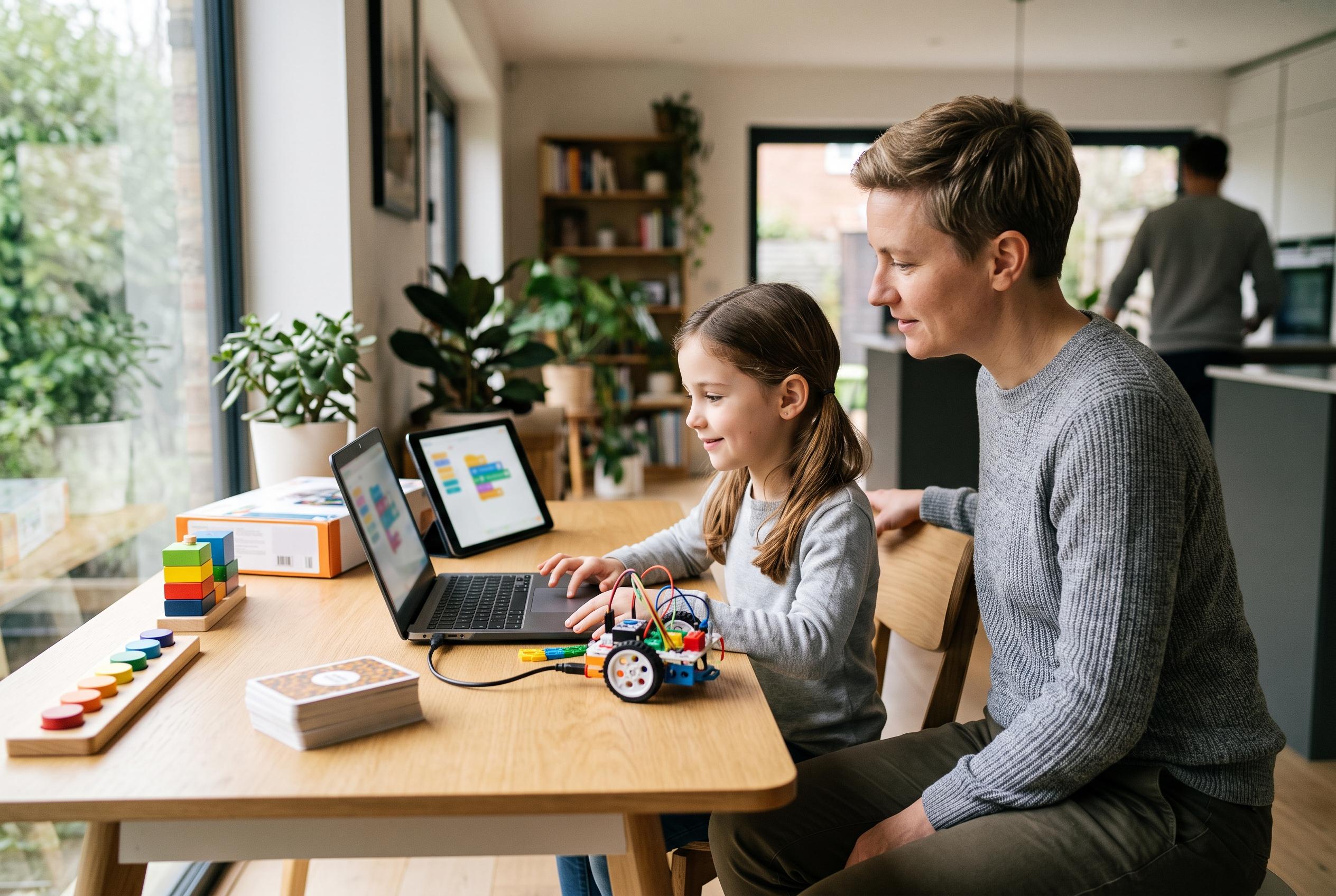

Research shows that children are more likely to stay engaged with coding when projects connect to their passions, progress is visible, and their work is valued, highlighting practical strategies for maintaining interest during early years.
Children are far more likely to stick with coding when it still feels like something they own. The biggest drop-off usually does not come from difficulty alone; it happens when programming turns into routine, imitation and pressure rather than play. When a child can connect code to an interest they already have, see the difficulty rise in manageable steps and show off what they have made, the subject is more likely to stay alive for them.
That pattern matters because interest can fade surprisingly early. Research highlighted by Let’s Talk Science, drawing on the Canadian Youth Science Monitor, found that enthusiasm for science was much higher among 12- and 13-year-olds than among 17- and 18-year-olds, suggesting that curiosity can weaken before the teenage years are over. The same dynamic can affect coding, especially if children begin to see it as an assignment rather than a creative tool. In practice, children often lose steam when they repeat the same kind of project too many times, follow tutorials without room to experiment or are asked to leap from block-based coding straight into a blank text screen with no bridge in between.
The most effective way to keep them going is to make each stage feel like a fresh achievement. That may mean starting with blocks, then moving to text-based languages, and later extending into projects that feel more tangible, such as robots or 3D models. It also means rotating tools before boredom sets in, rather than waiting until a child has exhausted the same format. Several coding educators and family-focused learning guides make the same point: children stay engaged when the challenge is achievable, progress is visible and the work leaves room for creativity. Small wins matter because they create a sense of momentum.
An audience can be just as important as the project itself. Children who know someone will notice what they have built are often more willing to refine it, share it and build something else afterwards. That is why parents and caregivers can help most by treating a child’s work as a real creation, not a worksheet. Ask what they want to build, not just what lesson they are on. Let them remix a project instead of copying it exactly. Most importantly, follow the child’s own obsessions, whether that is a game, a favourite character or a simple story idea. When coding is tied to something they already care about, it is far more likely to become a habit than a phase.
Disclaimer: This content is for informational purposes only and is not intended to be a substitute for professional medical judgment, advice, diagnosis, or treatment.



