

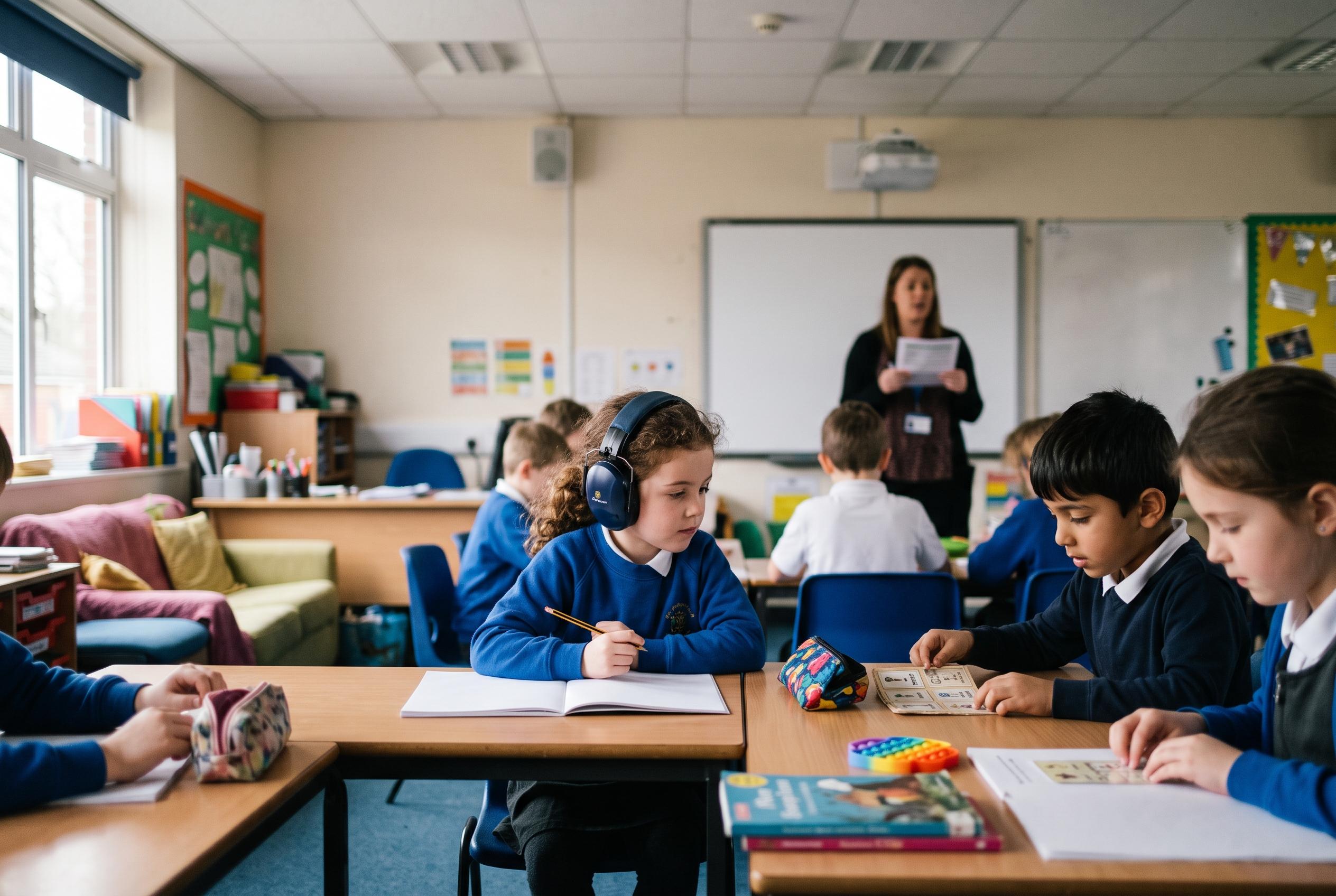

With over 1.8 million pupils in England now identified as having special educational needs, experts warn that poor acoustic conditions in classrooms significantly impact their learning, wellbeing, and fatigue levels, prompting calls for improved soundproofing and targeted support.
More than 1.8 million pupils in England are now recorded as having special educational needs, according to the Department for Education’s January 2026 school census. That is roughly one in five children in the classroom, and it includes large numbers of pupils with autism, hearing impairment and speech and language difficulties. For many of them, the daily problem is not only what is taught, but the environment in which it is taught. In ordinary classrooms, background noise can make learning far harder than it is for their peers.
The issue begins with the room itself. Hard floors, high ceilings, large windows and lightweight partition walls all reflect sound, which means noise lingers and builds up. For pupils who already struggle to process speech, that acoustic clutter can make even a familiar lesson exhausting. The American Academy of Audiology has noted that hearing technology does not solve this problem on its own, because hearing aids amplify the whole soundscape, not just the teacher’s voice. In a busy classroom, that can mean the projector, chairs, corridor chatter and heating systems are all heard at once.
Research in the American Journal of Audiology has found that children with hearing loss can experience repeated difficulty understanding speech in noisy, reverberant classrooms, and that the strain contributes to fatigue. Another study in the same journal linked poor acoustic conditions with listening difficulty and tiredness in children with and without hearing loss. The practical effect is cumulative: the longer a child has to work to decode speech, the more energy they burn simply trying to keep up.
Autistic pupils can be affected in a different but equally serious way. Sensory differences are part of the diagnostic picture for autism, and research suggests auditory sensitivity is one of the most disruptive forms. A 2016 study by Howe and Stagg found that autistic pupils in mainstream secondary schools often struggled most with sound-related barriers, from bells and conversations to the noise of dining halls. What can look like avoidance or defiance is often a sign of overload, with some children covering their ears, withdrawing or refusing to enter noisy spaces because the sound around them has become physically overwhelming.
Children with speech, language and communication needs face their own barrier in rooms where sound bounces around. For them, clarity matters as much as volume. Reverberation blurs words, making it harder to follow instructions, build vocabulary and join in discussion. A study by Wålinder and colleagues found that classroom noise levels between 59 and 87 dB were associated with fatigue and headaches, underlining how quickly a noisy setting can tip vulnerable pupils from coping to struggling. When that happens day after day, the result can be anxiety, school avoidance and wider gaps in learning.
Schools can make meaningful changes. The first step is awareness: teachers who recognise that a child’s restlessness or withdrawal may be a response to noise can adjust seating, timing and group work more effectively. Acoustic treatment is the bigger fix, with wall and ceiling panels reducing reverberation and improving speech clarity. Quiet breakout areas, better scheduling for demanding listening tasks and advice from specialists such as Teachers of the Deaf can also help. With more than 1.8 million pupils in England now identified as having special educational needs, the case for better classroom acoustics is no longer niche. It is a basic part of making education accessible.
Disclaimer: This content is for informational purposes only and is not intended to be a substitute for professional medical judgment, advice, diagnosis, or treatment.



