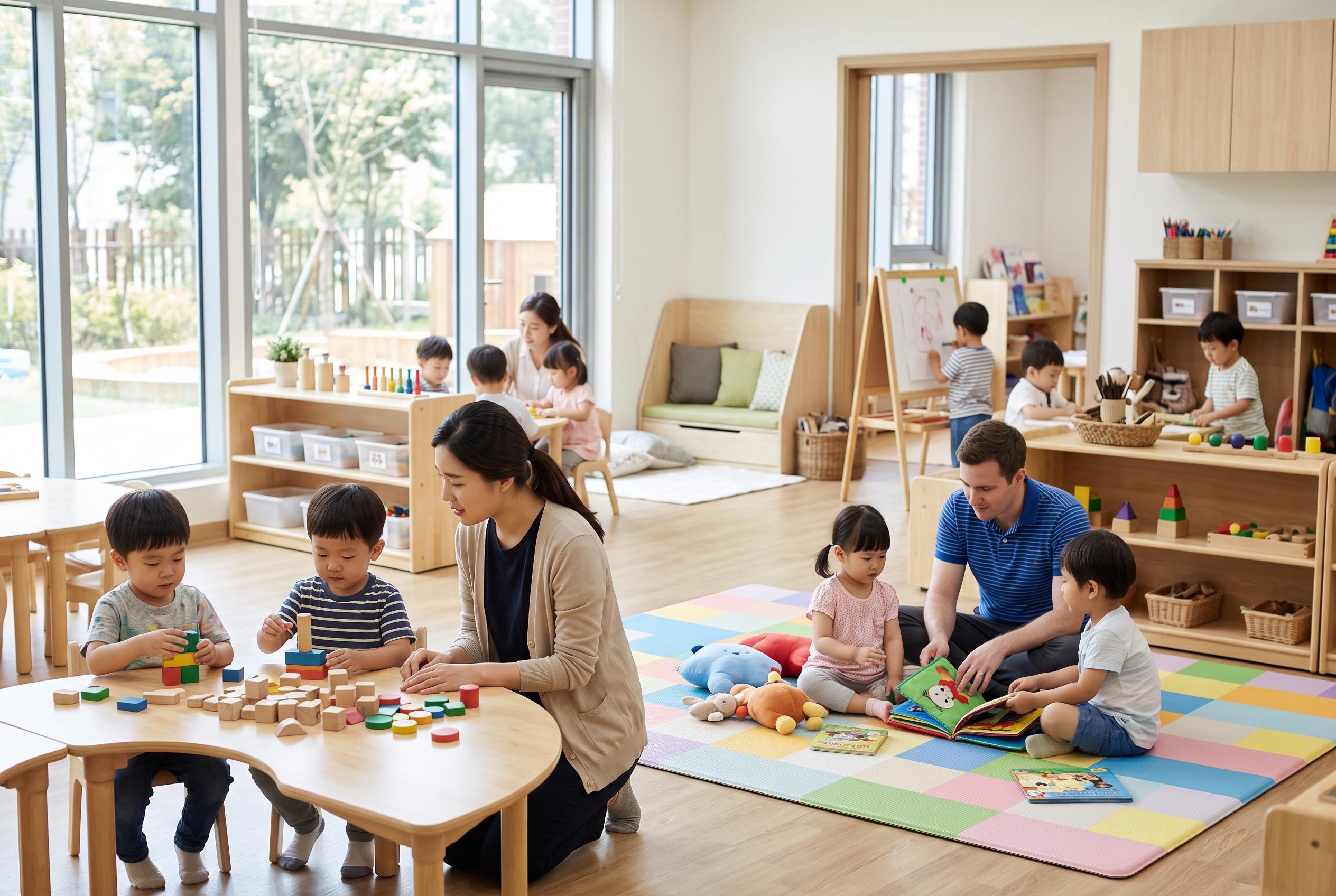

South Korea plans to raise early childhood education and care spending to 10 trillion won next year, expanding free education for children aged three to five and improving nursery staff-to-child ratios, as part of broader government reforms to enhance childcare services.
South Korea plans to raise spending on early childhood education and care to 10 trillion won next year, up from 9.3 trillion won this year, as it moves to widen free education and care for children aged three to five and improve staff-to-child ratios in nursery rooms.
The expansion was outlined on Tuesday during a visit by finance minister Park Hong-beun to Manri Childcare Centre in central Seoul, where he joined a class and met parents, teachers and centre staff. According to the ministry, the visit was intended to explain the government’s proposed 2027 budget for infants and young children and to gather views from the sector on how additional spending would be felt on the ground.
The government said the free education and care programme, which currently covers four- and five-year-olds, will be extended to children aged three to five. It also plans to use public funds to cover costs that parents still pay out of pocket, including 20,000 won a month for after-school kindergarten activities at public kindergartens, 110,000 won a month for early childhood education fees at private kindergartens, and 70,000 won a month for other necessary expenses at childcare centres.
Staffing changes are also part of the package. The ministry said the ratio improvement scheme will be broadened from infants aged zero to a wider zero- to one-year-old group. In zero-year-old rooms, one teacher will care for two children instead of three; in one-year-old rooms, the ratio will move from one to five down to one to four. The government will cover 80% of the additional wage costs for newly hired teachers and will introduce monthly incentives of 200,000 won for zero-year-old classes and 100,000 won for one-year-old classes.
Teacher pay will rise as well. Monthly allowances for teachers in infant classes will increase from 280,000 won to 300,000 won, while homeroom teachers in older children’s classes will receive 400,000 won a month, up from 380,000 won. Teachers working extended shifts will see their monthly allowance rise from 140,000 won to 150,000 won. The basic childcare fee for children aged zero to two will also go up by 3%, taking parental support for a zero-year-old from 584,000 won a month to 602,000 won.
At the meeting, participants stressed that better meals, safer facilities and a lighter workload for teachers are all needed if childcare services are to improve in practice. Park said the government would keep strengthening the nursery budget to balance investment in education and would prepare the broader unification of kindergartens and childcare centres through closer consultation with interested parties.
Disclaimer: This content is for informational purposes only and is not intended to be a substitute for professional medical judgment, advice, diagnosis, or treatment.