

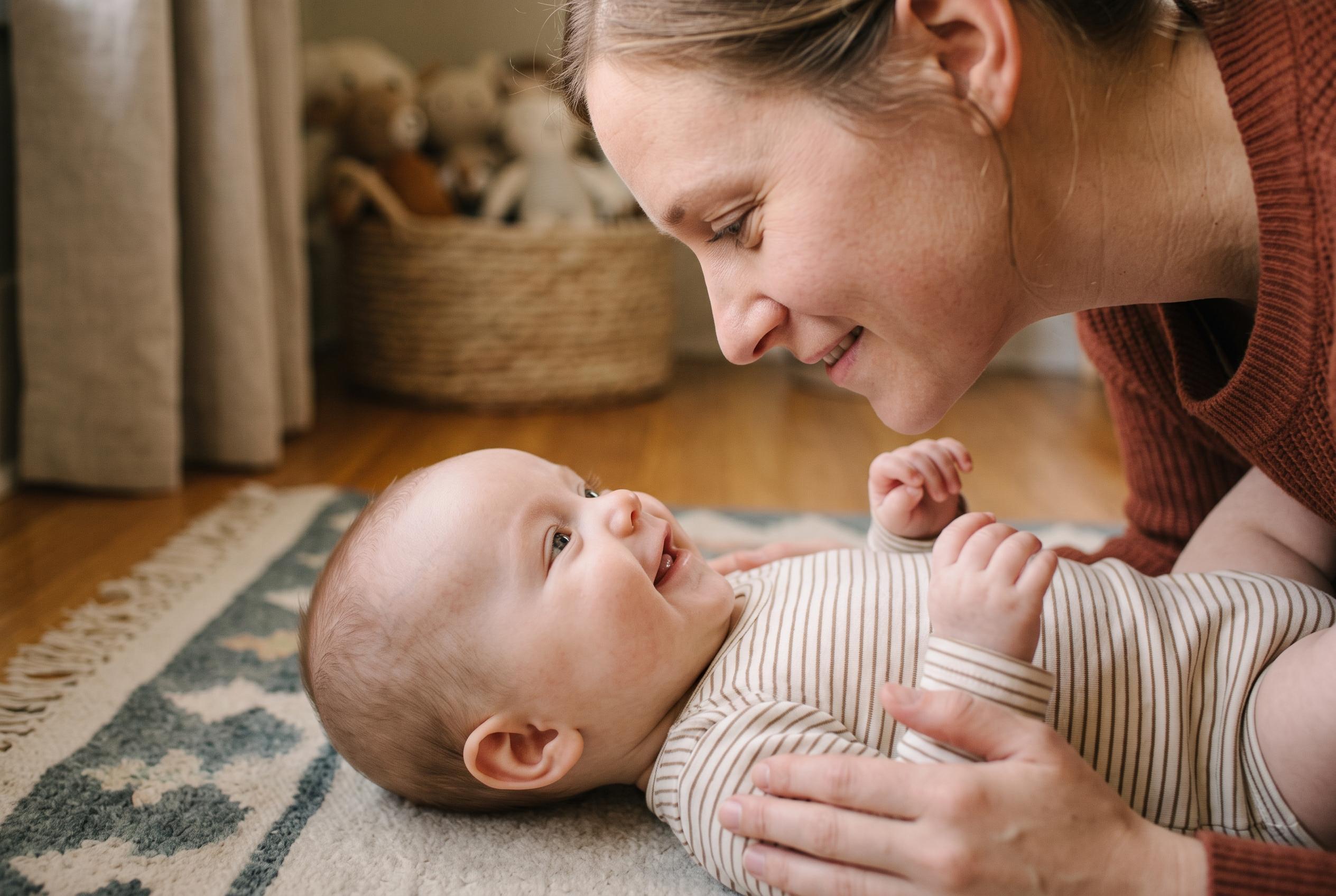

New research reveals that mutual positive exchanges between babies and caregivers not only foster early emotional skills but also build vital physiological systems, with implications for lifelong emotional health.
A baby’s smile may be doing more than expressing contentment. New research suggests that when infants and caregivers share warm, positive exchanges, those moments may help build the physiological systems that support later emotional regulation.
According to a study published in Philosophical Transactions of the Royal Society B: Biological Sciences, researchers tracked the heart rates of nearly 1,000 four-month-old babies while they interacted with their mothers. The team found that respiratory sinus arrhythmia, a measure of heart-rate variability linked to breathing and widely used as an indicator of emotional adaptability, rose during periods when mother and baby were both positively engaged. The increase did not appear when only the infant was smiling or when only the mother showed positive emotion. Daniel Messinger, a professor of psychology at the University of Miami and a senior author of the paper, said the findings point to a physiological role for play and positive social contact in infancy.
The researchers attached sensors to the babies to monitor their heart activity while trained observers coded the interactions in real time, noting whether each pair showed positive, neutral or negative engagement. The study found that the physiological effect was strongest when positive emotion was mutual and sustained, and that it could begin before the shared positive bout was fully underway. When mothers initiated the interaction with a positive expression, the infant’s heart-rate variability remained elevated for longer. The authors argue that these coordinated exchanges may help organise the body’s response systems in ways that support emotion regulation.
A related study in the same journal looked at how infant smiling develops across the first year of life. Drawing on observations of 58 babies at four and eight months, and including mothers, fathers and strangers, the researchers found that adults were more likely than infants to initiate and maintain shared smiling. Even so, an adult smile reliably increased the likelihood that a baby would smile in return. Babies were also more likely to bring a smiling exchange to an end, which the researchers suggest may reflect an early ability to moderate excitement. By eight months, infants were more likely to start smiling interactions themselves and more likely to reciprocate an adult’s smile than they were at four months.
The work also points to the importance of relationship context. Babies at both ages were most responsive to their mothers’ smiles, while strangers tended to elicit more initiating and sustained smiling from adults than mothers did. Earlier studies have likewise found that infants’ heart rhythms and behavioural patterns are more strongly organised in interactions with parents than with unfamiliar adults, and other research suggests that temperament may shape how children respond to different partners. Taken together, the findings reinforce a simple but important message for parents and caregivers: early emotional development appears to be built not just on what babies feel, but on the back-and-forth rhythm of the relationships around them.
Disclaimer: This content is for informational purposes only and is not intended to be a substitute for professional medical judgment, advice, diagnosis, or treatment.



