

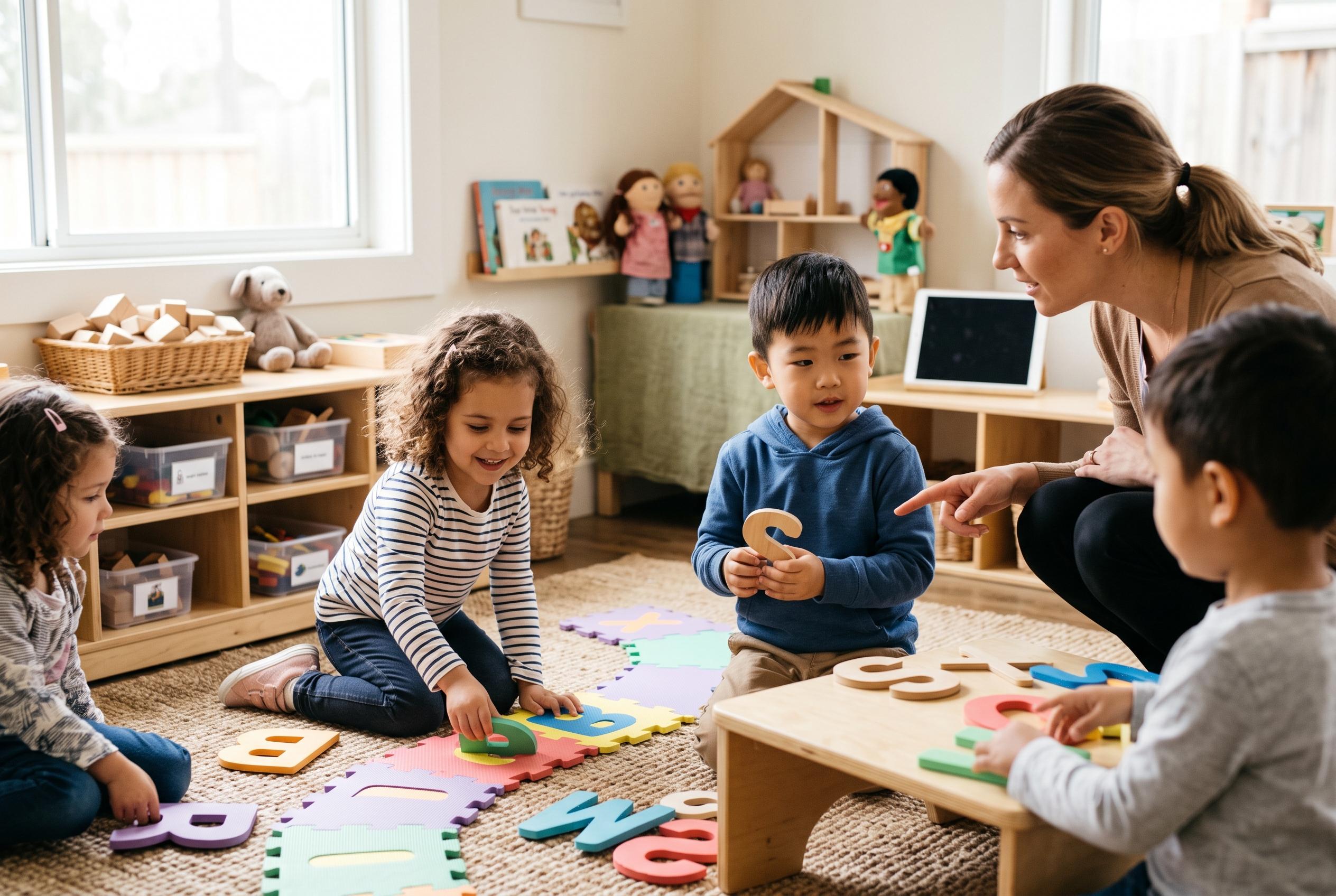

Innovative approaches that link letter learning to children’s interests, movement, and ownership are transforming early literacy education, making it more effective and enjoyable for preschoolers.
Many parents discover that the hardest part of early literacy is not the alphabet itself, but getting a young child to care about it long enough to begin. A child who bolts from the workbook the moment it appears is not unusual. In one household, the turning point came only when letters were tied to what already held a five-year-old’s attention: football, favourite characters, drawing and a small sense of ownership over the tools of learning.
That approach fits what child-development guidance and early-years teaching resources repeatedly suggest: start with what is familiar, keep the sessions short, and make letters feel concrete rather than abstract. Experts at preschool education sites advise beginning with a child’s own name, introducing only a few letters at a time, and using playful activities that involve movement, sound and touch. The aim is not to race through the alphabet, but to help children recognise that letters are everywhere in their daily lives.
Movement can be especially effective. Teachers and parent guides recommend large arm motions, body shapes and “sky writing” because young children often learn best when their whole body is involved. That matters for restless children, who may struggle to sit still for long periods but can happily copy a celebration pose, stretch into a letter shape or hunt for an object that begins with a particular sound. For many preschoolers, the body is the bridge between the idea of a letter and the act of learning it.
Ownership also helps. A pencil, a bag or a workbook chosen for the child can turn letter practice from an instruction into a personal project. That sense of “mine” often matters as much as the learning material itself. It can also reduce anxiety around mistakes. When children know they are allowed to erase, try again and make a mess before getting it right, they are more likely to keep going.
Short, repeated sessions are usually more productive than long lessons. Several early-learning guides recommend predictable routines and small daily doses of alphabet work, rather than one extended sitting. One day a child might trace a letter, the next day find it on a sign or in a picture book, and the following day write it under a drawing. The activity changes, but the letter stays the same. That repetition, spread across different contexts, is often what makes the learning stick.
Uppercase letters are commonly introduced first because their shapes are easier to distinguish, though many programmes now recommend teaching uppercase and lowercase together so children recognise both forms early. Experts also stress the importance of letter sounds, not just letter names, because phonics helps children move from recognition to reading. Developmentally, some reversals are entirely normal at this stage. Confusing b and d, or p and q, is common in the early years and is not usually a sign that something is wrong.
Traced letters can help children understand direction and shape, but tracing should not be the end point. Research from Indiana University found that five-year-olds showed stronger reading-related brain activity after printing letters by hand than after tracing or typing them. That does not mean tracing has no value; it does mean children should gradually move on to writing letters freehand on blank paper once they are ready. The point is to build the motor memory that supports reading and writing, not to keep children permanently in the guided stage.
Digital tools can play a useful supporting role if they are used carefully. Educational apps are most helpful when they are short, ad-free and used alongside an adult rather than as a substitute for direct teaching. The American Academy of Paediatrics advises roughly an hour a day of high-quality screen content for children aged two to five, ideally with a caregiver present. In practice, a good learning app is best treated as one small part of a wider routine that includes conversation, drawing, movement and real-world letter spotting. In other words, the goal is not to force a child into sitting still. It is to make letters part of the child’s world, so that learning begins with interest, not resistance.
Disclaimer: This content is for informational purposes only and is not intended to be a substitute for professional medical judgment, advice, diagnosis, or treatment.



