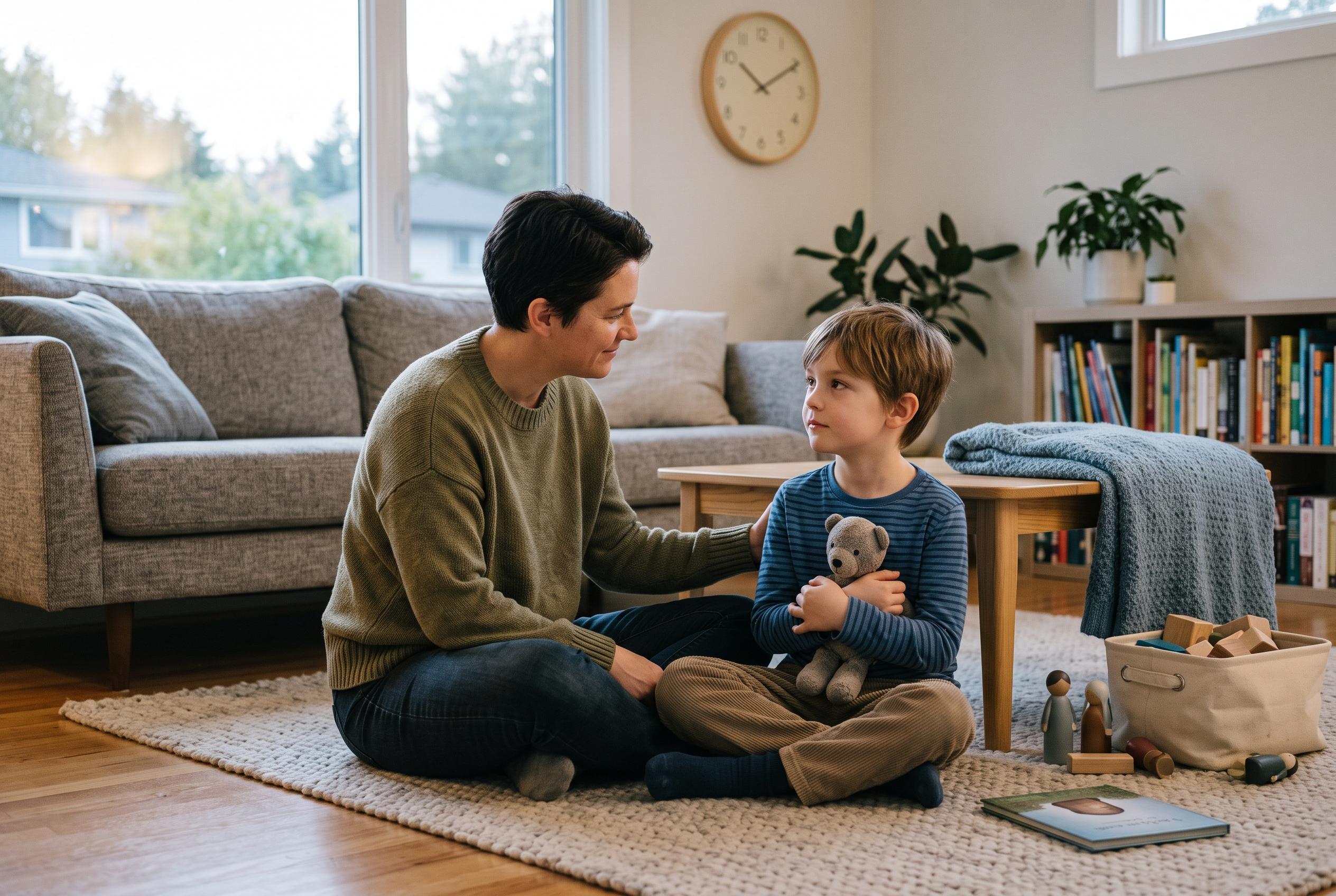

Creating a supportive environment with routine, emotional literacy, and adult modelling helps children face adversity and build resilience, vital for mental wellbeing amidst rising adolescent mental health issues.
When a child lies awake before a school presentation, overwhelmed by nerves, the most useful response is not always the quickest reassurance. A parent who says, “I can see that you are worried. Tell me what is making you nervous” does more than calm the moment. They help the child begin to name the feeling, examine it and move through it. That small exchange captures what emotional resilience looks like in practice: not the absence of distress, but the ability to face it, understand it and recover. Mayo Clinic Press says resilience helps children cope with both small setbacks and larger challenges, while Dartmouth Health Children’s describes it as the capacity to respond effectively to difficulty.
The scale of the need is clear. The World Health Organisation has said roughly one in seven adolescents aged 10 to 19 lives with a mental health condition, and that many mental health disorders begin early in life. That makes the home environment especially important. Children do not need parents to eliminate every hard feeling; they need adults who can create a setting where fear, disappointment and frustration can be acknowledged without shame, and where help is available when those feelings become too heavy.
A secure bond with a dependable adult remains one of the strongest foundations for resilience. Harvard University’s Center on the Developing Child has found that responsive, back-and-forth interactions support brain development as well as emotional and social growth. Other child health experts make the same point in different language: resilient children are usually the ones who know there is at least one adult who will listen, stay calm and keep showing up. That kind of steadiness can be built through ordinary habits such as listening without interruption, keeping promises, reading together or sharing regular meals.
Parents also help children when they treat emotions as information rather than as behaviour that must be shut down immediately. Psychology Today argues that children benefit when adults use accurate feeling words and respond honestly to distress. Naming a child’s disappointment, fear or anger does not mean agreeing with every reaction. It means recognising the emotion before guiding the child towards a better response. Children who are told only to stop crying or toughen up may learn silence; children who hear, “You are disappointed because you wanted this to go well,” are more likely to learn self-awareness and regulation.
There is a fine line between supporting a child and rescuing them from every difficulty. Mayo Clinic Press advises parents to let children experience the consequences of their choices, while Dartmouth Health Children’s warns that overprotective parenting can weaken self-reliance. That does not mean leaving children alone with problems they cannot manage. It means stepping back enough for them to practise solving age-appropriate challenges, whether that is doing a difficult piece of homework, repairing a friendship or recovering after a setback. Each successful effort becomes evidence that they can handle hard things.
Predictable routines can be just as powerful as big conversations. Child Psychiatry Today says resilience grows not only from temperament and biology, but also from supportive environments, sleep, movement and adults who notice distress early. Regular bedtimes, family rituals, time outdoors and clear expectations create a sense of order that helps children absorb disruption. A child who knows what to expect is often better able to tolerate what they cannot predict. In that sense, everyday structure becomes emotional support.
Children also learn resilience by watching how adults handle their own frustration. If a parent misses a deadline, loses patience or has a difficult day, the lesson is not ruined by the mistake. What matters is the repair. Dartmouth Health Children’s recommends that parents model calm and empathy, and Psychology Today notes that children learn from seeing adults deal constructively with hard feelings. When a parent says, “Today was difficult, but I am going to calm down and decide what to do next,” that is not weakness. It is a practical demonstration of recovery.
Positive experiences matter as much as protection from hardship. A 2019 study in JAMA Pediatrics found that favourable childhood experiences were linked with lower odds of depression and poor mental health in adulthood, even after adverse experiences were taken into account. That means resilience is not built only by helping children survive stress; it is also shaped by the presence of supportive teachers, trusted relatives, hobbies, friendships and family traditions that give a child a sense of belonging and competence.
Parents, of course, are not outside the equation. Exhaustion, financial strain and relationship pressure can make patient parenting harder. Child health specialists note that resilience is strengthened when the surrounding adult world is supportive rather than punitive. That is why looking after parental well-being is part of looking after children. A parent who rests, asks for help or seeks professional support when needed is not failing; they are modelling the principle that emotional health deserves attention. The message children need is not “be strong no matter what”, but “feelings can be handled, help is real and setbacks do not last forever”.
Disclaimer: This content is for informational purposes only and is not intended to be a substitute for professional medical judgment, advice, diagnosis, or treatment.