

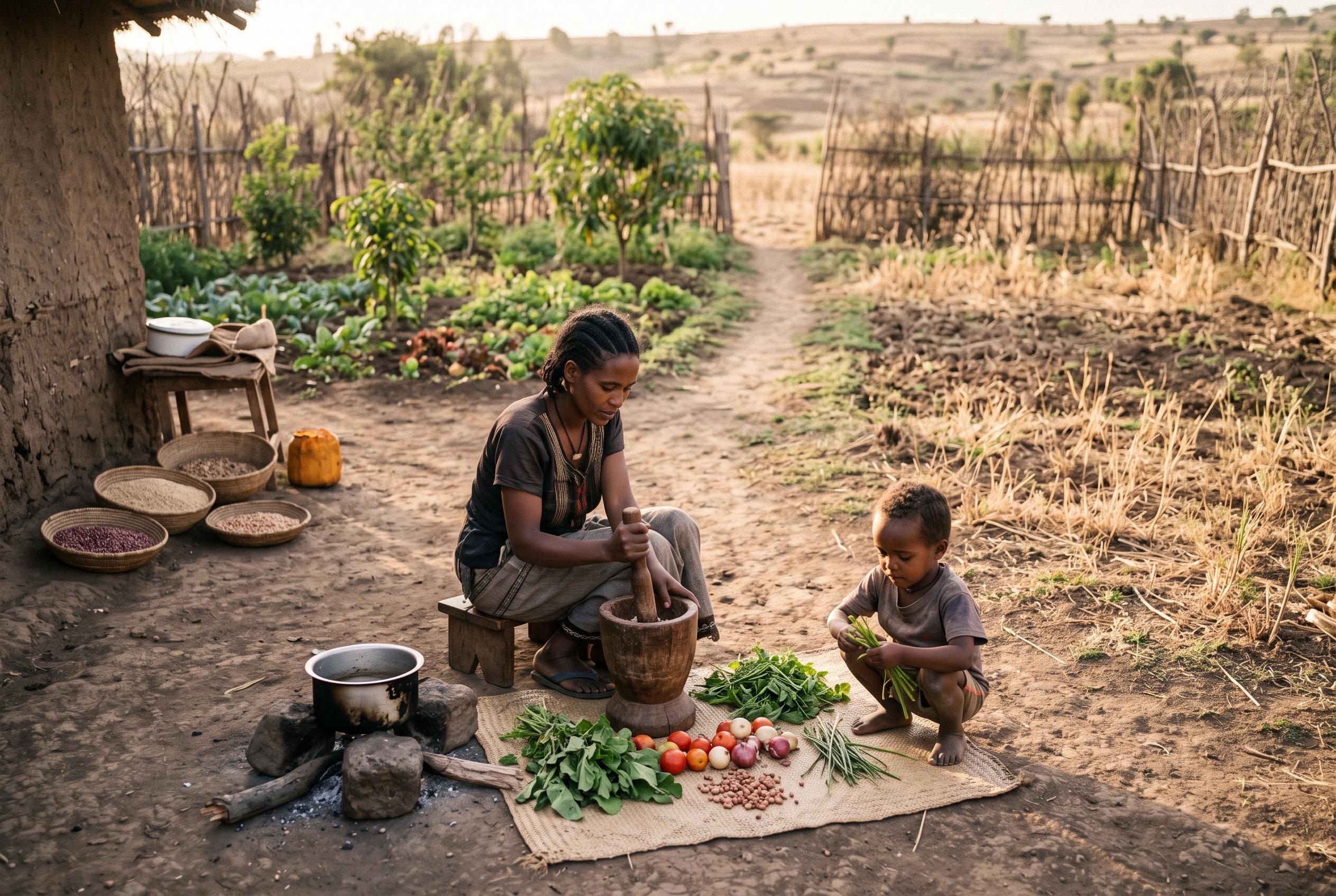

A new study reveals that increasing farm diversity improves dietary intake among women and children in rural Ethiopia, yet seasonal hunger and inadequate nutrition remain significant challenges that require multi-faceted solutions beyond agriculture.
A new study of rural Ethiopia suggests that what families grow on their own land can make a measurable difference to the diets of mothers and young children, but it also shows how far short many households still fall of adequate nutrition. Researchers found that each extra food group produced on a farm was linked with higher intakes of energy and key micronutrients, including calcium, iron, zinc and vitamin A. Even so, diets remained poor overall, and the gains seen after harvest were not enough to erase the deeper problem of seasonal hunger.
The research, published in BMC Agriculture, drew on repeated surveys of more than 500 women and 250 children across five regions of Ethiopia. It compared the pre-harvest lean months with the period after the main harvest, using standard dietary assessment tools adapted to local foods and measured against Ethiopian and international nutrient benchmarks. The result was a clear seasonal pattern: after harvest, more households reached minimum dietary diversity, but the increase was modest and far from sufficient to put most mothers and children on a nutritionally secure footing.
For women, the share meeting the minimum dietary diversity threshold rose from 16.8% before harvest to 25% afterwards. Among children aged 6 to 23 months, the proportion achieving minimum dietary diversity nearly doubled, from 11.8% to 23.3%, while the share meeting a minimum acceptable diet also more than doubled, from 7.6% to 16.5%. Yet the foods driving those improvements were mostly crops households produced themselves. Eggs, meat, poultry, fish, nuts and seeds remained scarce in both seasons, leaving diets heavily reliant on staples, pulses and vegetables.
The nutrient figures were just as stark. Women’s average daily energy intake rose from 1,430 kilocalories to 1,589 kilocalories after harvest, still well below recommended levels. Children’s intake increased from 734 kilocalories to 815 kilocalories, also far short of the guideline cited by the researchers. Calcium was the weakest point for both groups: fewer than one in five women and only 27% of children met adequacy thresholds. The study found that the mean adequacy ratio hovered at about 60% overall, underscoring how much nutritional ground remains to be covered even in better seasons.
The strongest gains were linked to farm production diversity. The researchers reported that each additional food group produced was associated with higher daily intakes of energy, calcium, vitamin A, iron and zinc in women, and with better micronutrient intake in children as well. They also found meaningful differences between farming systems: agropastoral households had the highest calcium intake, highland perennial systems did best for vitamin A, and cereal-pulse mixed systems performed well for iron. But the authors stressed that agriculture alone cannot solve the problem. Distance from markets, poor roads, high food prices and long fasting periods associated with Ethiopian Orthodox practice all limit access to nutrient-rich foods. Their conclusion was straightforward: more diverse farming helps, but roads, markets, biofortified foods and targeted supplementation are also needed if rural families are to escape the cycle of post-harvest improvement followed by lean-season decline.
Disclaimer: This content is for informational purposes only and is not intended to be a substitute for professional medical judgment, advice, diagnosis, or treatment.



