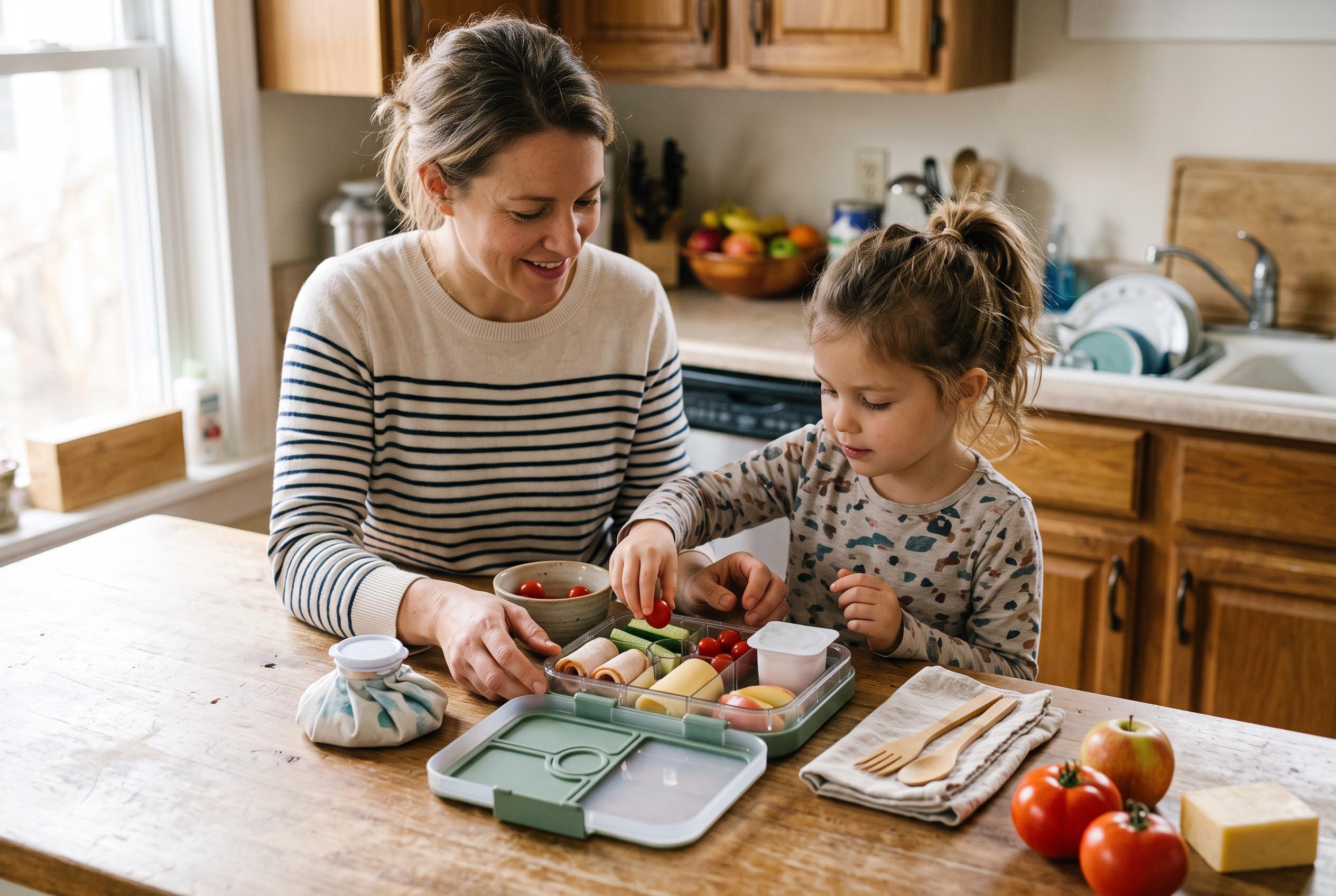

A guide to building simple, familiar, and manageable school lunches that are more likely to be eaten, focusing on repeatability, texture control, and involving children in the packing process.
Packing a school lunch for a child who is fussy about food is less about ingenuity than repeatability. The most reliable approach is usually the least dramatic: choose foods a child already recognises, keep flavours simple, and make sure the lunch still looks and feels right by the time the bell goes. The original article’s central idea is a practical one: a good lunch has to work in the kitchen at 7 a.m. and in the classroom at noon. That means thinking not only about what children are willing to eat, but also about texture, packaging and whether the food can survive the journey. Guidance from the American Academy of Pediatrics also supports the idea that parents often do better by starting with familiar foods rather than chasing novelty.
A useful way to build a lunch is to begin with one accepted main item, add a fruit or vegetable a child already tolerates, and finish with another dependable food. That might mean cheese and crackers, a deconstructed sandwich, yoghurt with cereal, quesadilla wedges or warm pasta. Other lunch guides aimed at picky eaters make the same point in different ways: one should pay attention to whether a child prefers crunchy or soft foods, and whether they are bothered by mixed textures, because many children will happily eat the same ingredients if they are served separately rather than combined. A low-pressure lunchbox is often more effective than a clever one.
That helps explain why some of the most successful ideas are simple combinations rather than full recipes. Turkey and cheese roll-ups, a separated sandwich box, mini bagels with cream cheese, cheese quesadilla wedges and plain pasta all fit the same pattern: familiar food, controlled texture and no unnecessary surprise. The same principle appears in other parenting guides, which recommend cutting food into manageable pieces, keeping wet and dry items apart and building lunches from the few cold foods a child already accepts. Parents are also more likely to succeed when they involve children in the packing process, even in a limited way, because a child who helps choose the lunch is often more willing to open it.
Sandwich-free lunches can work just as well. Yoghurt with dry cereal, waffle strips with berries, a cooked egg with pita, hummus with dippers and a cheese-and-cracker box all offer the same advantage: they can be assembled in advance without depending on a single mixed dish. The key is to protect texture. Dry foods should stay dry, dips should be separated, and anything that softens quickly should be packed as if sogginess is the main enemy. For some children, that matters more than the ingredients themselves. A cracker that remains crisp may do more to get eaten than a more nutritious food that turns limp before lunch begins.
For children who prefer familiar warm foods, macaroni and cheese, buttered noodles with a separate protein, rice and beans, mild soup or a gentle chilli can be sensible options. The important point is that heat control matters as much as flavour. The USDA says cold foods need proper chilling, while hot foods should be kept at 140°F or above, with leftovers reheated to 165°F. That means an insulated container is useful, but not magical. Parents still need to preheat or pre-chill containers correctly, pack foods at the right temperature and make sure the child can open the container without difficulty once they reach school.
When a lunch comes home untouched, that does not necessarily mean the food was wrong. The problem may be time, temperature, packaging, smell, or the simple fact that lunch is different at school. The article’s “7 a.m. versus noon” test is a sensible way to think about this: a lunch should be easy to pack and easy to eat. The Centers for Disease Control and Prevention recommends at least 20 minutes of seated lunch time, after students are actually sitting with their food, which helps explain why some children struggle even with foods they like. A lunch that opens awkwardly or takes too long to unpack may fail for reasons that have nothing to do with appetite.
There is also a broader lesson in current consumer research. A Curion PULSE poll from August 2026 found that parents of children aged five to 13 put a premium on portability, lunchbox-friendly formats and taste their children would accept. That lines up neatly with what many families already know: the parent buys the food, packs the lunch and hopes for the best, while the child decides whether any of it gets eaten. The most practical response is not to keep reinventing lunch, but to build a small rotation of dependable options and repeat them. According to several parent-focused lunch guides, including those that emphasise deconstructed meals, familiar foods and manageable textures, consistency is often more useful than novelty.
A five-day rotation can make the routine easier for everyone. Turkey and cheese roll-ups on Monday, yoghurt and cereal on Tuesday, warm macaroni and cheese midweek, quesadilla wedges on Thursday and a repeat favourite on Friday is not boring if it gets eaten. The point is not to create a lunchbox worthy of applause. It is to send food that a child can open, recognise and manage without a struggle. For many families, that is the difference between a lunchbox that looks impressive and one that actually works.
Disclaimer: This content is for informational purposes only and is not intended to be a substitute for professional medical judgment, advice, diagnosis, or treatment.