

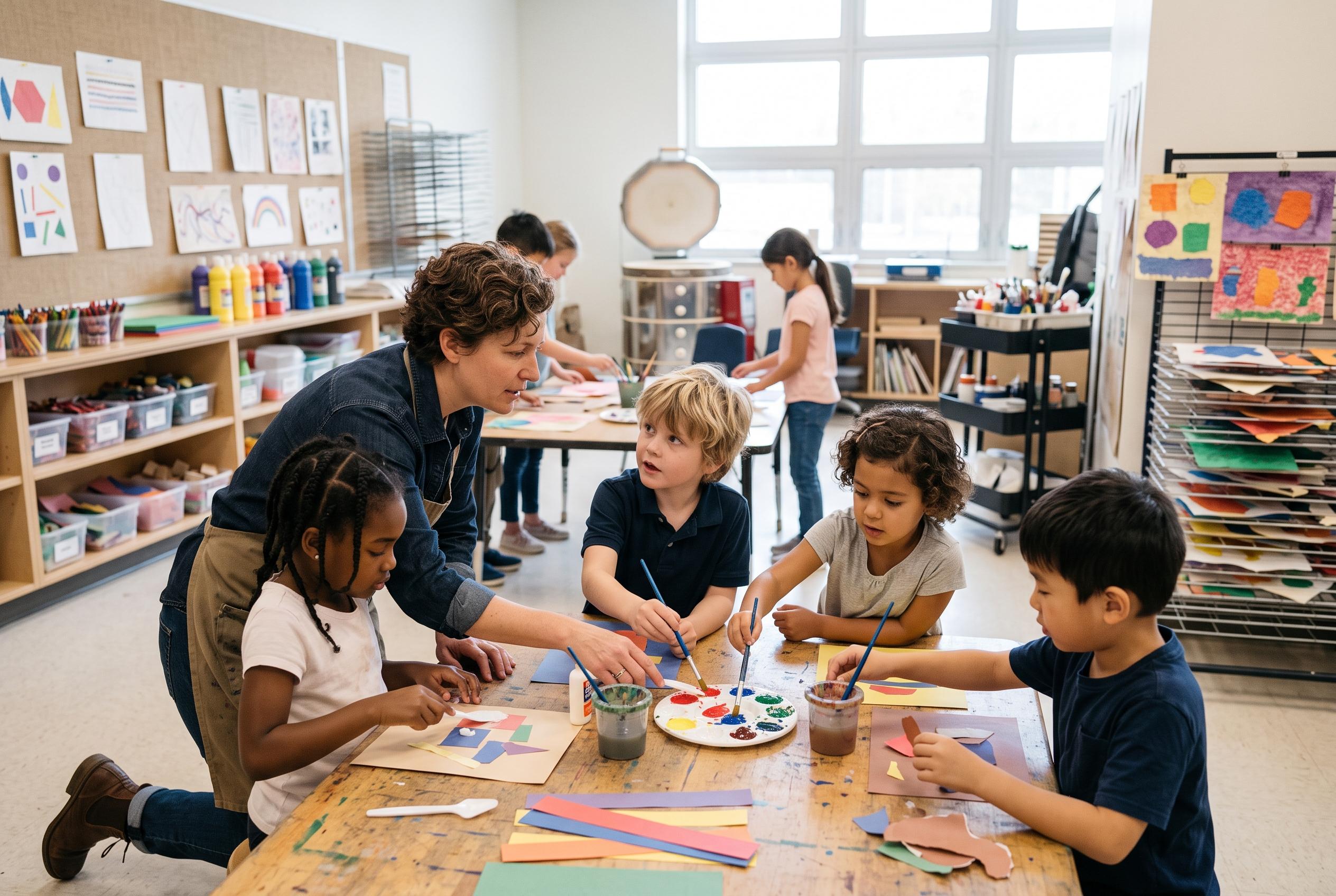

New research underscores the importance of increased access to art in American schools, linking it to improved behaviour, literacy, empathy, and mental wellbeing, amid ongoing struggles with resources and curriculum prioritisation.
Art education is often treated as optional, yet the evidence suggests it is anything but. In many schools, it survives on the margins of the timetable, squeezed out by testing, staffing pressures and tight budgets. Still, research keeps pointing to the same conclusion: when children have more access to the arts, they tend to do better in school and beyond it.
The current picture in American public schools shows both access and scarcity. A federal survey found that most public schools do offer visual arts as a stand-alone subject during the school day, but many provide less than an hour a week. In practice, that leaves little room for experimentation, revision and the kind of sustained making that helps children learn from mistakes. It also matters who is teaching. In a sizeable minority of schools, art is taught by general classroom teachers rather than by specialists, which can limit the depth of the subject and the confidence with which it is delivered.
That shortage sits awkwardly beside a growing body of evidence on what the arts can do. A major Houston study, which followed more than 10,000 students in 42 schools, found that a large increase in arts experiences was linked with better behaviour, stronger writing and greater empathy. Schools that received the extra provision saw a fall in disciplinary incidents, while students also produced better writing scores than peers in the comparison group. The same study suggested that pupils became more attentive to the feelings of others and more willing to help classmates.
Researchers have long argued that the value of art reaches beyond test scores. Elliot W. Eisner’s work on painting and cognitive development described art as a way of changing how children think, perceive and interpret the world. More recent reviews have made a similar point, though with a caution: the evidence base is uneven. A 2016 review of international studies found positive links between arts participation and a range of outcomes, including creativity and useful life skills, while a 2021 systematic review said too much of the research still focuses narrowly on academic measures and uses designs that cannot prove cause and effect. Taken together, the literature suggests that the arts can matter greatly, even if every benefit is not easily captured in a spreadsheet.
That wider value is part of what makes art different from many other subjects. There is rarely a single right answer. Children have to decide what to make, how to make it and how to adapt when the first attempt falls short. In that process, they practise solving open-ended problems, receiving feedback, persisting through frustration and explaining their choices to others. Those are not soft extras. They are core habits of learning, work and relationships.
Art may also help children grow in less visible but no less important ways. Reviews of arts education have linked it with self-confidence, mental wellbeing and creativity, even when gains on standardised tests are less obvious. Other studies have found that early exposure to the arts can shape children’s attitudes towards art itself, making them more open to participation later on. That matters because children are more likely to keep engaging with something they feel confident about and curious towards.
For schools looking to give art more room, the solution does not have to be grand or expensive. Protected time on the timetable is one of the simplest steps. So is specialist teaching, whether through hiring trained art teachers or supporting existing staff with subject-specific training. Art can also be woven into other lessons through drawings of plant cells, models of bridges or illustrated stories. Outside partnerships, such as local galleries, artists and community groups, can add experience and enthusiasm without placing all the burden on schools.
The case for art education is not that it replaces reading, maths or science. It is that children benefit when schools treat creativity, observation and expression as part of a complete education rather than as a luxury. The evidence suggests that more art can improve behaviour, strengthen writing and help children relate better to one another. For parents and educators alike, that makes art less of an add-on than a foundation worth defending.
Disclaimer: This content is for informational purposes only and is not intended to be a substitute for professional medical judgment, advice, diagnosis, or treatment.



