

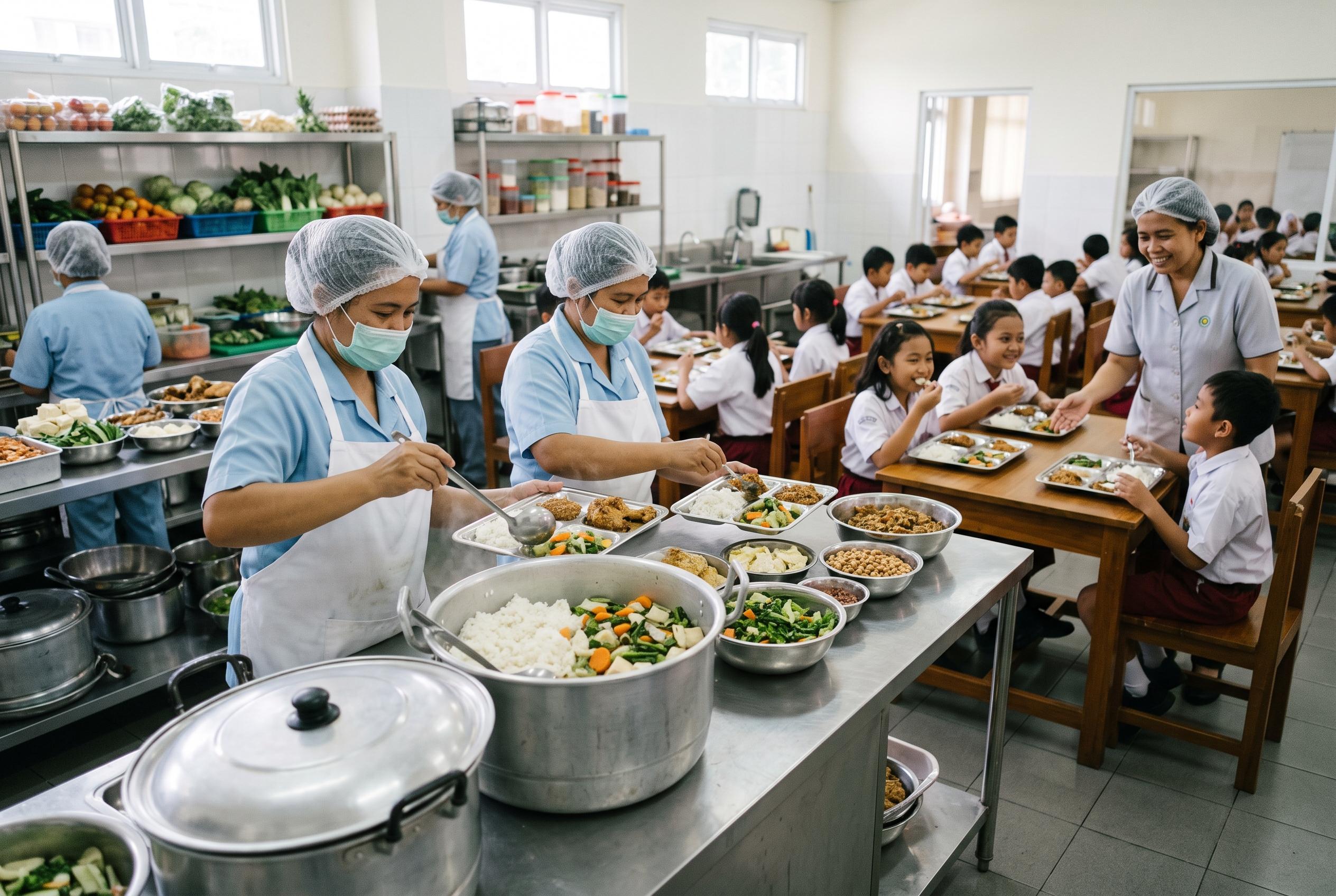

Indonesia is studying Japan’s school lunch system, including kitchen operations and nutrition education, as it aims to expand its Free Nutritious Meal programme and improve food security nationwide.
Indonesia is looking to Japan for lessons that could help strengthen its Free Nutritious Meal programme, as the country expands one of President Prabowo Subianto’s flagship social policies. The National Nutrition Agency, known as BGN, is studying how Japan organises school lunches, from kitchen operations to the wider system of governance that keeps the programme running smoothly, according to ANTARA.
BGN head Sudaryono said after meeting the Japan International Cooperation Agency, or JICA, in Jakarta on Wednesday that Indonesia is trying to understand how different parts of the school meal ecosystem work together. He said the agency is examining not only how food is prepared and served, but also the roles played by schools, teachers, principals, pupils and parents in sustaining the programme.
The interest in Japan is not new. JICA said it has been working with Indonesian ministries since 2024 on school meal-related training, including a programme in Tokyo and Nagasaki that introduced officials to Japan’s long experience of school lunches and nutrition education, known as shokuiku. A further training course in Shizuoka and Aichi in June 2025 focused on meal management, hygiene control and reducing food waste, with participants drawn from the health, education, religious affairs and nutrition agencies.
Indonesia’s engagement with Japan also widened in February 2026, when BGN and JICA held a national seminar in Jakarta on strengthening food security and nutrition education in the MBG programme. JICA said the event drew more than 8,000 participants online and in person, underlining the scale of interest in how Japan runs its school meal system and how those methods might be adapted for Indonesia’s needs.
Sudaryono said Japan’s model is particularly useful because it does not depend on a single delivery method. Alongside school kitchens, Japan also uses central kitchens, where meals are prepared in one place and then transported to schools. He said that approach offers a possible option for Indonesia as it seeks to tailor MBG to local conditions, especially in a country where geography and infrastructure vary widely.
The agency is also studying Japan’s broader philosophy of school meals, which links food provision with nutrition education. Japan’s ambassador to Indonesia said in 2024 that the country’s school lunch system, built over more than a century, is designed not only to improve children’s diet but also to teach them healthy habits that last into adulthood. That emphasis on education, rather than feeding alone, appears to be one of the main lessons Indonesia wants to bring into its own programme.
The MBG scheme was launched in early 2025 and aims to reach millions of beneficiaries nationwide, including toddlers, pregnant women, breastfeeding mothers and school-age children. As the programme grows, BGN has signalled that it is open to borrowing ideas from several countries, including Japan, India and Brazil, in an effort to improve delivery, safety and nutritional impact.
Disclaimer: This content is for informational purposes only and is not intended to be a substitute for professional medical judgment, advice, diagnosis, or treatment.



