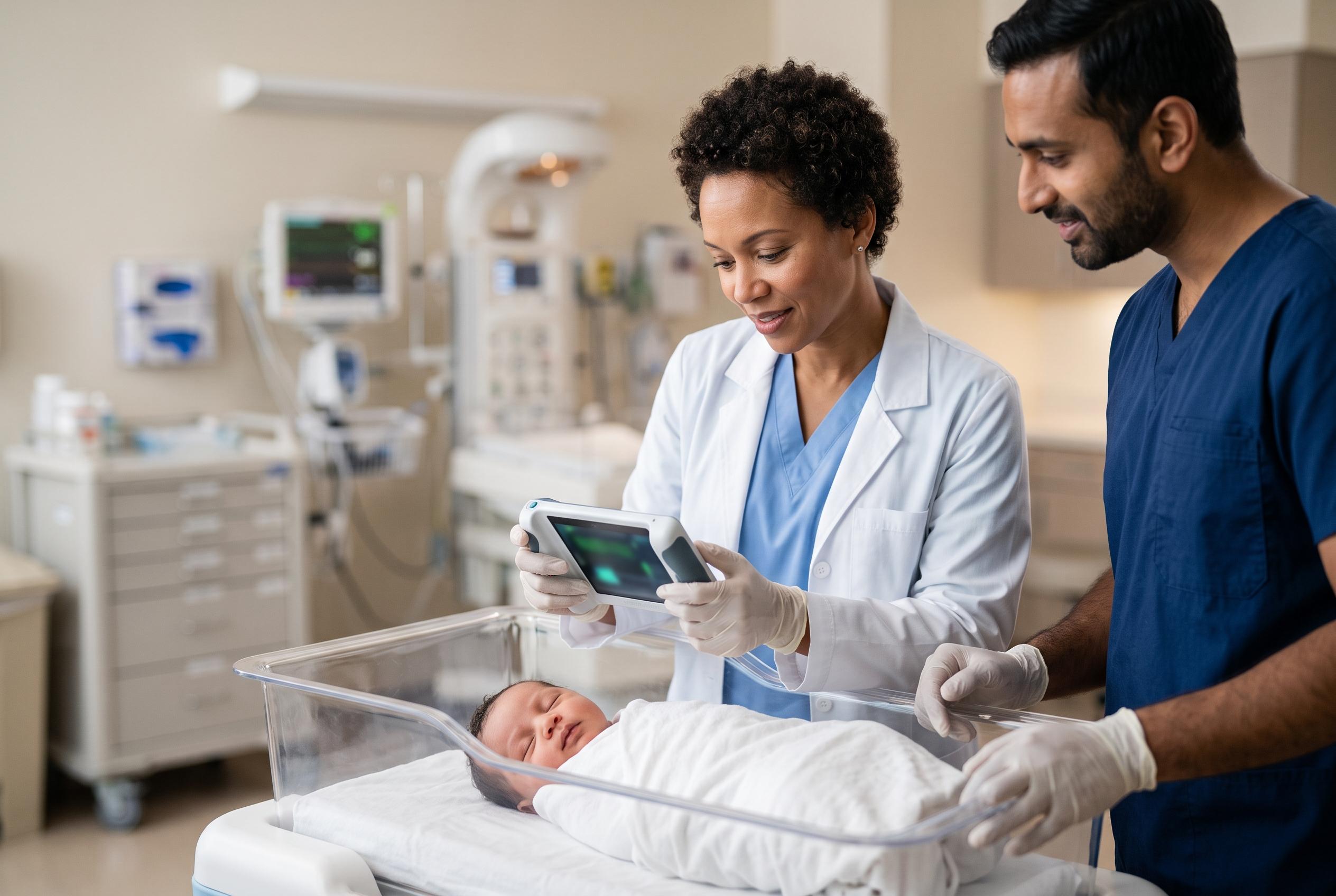

A new machine-learning approach developed in Shanghai demonstrates high accuracy in recognising Prader-Willi syndrome in newborns through facial analysis, potentially transforming early diagnosis and intervention.
Researchers in Shanghai say a machine-learning system could help spot Prader-Willi syndrome in babies far earlier than standard care usually allows, by reading subtle facial patterns that are easy for clinicians to miss in the first days of life. According to a study in Pediatric Research, the model was built at Children’s Hospital of Fudan University and was designed to distinguish affected children from unaffected controls using measurements taken from photographs rather than relying solely on obvious clinical signs. The approach is aimed at a disorder that can begin with little more than poor muscle tone, feeding difficulty and faint facial differences, yet later leads to relentless hunger, severe obesity and lasting developmental challenges.
Prader-Willi syndrome is caused by abnormal expression of genes inherited from the father on chromosome 15. It is rare, affecting roughly one in 10,000 to one in 30,000 births, but early recognition can make a major difference because it allows feeding support, growth hormone treatment and developmental care to begin sooner. That matters because the distinctive features of the syndrome often become clearer only with age, leaving newborns vulnerable to delayed diagnosis. Earlier work, including studies published in the American Journal of Medical Genetics and Annals of Translational Medicine, has already shown that facial analysis can assist diagnosis, especially when the dysmorphism is slight and age-dependent.
The Fudan team, led by Yunqian Zhu and Wenhao Zhou, trained its system on 113 children, including 21 with confirmed Prader-Willi syndrome, using facial measurements such as distances, angles and shape descriptors. They tested several algorithms, among them logistic regression, random forest and AdaBoost, across different feature sets. The strongest results came from the random forest model using the full set of measurements, which reached 97 per cent sensitivity and 95 per cent specificity in cross-validation, meaning it identified almost all affected children while correctly excluding most unaffected ones.
The model also appears to have learnt more than just the syndrome’s best-known facial markers. Age, face width and upper-lip features were among the most influential predictors, but the study also identified four facial traits not previously reported in this condition: jaw symmetry, chin shape, nose width and jaw width. The researchers said those findings suggest the software was responding to real craniofacial structure rather than merely learning age patterns in the dataset.
The most important test came when the model was applied to a separate neonatal group of 10 babies with Prader-Willi syndrome and 13 controls. Because newborn faces are more subtle than those of older children, the team adjusted the decision threshold before testing. After that recalibration, the model picked up 80 per cent of affected newborns and correctly cleared 77 per cent of controls. The researchers also compared the system with Face2Gene, a commercial facial-analysis tool used in genetic diagnosis. On the same newborn images, Face2Gene achieved 70 per cent sensitivity but only 15 per cent specificity, suggesting far more false alarms than the Fudan model.
That gap matters in a screening setting, where too many false positives can overwhelm families and stretch follow-up testing. At the same time, the study’s authors were careful not to overstate the result. The neonatal validation sample was small, and the model still needs testing across larger and more diverse populations, different camera conditions and varying gestational ages. The researchers also stressed that facial analysis would not replace the methylation tests used to confirm Prader-Willi syndrome. Instead, they see it as a triage tool that could direct scarce genetic testing towards the babies most likely to need it. Earlier studies, including work published in the European Journal of Pediatrics and the American Journal of Medical Genetics, have pointed to the same broader goal: making earlier diagnosis possible in syndromes whose signs are easy to overlook at birth. If larger studies confirm the Shanghai findings, facial screening could become a practical first step in newborn care for rare genetic disorders, helping children receive treatment before the syndrome’s most harmful effects take hold.
Disclaimer: This content is for informational purposes only and is not intended to be a substitute for professional medical judgment, advice, diagnosis, or treatment.