

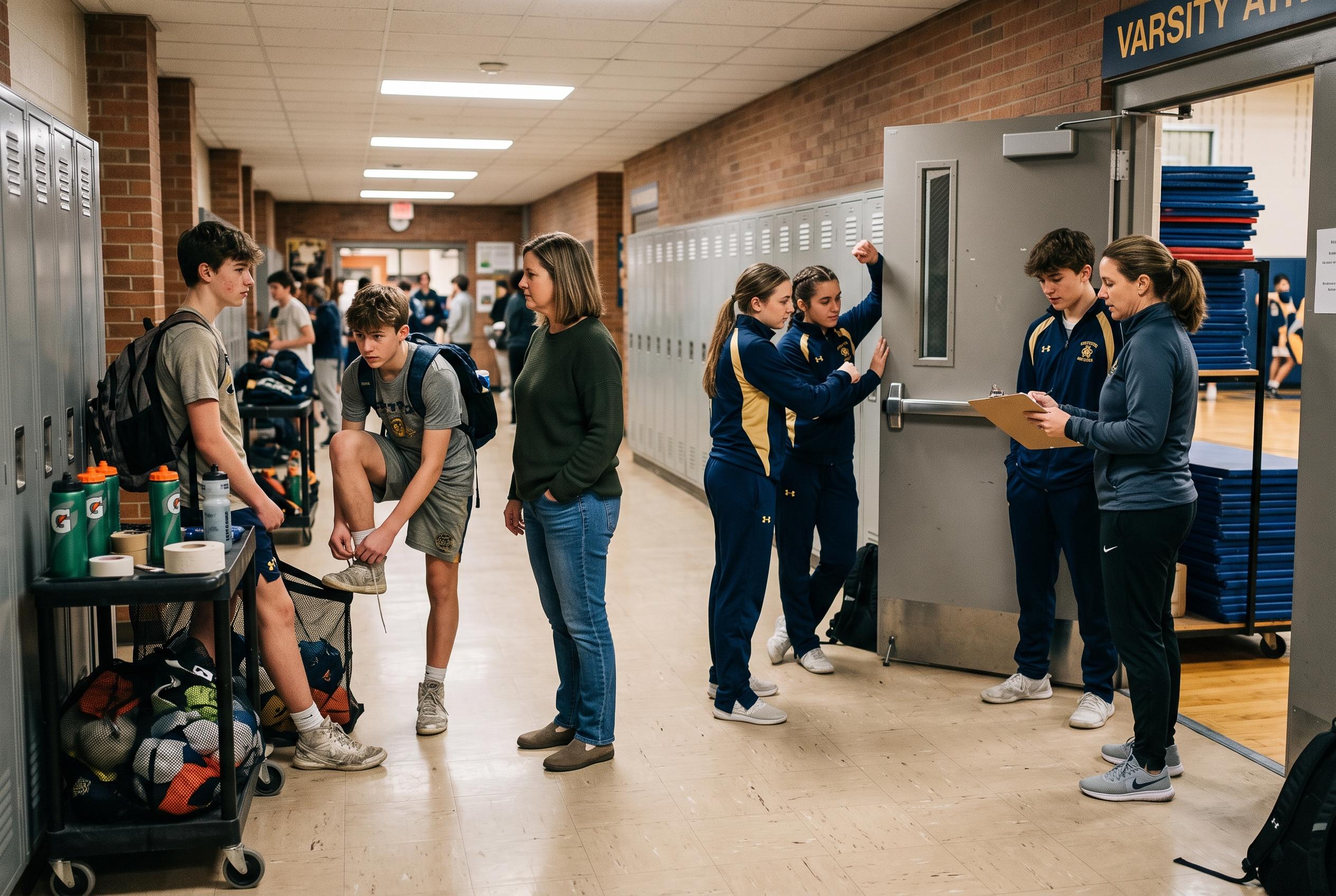

A new study highlights how disparities in varsity sports access among American teenagers perpetuate social divides, revealing the potential of sport to foster belonging and community within schools.
Sports are often treated as nothing more than entertainment, but they also perform a quieter civic role. They give children and teenagers a place to belong, a set of routines to join, and adults and peers who know whether they turned up. In a country worried about loneliness and social fragmentation, that kind of shared experience matters.
That idea is supported by a recent More in Common study on sports fandom, which found that the most devoted fans were far more likely to use sport as a way to meet new people than those with little interest in it. The group also reported more frequent contact with friends and family and lower levels of loneliness. Separate academic research has similarly linked sport participation and attendance at sporting events with stronger social ties, broader networks and a greater sense of connectedness.
Yet the teenagers most likely to benefit from those relationships are often least likely to receive them. A report from the American Enterprise Institute looked at roughly 273,000 Indiana high school students and found marked gaps in varsity sports participation by income, special education status, behaviour and academic performance. After adjusting for school size, 28% of students who did not receive subsidised meals played varsity sports, compared with 14% of those receiving free or reduced-price meals. Students in special education took part at less than half the rate of their peers, and those with a disciplinary incident were also much less likely to make a team.
The strongest divide ran through academic achievement. AEI found that 35% of students whose eighth-grade maths scores placed them in the top fifth of their cohort played varsity sports, compared with 12% of students in the bottom fifth. That pattern undermines the old stereotype that athletics and academic seriousness sit at opposite ends of the school spectrum. It suggests something more complicated: the students who are already most engaged with school are often the same ones who gain access to its most visible activities.
That overlap matters because high school sport can do more than fill an afternoon. Teams can connect teenagers with coaches who notice when something is wrong, peers working towards a common goal and a visible role in the life of the school. Previous AEI research in Indiana found that varsity athletes had attendance rates around 20% lower than non-athletes, and comparisons of attendance during and outside playing seasons suggested the relationship was at least partly causal. Other research reviewed by AEI has associated school sport with college enrolment, degree completion, employment, academic performance and attendance, even if the size of those effects remains uncertain.
The barriers are not simply official fees, because Indiana schools rarely impose formal pay-to-play policies, according to AEI. The problem appears to build up over years through equipment costs, transport difficulties, family work schedules, limited neighbourhood recreation and the expense of youth and travel sport, which can shape who is ready to compete for a varsity place by the time they reach high school. School size adds another layer: students in Indiana’s smallest schools were nearly three times as likely to play varsity sports as those in the largest schools, largely because smaller schools offered more roster spots relative to enrolment.
Taken together, the research points to a broader question than who makes the team. It is about who gets access to the relationships, identity and routine that sport can provide. That suggests schools should think beyond varsity rosters and treat participation as part of the wider job of education. Tracking which students are involved in nothing, expanding junior varsity, freshman and intramural options, and ensuring that every student has access to some sustained activity could help close what amounts to a belonging gap.
The larger lesson is not that every teenager should be placed on a varsity team. Competition is part of what makes sport meaningful. But if schools want to use athletics as a route into community, they need to pay closer attention to who is excluded and why. Sport cannot solve every problem facing education or society, yet it remains one of the clearest ways institutions create belonging: by giving young people something to do together, someone who expects them to show up and a place where their presence matters.
Disclaimer: This content is for informational purposes only and is not intended to be a substitute for professional medical judgment, advice, diagnosis, or treatment.



