

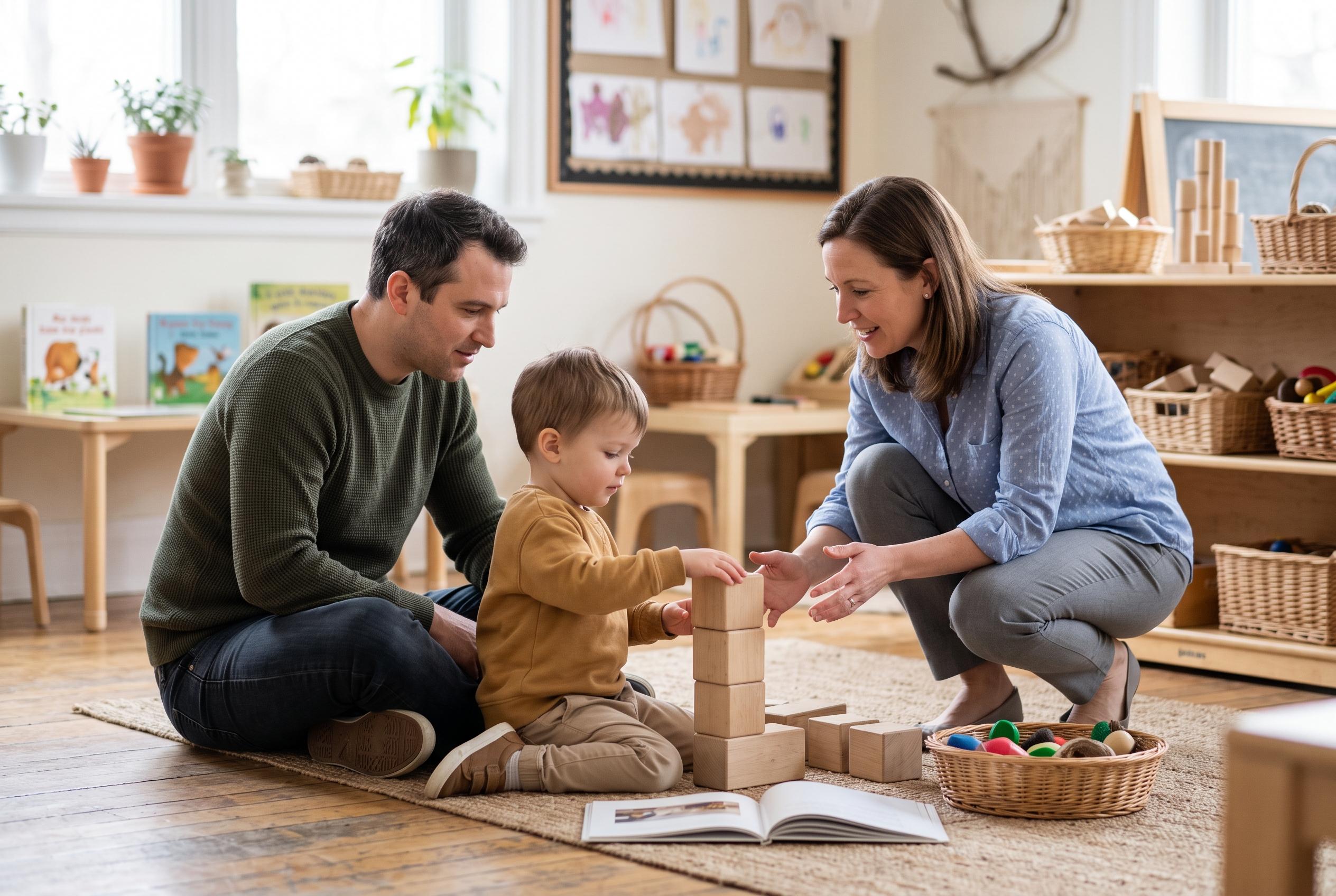

Research reveals that genuine parent-practitioner collaboration, based on shared understanding and mutual respect, is crucial for children’s emotional security and learning, yet practical barriers often hinder meaningful engagement in early years settings.
In early years settings, family partnership is too often judged by what is easiest to count: attendance at events, quick replies to messages, or a visible willingness to engage on the setting’s terms. Yet that can miss the deeper question of whether parents and carers feel recognised as people who genuinely shape their child’s experience. A parent who rarely appears at a coffee morning may still be highly involved in learning at home, while another who is present often may have little real influence on what happens day to day. Research and practice guidance both point to the same lesson: partnership is not simply about contact, but about shared understanding and mutual respect.
That distinction matters because children do not experience home and setting as separate worlds. The Early Years Foundation Stage statutory framework expects providers to work with parents and carers, and West Sussex County Council’s guidance says that children benefit when practitioners and families collaborate on observation, planning and assessment. In other words, families are not just recipients of information; they are sources of knowledge about the child’s language, routines, comforts, recent changes and interests. When that knowledge is welcomed, practitioners can make better judgements and children are more likely to feel that the important adults in their life are on the same side.
The quality of those relationships also shapes what children pick up emotionally. Studies of parent-practitioner partnerships have linked positive collaboration with wider opportunities to support children, particularly where additional needs or disadvantage are involved, and longitudinal research has long suggested that the home learning environment has a significant effect on later attainment. A separate review of interventions in early childhood found that well-structured parent-teacher relationships can support children’s development and learning. The message is not that every interaction must be elaborate, but that consistent, reciprocal contact can help children feel secure enough to take part.
However, the practical reality is more complicated than simply asking families to do more. Research with practitioners in English early years settings found that although parent partnership was widely seen as essential, it was understood and carried out in different ways, shaped by policy pressures, professional experience and each setting’s priorities. Other studies have shown that parents and staff may disagree about how much communication is enough, and may even define engagement in very different ways. That lack of shared language matters, because it can lead services to misread low visibility as low interest, when the real barriers may be working hours, transport, language, disability, digital access or previous bad experiences with education.
For settings, the challenge is to make partnership easier to enter and harder to ignore. That may mean translating information, using voice notes instead of forms, building in flexible meetings, or asking families what the child is doing at home and then acting on that information in the room. It also means making sure families can see the effect of what they share. If a parent’s observation changes how a child is supported, or if home language is welcomed rather than treated as an obstacle, the child receives a powerful message: the people who know me belong here. In that sense, parent partnership is not an optional extra to early years provision. It is part of the conditions that allow children to settle, participate and thrive.
Disclaimer: This content is for informational purposes only and is not intended to be a substitute for professional medical judgment, advice, diagnosis, or treatment.



