

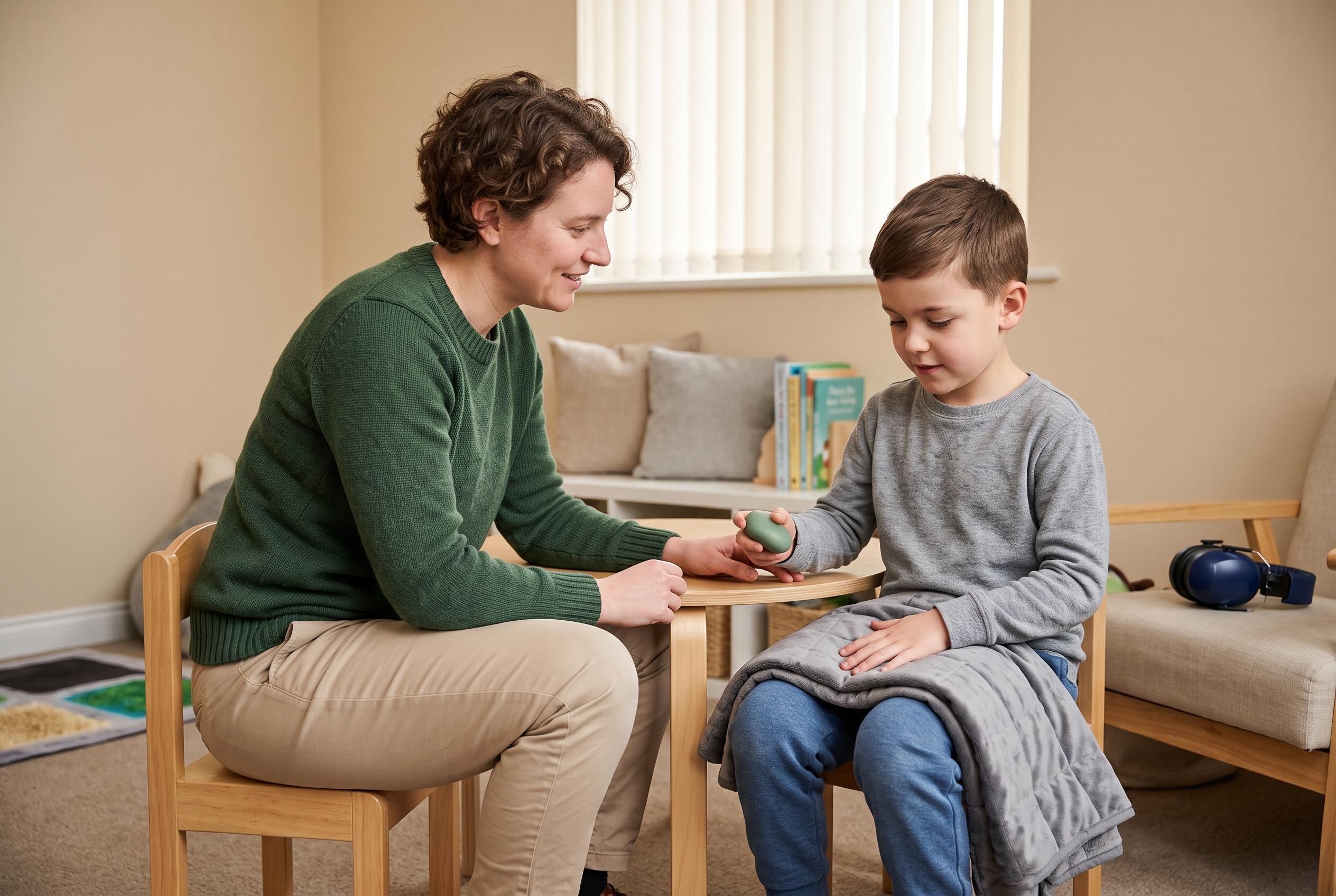

A UCLA study reveals that a familiar cognitive behavioural technique not only helps autistic children manage thoughts and feelings but may also decrease activity in brain regions responsible for sensory responses, offering new possibilities for addressing sensory overload.
A UCLA Health study suggests that a familiar cognitive behavioural therapy technique may do more than help children manage thoughts and feelings: it may also dampen activity in the brain’s sensory regions in autistic young people. The finding matters because sensory over-responsivity, such as distress triggered by scratchy clothing or loud alarms, can affect school, home life and friendships, yet there are few treatment options grounded in research.
The study, published in the Journal of Child Psychology and Psychiatry, involved 47 autistic children and teenagers and 45 typically developing peers aged eight to 15. While they were in an MRI scanner, researchers brushed unpleasant materials, including artificial grass and scratchy wool, across the participants’ forearms. Before the scan, the children were taught a form of cognitive reappraisal, sometimes framed as a “reporter game”, in which they described the sensation in neutral, factual terms rather than focusing on how unpleasant it felt.
In autistic participants, that strategy was linked to a clear drop in activity in sensory brain regions compared with trials in which they attended to the feeling itself. Both groups also showed increased activity in frontal brain areas involved in regulating emotion, although the effect appeared stronger in older autistic children and teens. Shulamite Green, the senior author and an associate professor-in-residence of psychiatry and biobehavioural sciences at UCLA, said the work moves the field closer to testing possible treatments rather than simply describing brain activity.
The results, however, were more mixed in day-to-day terms. Typically developing participants judged the textures as less unpleasant when using the reappraisal strategy, but autistic participants did not report the same shift even though their brain activity changed. The researchers suggested that cognitive flexibility may play a role, and that autistic children may need more practice or a longer intervention before changes in brain activity translate into a changed experience of touch. That idea fits with earlier research highlighted by News Medical showing that sensory overload in children is tied not only to autism traits but also to anxiety, and with other studies suggesting that the brain’s ability to switch strategies depends on flexible control circuits.
The authors said the approach could be incorporated into existing cognitive behavioural therapy rather than requiring a new treatment model. They cautioned, though, that the findings came from a single scan session and do not show whether repeated practice would ease sensory difficulties in everyday life. The next step, Green said, is to test whether the strategy can work as an intervention over time.
Disclaimer: This content is for informational purposes only and is not intended to be a substitute for professional medical judgment, advice, diagnosis, or treatment.



