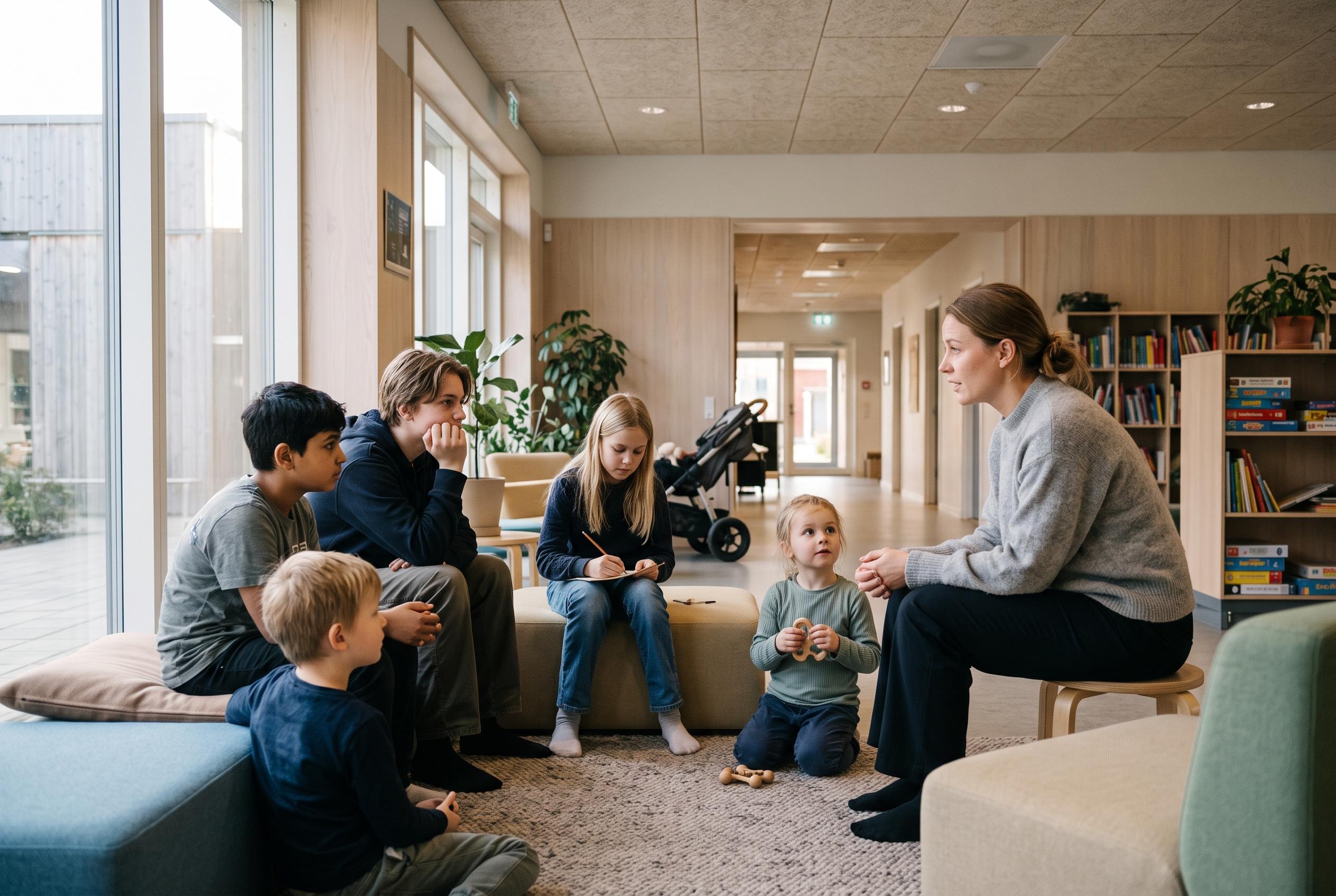

The Danish government introduces a new municipal support system offering free, early mental health aid to children aged five to 17, responding to increasing demands and highlighting the need for close monitoring of intervention outcomes.
An increasing number of children and teenagers in Denmark are struggling enough that families are seeking help earlier than before, according to Kommunernes Landsforening, the association of Danish local authorities. The scale of demand is becoming visible in the country’s new municipal support system, which is designed to catch problems before they grow into something more serious.
Under the scheme, children aged five to 17 can be seen free of charge and without a referral. The aim is to give families a quicker route to support, while also easing pressure on child and adolescent psychiatry, where waiting lists for assessment and treatment can be long. Kommunernes Landsforening said 14,000 children had been through an initial conversation over the past year, with 3,871 in the first quarter of 2026 alone.
Lasse Frimand Jensen, who chairs the social committee at Kommunernes Landsforening and is mayor of Aalborg, said the figures show that poor mental wellbeing among children and young people is among the biggest challenges facing Danish society. He said that when families reach out, the system must be ready to respond quickly and help identify what the child and family need.
Pia Jeppesen, a professor at the Department of Child and Adolescent Psychiatry at Region Zealand Hospital and the University of Copenhagen, said it is crucial that the new municipal offers are monitored closely. She warned that it remains difficult to track how many children go on to receive treatment, whether it helps them, and what quality the interventions have. Jeppesen said the local services form a new tier in the health system, comparable in some ways to municipal dental care: close to children’s daily lives, open to all and not dependent on a referral. She said anxiety is the most common mental disorder among children and a clear example of why early intervention matters. One of the better-known approaches, Mind My Mind, which she helped develop with Psykiatrifonden, is now part of the local offer in about 20 municipalities.
Disclaimer: This content is for informational purposes only and is not intended to be a substitute for professional medical judgment, advice, diagnosis, or treatment.