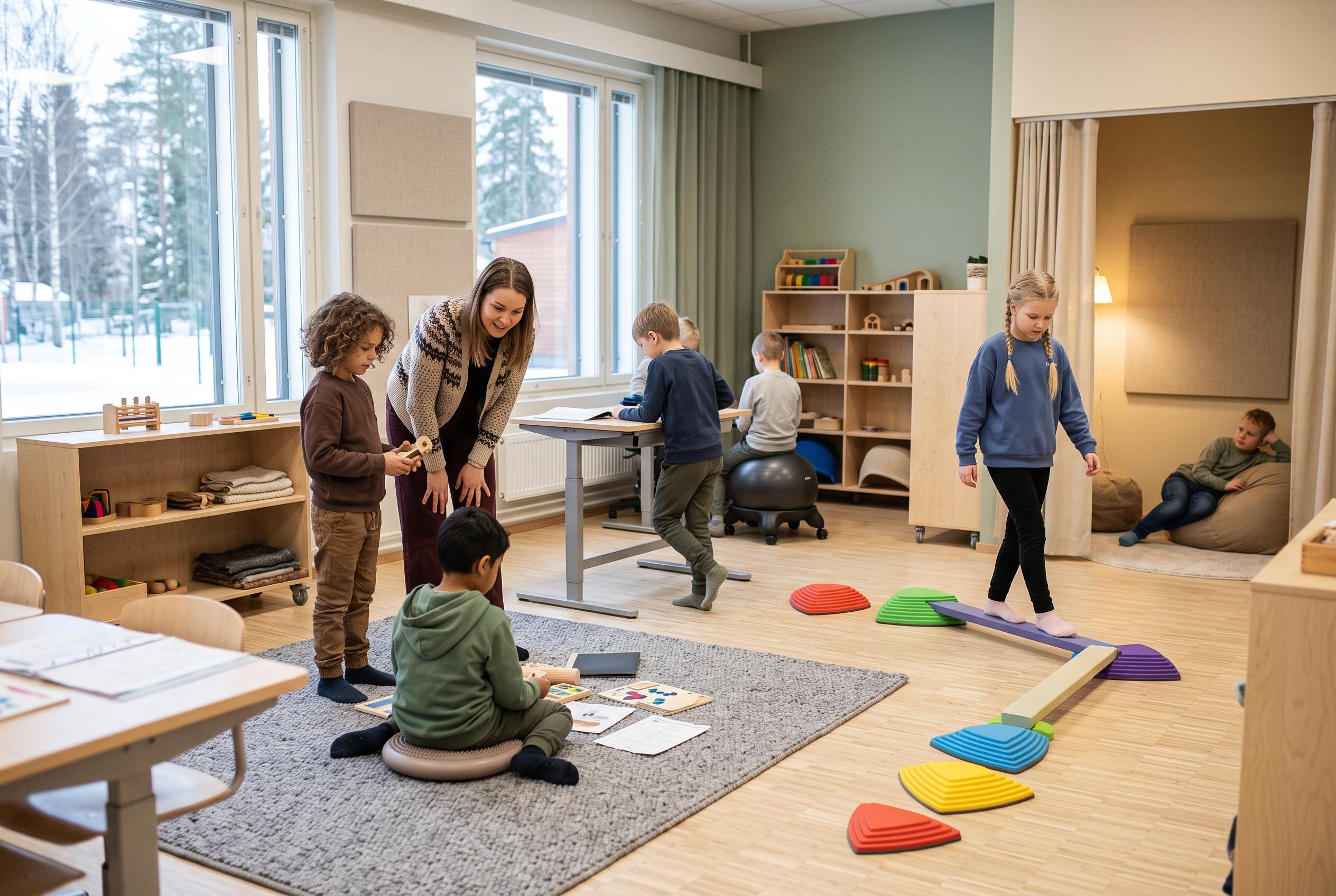

Moisio School in Salo integrates movement into daily routines through innovative activities and legal mandates, highlighting the benefits for neurodivergent students and broader educational reform.
At Moisio School in Salo, movement is built into the school day rather than treated as an afterthought. On the artificial pitch, seventh-form pupils were recently playing elephant ball, a chaotic version of football in which an oversized ball bounces unpredictably and levels the field for every player. Teacher Saana Raikko said that is precisely the point: the game helps draw in pupils who might not join a standard football match.
The school, which has about 550 pupils, has turned its grounds into a place that invites activity. There is a large turf pitch, trampolines, a climbing wall, outdoor basketball hoops, swings and an open-air gym, while indoors pupils can use table tennis tables and the sports hall. One midweek break is reserved for sport, and staff members are encouraged to join in. Principal Jari Kuusisto said the school also uses walks, cycling and activity-based lessons to keep pupils moving during the day.
Raikko said these low-threshold games matter because they give less confident pupils a way into exercise. She added that movement during the school day can be especially helpful for neurodivergent pupils, because even a short burst of activity can change how a young person feels and concentrates. The school has also arranged walking breaks led by the guidance counsellor, giving pupils the chance to leave the school grounds under supervision.
The wider policy backdrop is now shifting in the same direction. According to Finland’s government proposal for changes to the Basic Education Act, schools are expected to promote a physically active lifestyle as part of everyday teaching and school routines. The proposal also emphasises cooperation with families and the use of movement across different subjects. Separate national education rules and Finland’s sports legislation likewise underline the role of schools and municipalities in supporting physical activity.
In Salo, education officials say much of that work was already under way before the latest legal change. Instruction director Inkeri Lahti said the city had long included active living in its curriculum and has used the national “Liikkuva koulu” programme for years. She said schools now aim to give pupils at least an hour of movement during the school day, using sports days, active teaching methods and trained break-time leaders to make that happen. Lahti also pushed back against reports that first-form pupils had been barred from cycling to school, saying the law does not permit schools to prohibit school-run cycling and that the city encourages pupils to come on foot or by bike.
Disclaimer: This content is for informational purposes only and is not intended to be a substitute for professional medical judgment, advice, diagnosis, or treatment.