


A Florida International University study finds that children as young as three use sophisticated, whole-object strategies for mental rotation tasks, suggesting early emergence of advanced spatial skills.
A new Florida International University study suggests that even preschoolers may tackle mental rotation puzzles in much the same way adults do, using a whole-object strategy rather than checking each part one by one.
The research, published in Infant and Child Development, followed 148 children aged 3 to 7 as they chose which of two small images matched a larger object after it had been turned in space. Instead of asking the children to explain their thinking, the team used infrared eye-tracking to observe where they looked and for how long.
Karinna A. Rodriguez and her colleagues found two broad patterns. Some children repeatedly examined individual features such as wheels, ladders or the cab of a fire truck, which pointed to a piecemeal approach. Others looked less at separate details and appeared to treat the object as a single unit, a holistic strategy more often associated with adults.
Those using the holistic method solved the task roughly twice as fast as children whose eye movements suggested a slower, part-by-part approach. The result adds weight to the idea that an important form of spatial reasoning is present much earlier than many parents and educators might assume.
Mental rotation is the ability to picture an object turning without physically moving it. It is the skill used when fitting puzzle pieces together, reading maps or judging how a shape will look from another angle. Researchers have long linked spatial ability with later learning in maths and science, and sometimes even with reading, because children must learn that position and orientation can change meaning.
The new study fits into a longer research tradition. A 1983 paper in the Journal of Experimental Child Psychology reported that children over 8 showed clearer mental-tracking patterns during rotation tasks, while younger children did not, but that both holistic and part-to-part strategies were used across age groups. More recent eye-tracking work has also found that global strategies tend to outperform local ones in children’s mental rotation performance.
Other studies point to the wider value of early spatial play. Research from the University of Delaware and Temple University linked preschool block copying with stronger early maths performance, while a separate eye-tracking study in Developmental Psychology found that preschoolers’ attention to shape names was closely tied to spatial development. A 2026 study in the British Journal of Educational Psychology also suggests that brief strategy-focused teaching can improve preschoolers’ relational spatial reasoning, with changes visible in eye-tracking measures.
The reading connection remains more tentative. In their explanation of the Florida International University work, the researchers suggested that children who rely more on a piecemeal strategy may overlap with those who struggle to tell apart similar-looking letters such as p and q. But the study did not show that this approach causes reading difficulties.
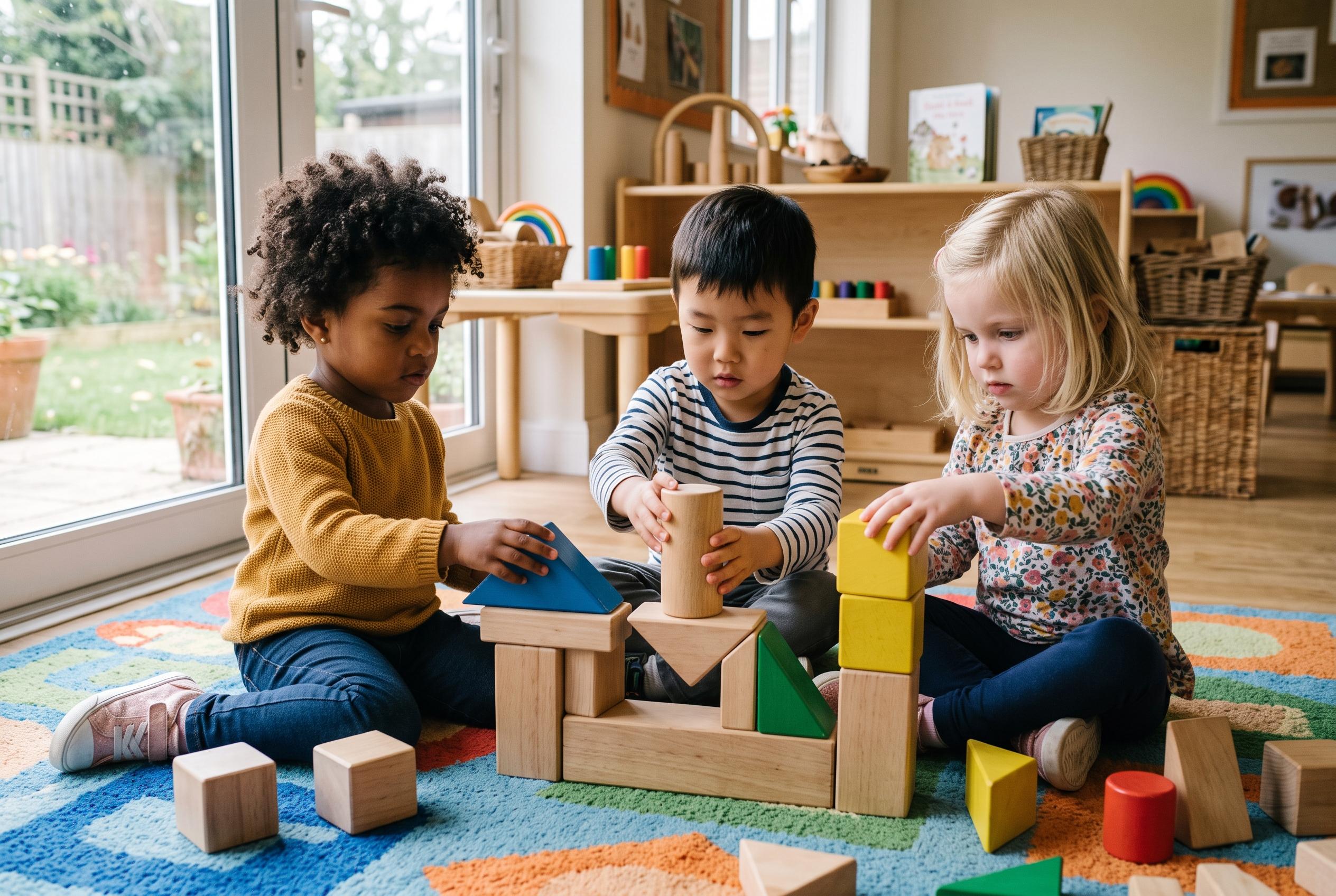
What it does show is that children are already practising sophisticated visual problem-solving long before they can describe it in words. For parents and caregivers, that makes puzzles, blocks, tangrams, LEGO and other shape-matching games more than just busy play. They are chances to strengthen a skill children are already beginning to use.
Disclaimer: This content is for informational purposes only and is not intended to be a substitute for professional medical judgment, advice, diagnosis, or treatment.



