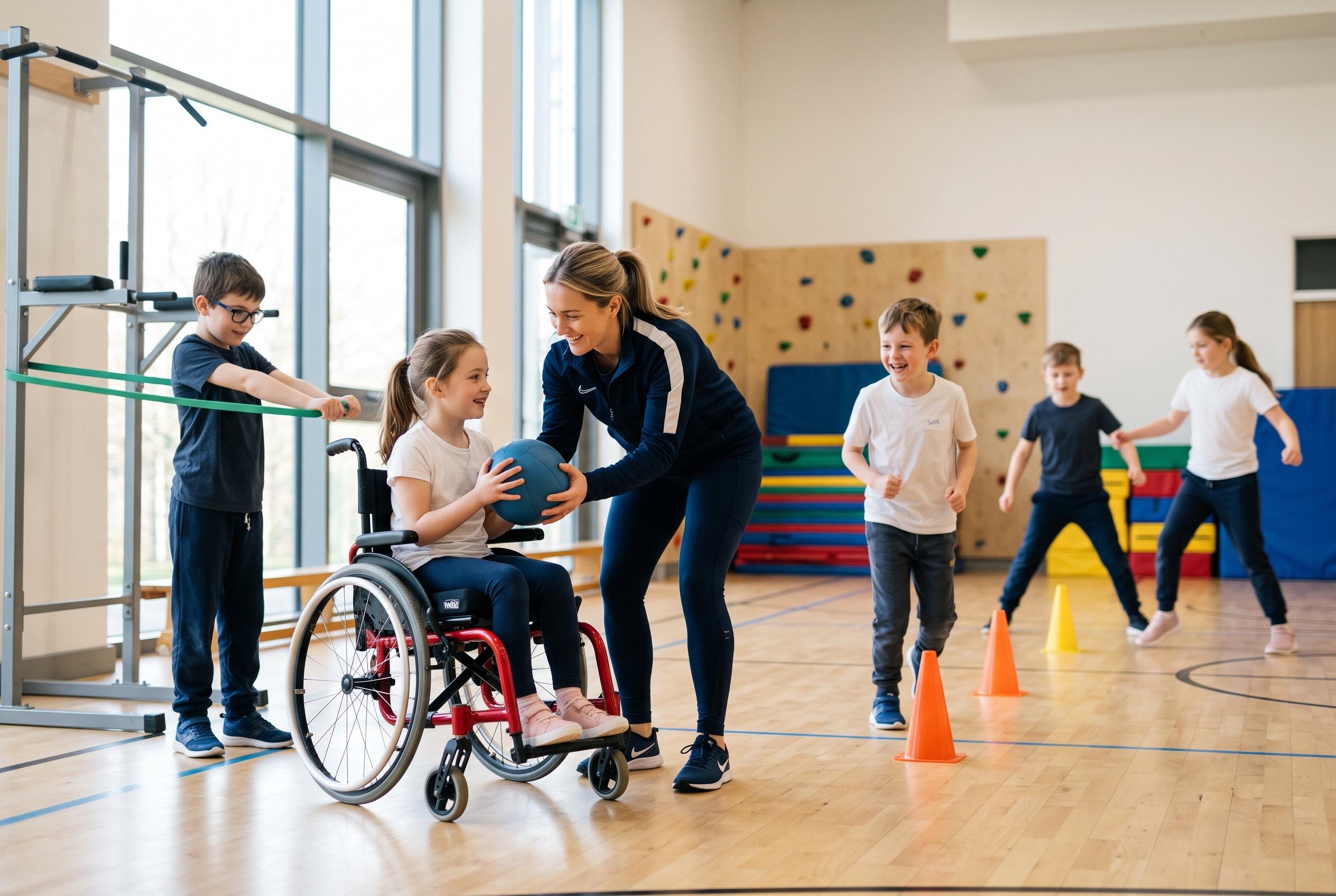

New approaches to inclusive physical education are emphasising personalised learning goals and adaptive strategies, making PE more equitable and engaging for all students, regardless of ability.
Inclusive physical education works best when teachers stop trying to make every student do the same thing at the same speed. In a single class, a teacher may have a club athlete, a beginner still learning basic movement, a pupil with a disability, and another who has learned to dread PE because it feels exposing or humiliating. The goal is not to split those pupils into separate worlds. It is to build one lesson with multiple ways in, multiple ways to succeed, and multiple ways to show progress.
The Centres for Disease Control and Prevention says inclusive PE should give all students equal access to activity and learning, with adaptations made to teaching methods, equipment, space, rules and assessment. Federal disability laws, including the Americans with Disabilities Act and the Individuals with Disabilities Education Act, also require schools to provide appropriate physical education opportunities for students with disabilities.
That principle matters because mixed-ability grouping can still reproduce the same old hierarchies if it is handled poorly. Research published in “Sport, Education and Society” found that, even when teachers set out to be inclusive, status differences and unequal participation can persist. An article from PE Scholar made a similar point, noting that mixed-ability settings can support modelling and peer learning, but only if teachers deliberately protect belonging and participation for everyone.
The most useful planning move is to separate the learning goal from the activity format. Instead of starting with “We will play football,” a teacher might frame the lesson around sending an object accurately, moving into space, or maintaining possession. Once the goal is clear, the task can be adjusted through the ball, distance, pace, group size, support, or scoring rules without changing the core learning.
That approach also helps teachers avoid two common mistakes: giving skilled pupils repetitive work that offers no real challenge, and placing less confident pupils into tasks that are too fast, too public, or too complex to allow success. A stronger model is to create a sequence with several levels, using neutral labels such as Explore, Build, Apply and Extend. The International Mixed Ability Sports movement has made a similar case in community sport, arguing that mixed-ability participation can be genuinely transformative when structures are built for inclusion rather than assumed.
Universal Design for Learning offers another useful frame. In PE, that means planning for choice, visual and verbal instruction, and multiple ways to act and demonstrate learning before the lesson begins. Students may be given bounded choices over partner work, task difficulty or equipment. They may receive brief demonstrations, visual cue cards, or peer modelling. And they may show understanding through movement, communication, decision-making or reflection, rather than through one narrow physical performance.
Teachers also need to make challenge visible and safe. High-performing pupils should not simply be asked to help everyone else for the whole lesson. They need tactical problems, constraints, and decision-making tasks that still make them think. At the same time, pupils with low confidence should be shielded from public failure through small-sided games, teacher-assigned groups, private progress tracking, and language that normalises error as part of learning.
A practical lesson in striking and fielding shows how this can work. One student might strike a balloon from a tee towards a wide target, another might choose a running path after striking a foam ball, and a more advanced pupil might work in a small-sided game with a tactical constraint. The learning target remains the same, but the level of challenge, pace and social pressure changes to suit the learner.
Assessment should reinforce that philosophy rather than undermine it. Comparing pupils against each other usually tells you more about background than growth. Better questions are whether a student understood the cue, chose the right level of challenge, improved over time, or adjusted after feedback. The best inclusive PE lessons ask not how to make every pupil perform identically, but how to help every pupil reach the same meaningful goal in a way that is demanding, safe and attainable.
Disclaimer: This content is for informational purposes only and is not intended to be a substitute for professional medical judgment, advice, diagnosis, or treatment.